
We read your photo as:
Which of the following properties is not correct about photons? They
ScanSolve AI Answer
Answer
Step-by-step solution
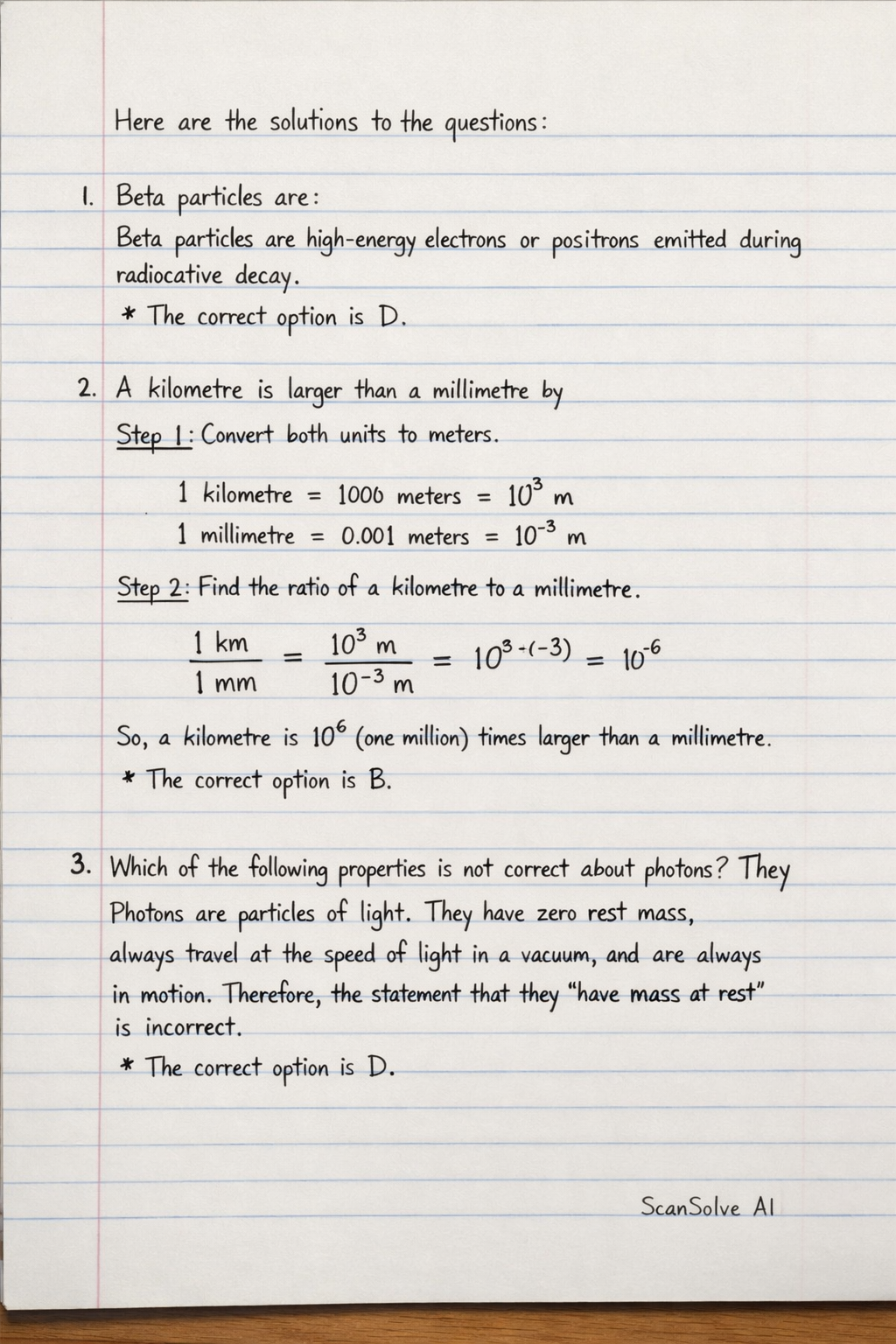
2 stepsHere are the solutions to the questions:
1. Beta particles are
Beta particles are high-energy electrons or positrons emitted during radioactive decay.
- The correct option is D.
2. A kilometre is larger than a millimetre by
Convert both units to meters.
Find the ratio of a kilometre to a millimetre.
So, a kilometre is (one million) times larger than a millimetre.
- The correct option is B.
3. Which of the following properties is not correct about photons? They
Photons are particles of light. They have zero rest mass, always travel at the speed of light in a vacuum, and are always in motion. Therefore, the statement that they "have mass at rest" is incorrect.- The correct option is D.
4. Gravitational field intensity is
- I. a scalar quantity: This is incorrect. Gravitational field intensity is a vector quantity, as it has both magnitude and direction.
- II. greatest at the poles: This is correct. The Earth is an oblate spheroid, meaning the poles are closer to the center of the Earth than the equator, and the effect of centrifugal force is minimal at the poles.
- III. zero at the centre of the Earth: This is correct. At the center of the Earth, the gravitational forces from all directions cancel out, resulting in a net gravitational field of zero.
- The correct option is C.
5. The temperature difference of is equivalent to
The Kelvin scale and the Celsius scale have the same size degree increments. This means that a change of is exactly equal to a change of .- The correct option is A.
Try one yourself
A new problem that tests the same skill.
Still stuck on this one?
Ask a follow-up, and the answer starts from this question.
More Physics Questions
Handwritten Step-by-Step Solution
Get this as a handwritten image on WhatsApp — like a tutor wrote it for you.
Try on WhatsApp