

This physics problem tests your understanding of fundamental physical laws and their applications. The step-by-step solution below breaks down the problem using relevant equations and physical reasoning.
ScanSolve AI Answer
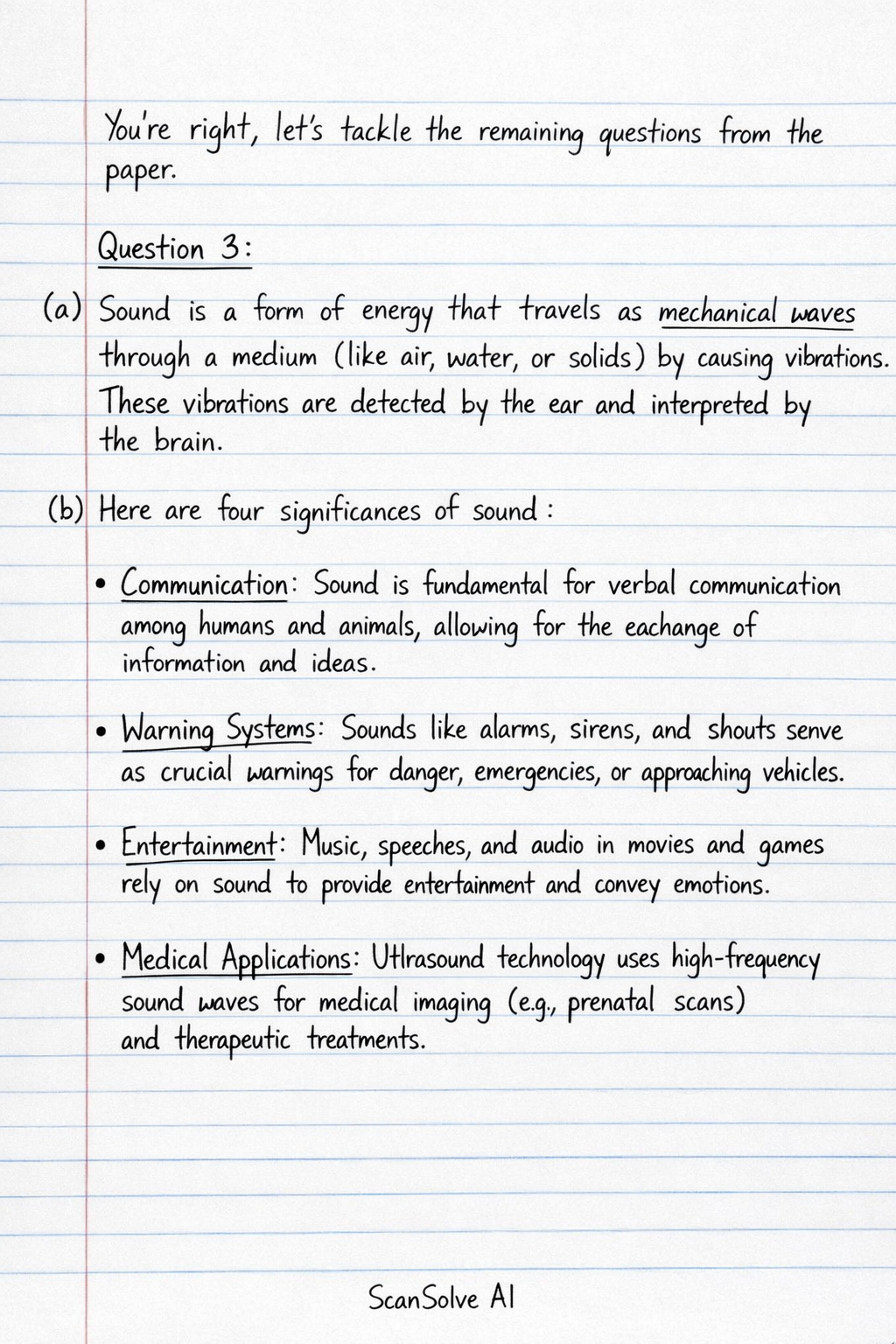
You're right, let's tackle the remaining questions from the paper. Question 3: a) Sound is a form of energy that travels as mechanical waves through a medium (like air, water, or solids) by causing vibrations. These vibrations are detected by the ear and interpreted by the brain. b) Here are four significances of sound: • Communication: Sound is fundamental for verbal communication among humans and animals, allowing for the exchange of information and ideas. • Warning Systems: Sounds like alarms, sirens, and shouts serve as crucial warnings for danger, emergencies, or approaching vehicles. • Entertainment: Music, speeches, and audio in movies and games rely on sound to provide entertainment and convey emotions. • Medical Applications: Ultrasound technology uses high-frequency sound waves for medical imaging (e.g., prenatal scans) and therapeutic treatments. c) Here are three characteristics of sound: • Pitch: This refers to how high or low a sound is, determined by its frequency. Higher frequency means higher pitch. • Loudness (Intensity): This is the perception of the strength of a sound, determined by its amplitude. Greater amplitude means louder sound. • Quality (Timbre): This describes the unique character or "color" of a sound, allowing us to distinguish between different instruments or voices even if they are playing the same note at the same loudness. It is determined by the presence and relative intensity of overtones. That's 2 down. 3 left today — send the next one.