
We read your photo as:
A body of mass 20 kg is at a height of 0.9 m. Calculate its potential energy and speed at the lowest point.
ScanSolve AI Answer
Step-by-step solution
16 stepsPart a(i)· 3 steps
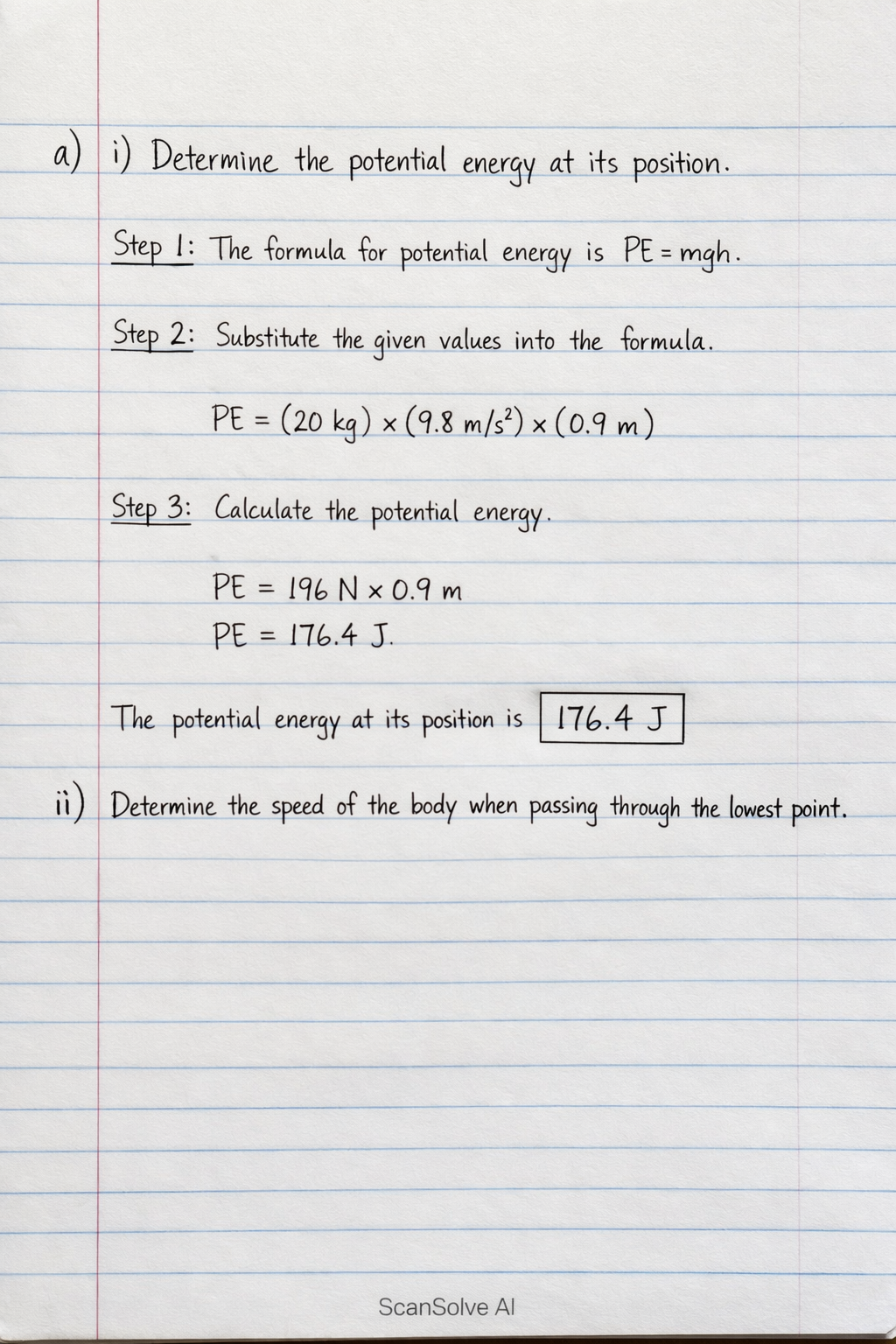
Determine the potential energy at its position.
Given:
Mass
Vertical height
Acceleration due to gravity
The formula for potential energy is .
Substitute the given values into the formula.
Calculate the potential energy.
The potential energy at its position is .
Part a(ii)· 3 steps
Determine the speed of the body when passing through the lowest point.
Apply the principle of conservation of mechanical energy.
At the initial position, all energy is potential energy (, ). At the lowest point, all potential energy is converted to kinetic energy (, ).
Simplify the equation and solve for .
Substitute the values and calculate the speed.
The speed of the body when passing through the lowest point is .
Part b(i)· 3 steps
Determine the work done by the crane.
Given:
Load mass
Vertical distance
Time
Rated power of electric motor
Acceleration due to gravity
The formula for work done against gravity is .
Substitute the given values.
Calculate the work done.
The work done by the crane is .
Part b(ii)· 3 steps
Determine the power developed by the crane.
The formula for power is .
Substitute the work done from part (b)(i) and the given time.
Calculate the power.
The power developed by the crane is .
Part b(iii)· 4 steps
Determine the efficiency of the crane.
The formula for efficiency is .
Convert the input power to Watts
. The output power is the power developed by the crane, which is from part (b)(ii).
Substitute the output power and input power into the efficiency formula.
Calculate the efficiency.
The efficiency of the crane is .
Still stuck on this one?
Ask a follow-up, and the answer starts from this question.
More Physics Questions
Handwritten Step-by-Step Solution
Get this as a handwritten image on WhatsApp — like a tutor wrote it for you.
Try on WhatsApp