

This physics problem tests your understanding of fundamental physical laws and their applications. The step-by-step solution below breaks down the problem using relevant equations and physical reasoning.
ScanSolve AI Answer
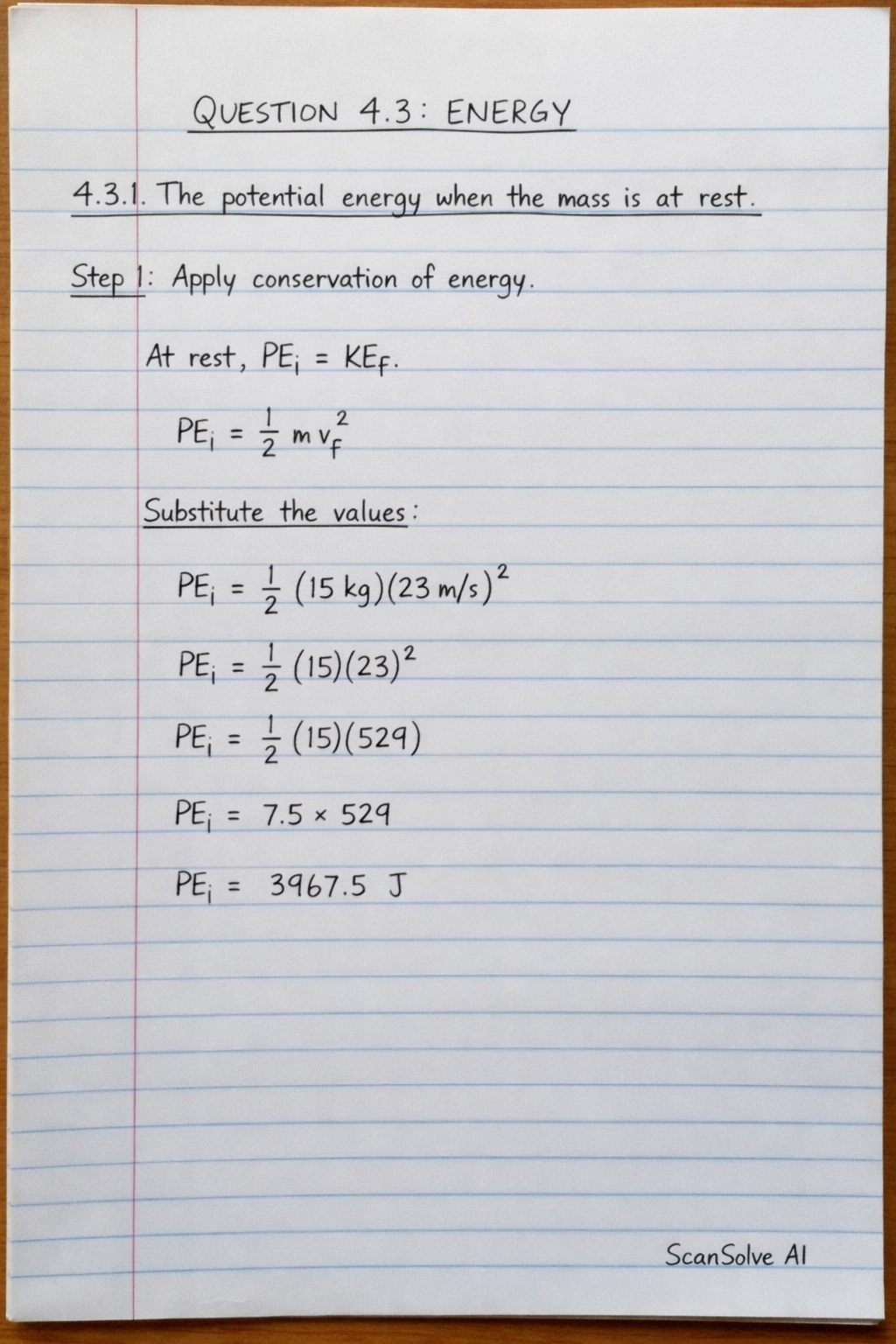
QUESTION 4.3: ENERGY A mass of 15 kg falls freely from rest and reaches a velocity of 23 m/s just as it reaches the ground. Given: Mass m = 15 kg Initial velocity v_i = 0 m/s (falls from rest) Final velocity v_f = 23 m/s Acceleration due to gravity g = 9.81 m/s^2 4.3.1 The potential energy when the mass is at rest. Step 1: Apply the principle of conservation of energy. When the mass is at rest at its maximum height, it possesses only potential energy. Just before it hits the ground, all this potential energy has been converted into kinetic energy (assuming no air resistance). Therefore, the initial potential energy (PE_i) is equal to the final kinetic energy (KE_f). PE_i = KE_f = (1)/(2)mv_f^2 Substitute the given values: PE_i = (1)/(2) × 15 kg × (23 m/s)^2 PE_i = (1)/(2) × 15 kg × 529 m^2/s^2 PE_i = 7.5 × 529 J PE_i = 3967.5 J Rounding to three significant figures: 3970 J 4.3.2 The height through which it falls. Step 1: Use the kinematic equation relating initial velocity, final velocity, acceleration, and displacement. We know v_f^2 = v_i^2 + 2gh, where h is the height and g is the acceleration due to gravity. Since the mass falls from rest, v_i = 0 m/s. v_f^2 = 0^2 + 2gh v_f^2 = 2gh Rearrange to solve for h: h = (v_f^2)/(2g) Substitute the given values: h = (23 m/s)^22 × 9.81 m/s^2 h = 529 m^2/s^219.62 m/s^2 h ≈ 26.962 m Rounding to three significant figures: 27.0 m