
We read your photo as:
A 0.5 ext kg object is thrown upwards with a velocity of 18 ext m/s. Determine the height at which potential energy equals kinetic energy.
ScanSolve AI Answer
Step-by-step solution
5 stepsHere are the solutions for the two problems.
: A object is thrown upwards with a velocity of . Determine the following:
a) the height at which potential energy equals kinetic energy
b) the kinetic energy
c) the potential energy
d) the mechanical energy
Given:
Mass
Initial velocity
Acceleration due to gravity
Calculate the initial kinetic energy and total mechanical energy.
The total mechanical energy is conserved. At the point of projection (height ), all energy is kinetic.
d) The mechanical energy is the total energy, which is conserved.
Determine the height where potential energy equals kinetic energy.
At this height , . Since , we have or .
So, and .a) The height at which potential energy equals kinetic energy is:
b) At this height, the kinetic energy is half of the total mechanical energy.
c) At this height, the potential energy is also half of the total mechanical energy.
: A ball is projected upward. At a certain height, its speed is and its kinetic energy equals its potential energy. Calculate the height at that point.
Given:
Speed at a certain height .
At this height, .
Acceleration due to gravity .Express kinetic and potential energy in terms of height and speed.
Use the condition to find the height.
Cancel out the mass from both sides:
Solve for height .
Substitute the given values:
The height at that point is:
Still stuck on this one?
Ask a follow-up, and the answer starts from this question.
More Physics Questions
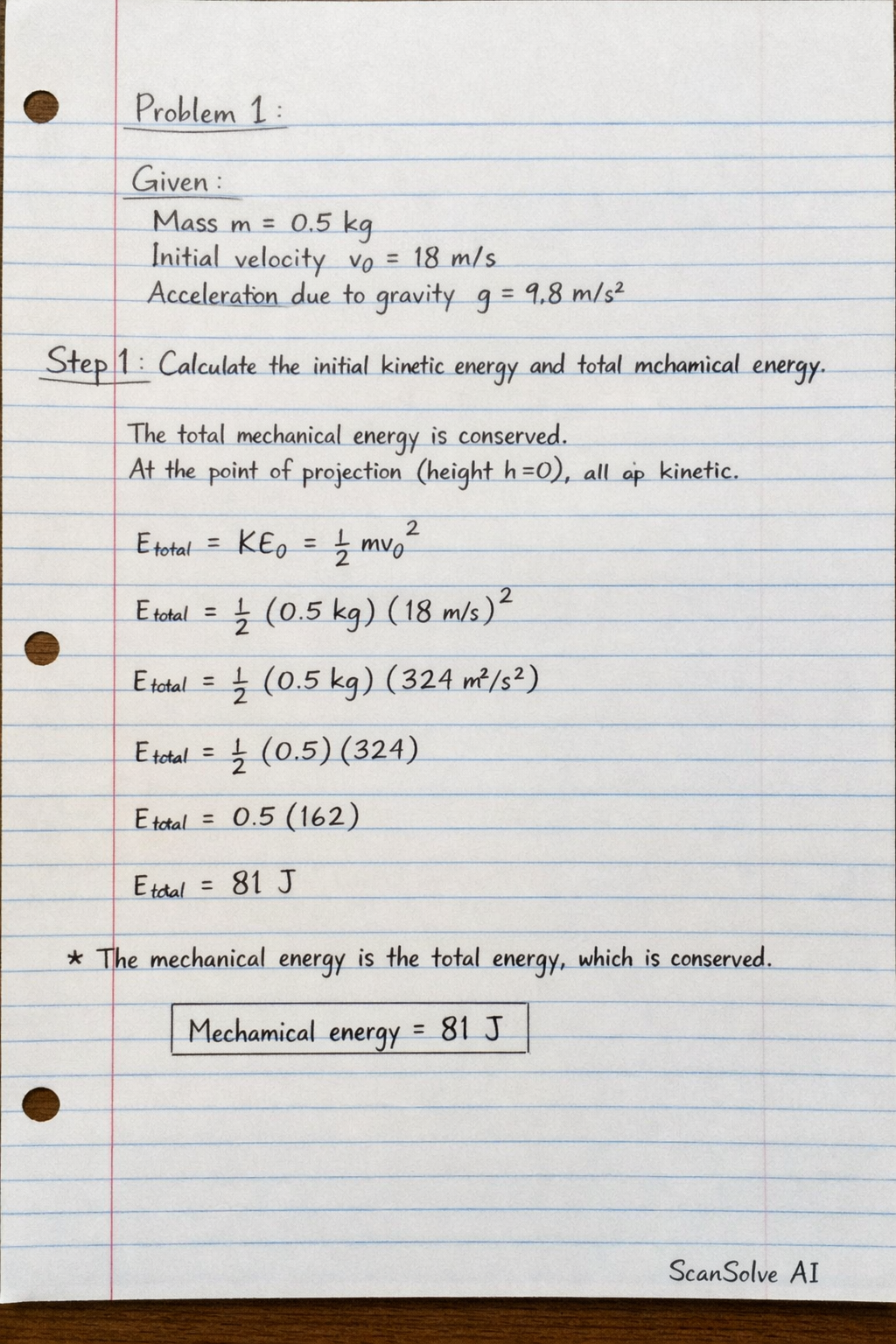
Handwritten Step-by-Step Solution
Get this as a handwritten image on WhatsApp — like a tutor wrote it for you.
Try on WhatsApp