

This physics problem tests your understanding of fundamental physical laws and their applications. The step-by-step solution below breaks down the problem using relevant equations and physical reasoning.
ScanSolve AI Answer
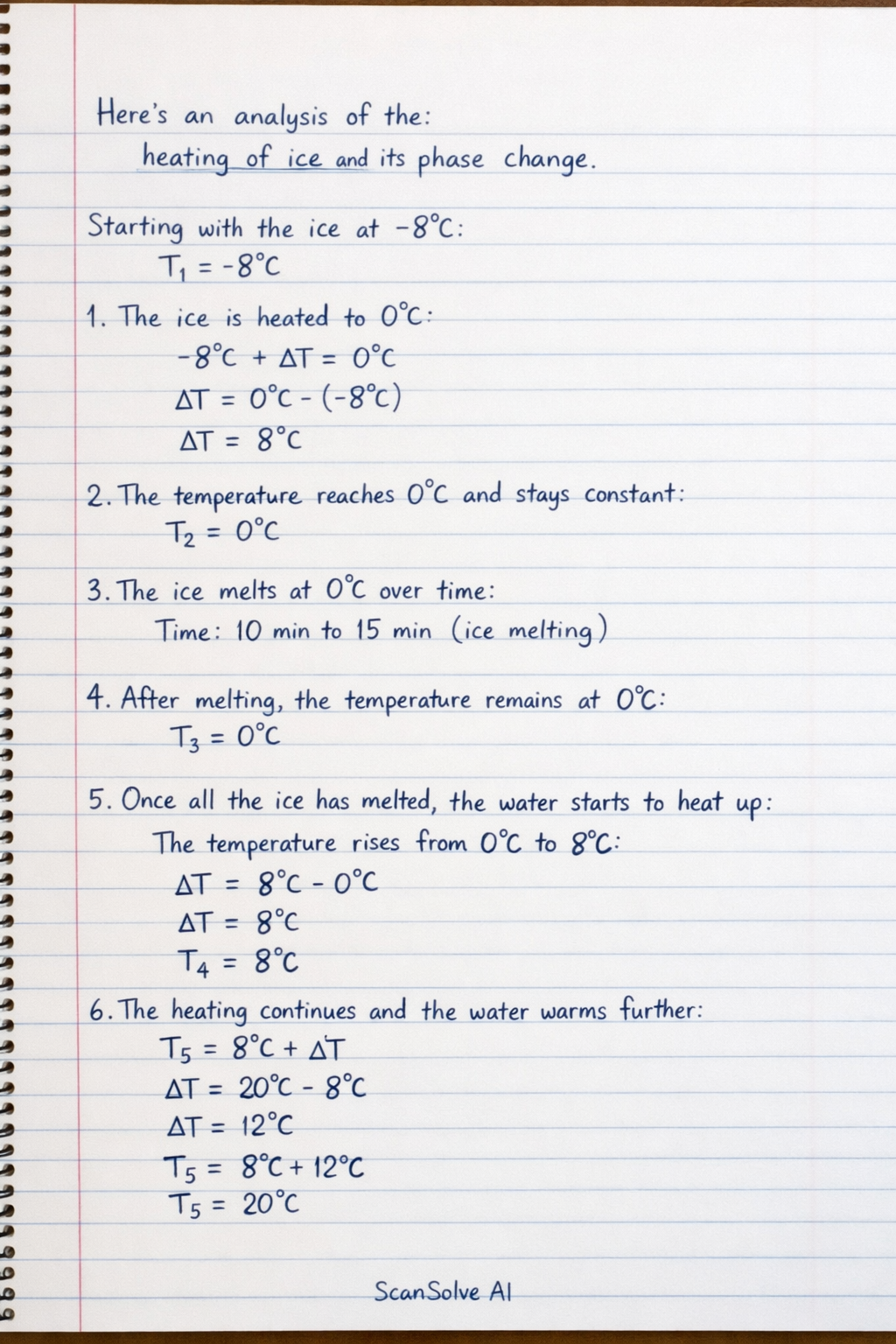
In this diagram, an experiment is being conducted to observe the heating of ice and its phase change from solid to liquid, followed by the heating of the resulting water. What happens: The ice is initially at -8^ and is being heated. Its temperature rises to 0^. At 0^, the temperature remains constant for a period (from 10 minutes to 15 minutes, according to the table) while the ice melts into water. After all the ice has melted, the temperature of the water then begins to rise again (from 0^ to 8^ and then to 20^). Reason: The reason the temperature remains constant at 0^ during the melting process is due to the latent heat of fusion. During this phase change, the heat energy supplied by the burner is not used to increase the kinetic energy of the water molecules (which would raise the temperature). Instead, this energy is absorbed to break the intermolecular bonds holding the water molecules in their rigid solid structure (ice), allowing them to transition into the liquid state (water). Once all the ice has converted to liquid water, the absorbed heat energy then increases the kinetic energy of the water molecules, causing the temperature of the water to rise. That's 2 down. 3 left today — send the next one.