
We read your photo as:
Explain Newton's Second Law of Motion and calculate the common velocity of a boy and skateboard after the boy jumps onto it, given their masses and initial velocities.
ScanSolve AI Answer
Step-by-step solution
9 stepshere are the solutions to your questions:
-
a) Newton's Second Law of Motion states that the acceleration of an object is directly proportional to the net force acting on it and inversely proportional to its mass. The direction of the acceleration is in the direction of the net force. Mathematically, this is expressed as .
b) This question is incomplete due to the blurry image. Please provide the full text for me to answer it.
c) To determine the common velocity of the boy and the skateboard:
Identify the given values.
Mass of boy, $m_1 = 50 \text{ kg}$ Initial velocity of boy, $u_1 = 2 \text{ m/s}$ Mass of skateboard, $m_2 = 5 \text{ kg}$ Initial velocity of skateboard, $u_2 = 0 \text{ m/s}$ (assuming it starts from rest) Let the common final velocity be $v$.Apply the principle of conservation of momentum.
The total momentum before the collision equals the total momentum after the collision. $$ m_1 u_1 + m_2 u_2 = (m_1 + m_2) v $$Substitute the values into the equation.
$$ (50 \text{ kg})(2 \text{ m/s}) + (5 \text{ kg})(0 \text{ m/s}) = (50 \text{ kg} + 5 \text{ kg}) v $$ $$ 100 \text{ kg m/s} + 0 = (55 \text{ kg}) v $$ $$ 100 \text{ kg m/s} = 55 \text{ kg} \cdot v $$Solve for .
$$ v = \frac{100 \text{ kg m/s}}{55 \text{ kg}} $$ $$ v \approx \boxed{1.82 \text{ m/s}} $$13. a) Refraction of light is the bending of light as it passes from one transparent medium to another, due to a change in its speed.
**b)** To determine the refractive index of water with respect to air:Identify the angles from the diagram.
Angle of incidence in air, $\theta_{\text{air}} = 42^\circ$ Angle of refraction in water, $\theta_{\text{water}} = 30^\circ$ The refractive index of air, $n_{\text{air}} \approx 1$.Apply Snell's Law.
$$ n_{\text{air}} \sin \theta_{\text{air}} = n_{\text{water}} \sin \theta_{\text{water}} $$Substitute the known values.
$$ 1 \times \sin 42^\circ = n_{\text{water}} \times \sin 30^\circ $$Calculate the sine values.
$$ \sin 42^\circ \approx 0.6691 $$ $$ \sin 30^\circ = 0.5 $$Solve for .
$$
0.6691 = n_{\text{water}} \times 0.5
$$
$$
n_{\text{water}} = \frac{0.6691}{0.5}
$$
$$
n_{\text{water}} = \boxed{1.3382}
$$
Still stuck on this one?
Ask a follow-up, and the answer starts from this question.
More Physics Questions
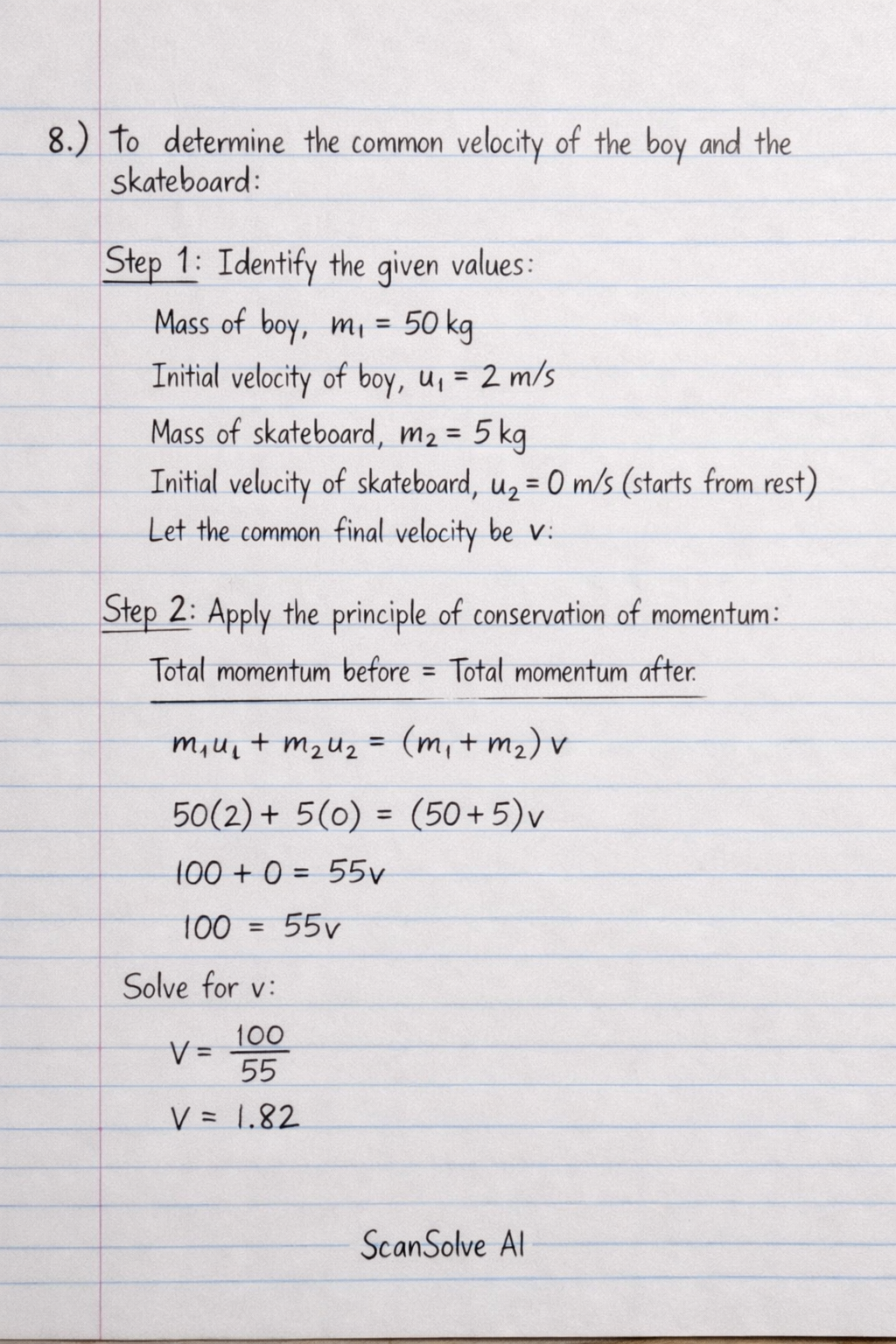
Handwritten Step-by-Step Solution
Get this as a handwritten image on WhatsApp — like a tutor wrote it for you.
Try on WhatsApp