
We read your photo as:
A 87 kg man moving at some speed grabs a 22 kg boy who is standing still. They then move together at 2.4 m/s. What was the man's speed before he grabbed the boy? Was the collision elastic?
ScanSolve AI Answer
Answer
Step-by-step solution
3 stepsCalculate the man's speed just before he grabs the boy.
This is an inelastic collision where the man and boy stick together. The principle of conservation of linear momentum applies.
Given:
Mass of man, kg
Mass of boy, kg
Initial velocity of boy, m/s (standing still)
Final velocity of man and boy combined, m/sLet be the man's speed just before he grabs the boy.
According to the principle of conservation of linear momentum:Substitute the known values:
The man's speed just before he grabs the boy is .
Determine if the collision is elastic and support the answer with a calculation.
To determine if the collision is elastic, we compare the total kinetic energy before and after the collision.
An elastic collision conserves kinetic energy, while an inelastic collision does not.Calculate the total initial kinetic energy ():
Using m/s:
Calculate the total final kinetic energy ():
Compare and :
Since and , .
Therefore, the collision is not elastic.
The collision is because the total kinetic energy before the collision () is not equal to the total kinetic energy after the collision ().Calculate the magnitude of the force exerted by the gravel surface on the man and the boy.
After the collision, the combined mass moves at 2.4 m/s. They then decelerate to rest over a distance of 2 m.
Given:
Combined mass, kg
Initial velocity on gravel, m/s
Final velocity on gravel, m/s
Distance travelled on gravel, mFirst, calculate the acceleration () using a kinematic equation:
The negative sign indicates deceleration.
Next, calculate the magnitude of the force () using Newton's second law:
The magnitude of the force is the absolute value of this result.
The magnitude of the force exerted by the gravel surface on the man and the boy is .
Try one yourself
A new problem that tests the same skill.
Still stuck on this one?
Ask a follow-up, and the answer starts from this question.
More Physics Questions
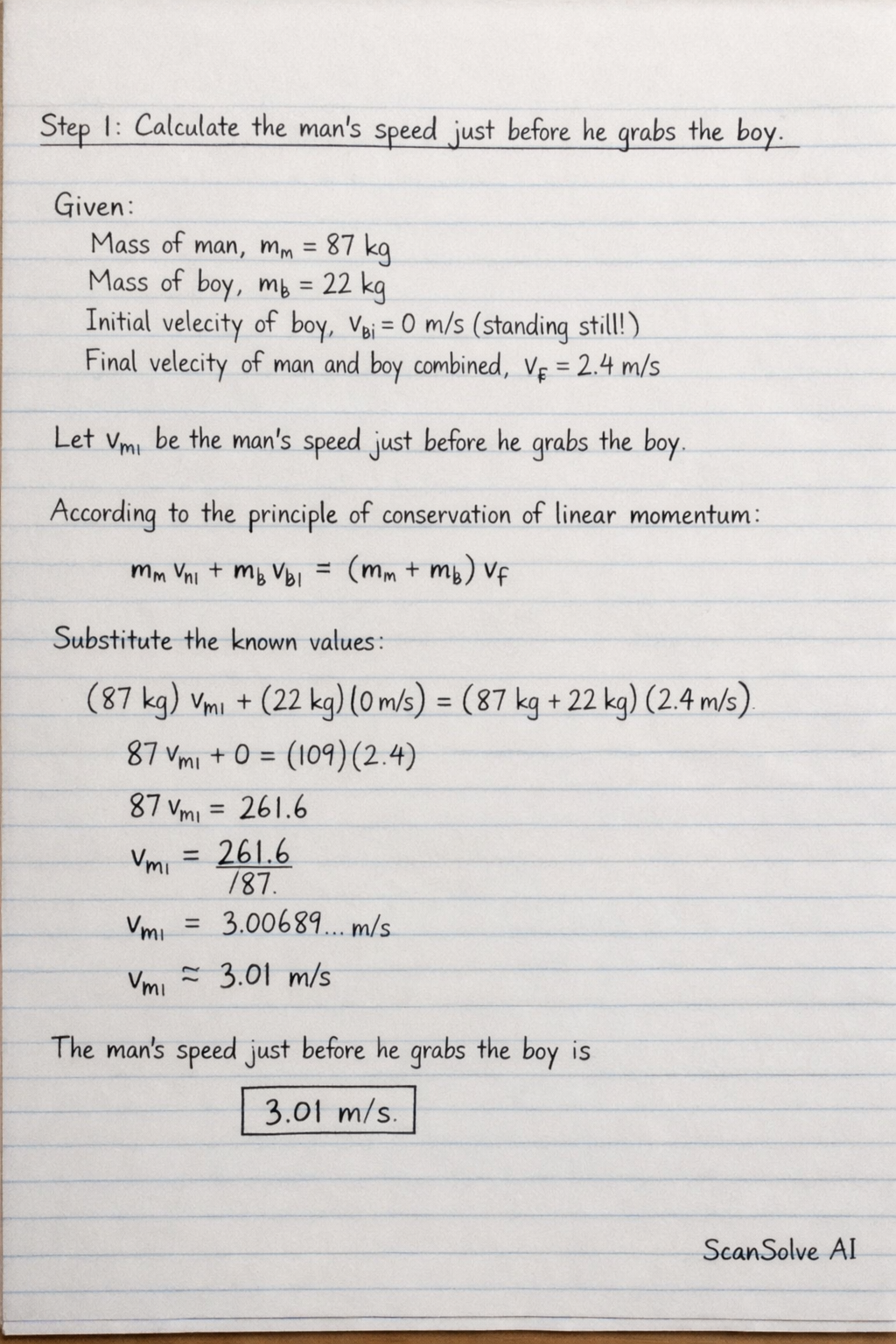
Handwritten Step-by-Step Solution
Get this as a handwritten image on WhatsApp — like a tutor wrote it for you.
Try on WhatsApp