
We read your photo as:
In which way are bulb F and T connected in series? What is the reading on voltmeter V1? If voltmeter V1 is connected in parallel to the circuit and not the one across the circuit. V2 and V3 do
ScanSolve AI Answer
Step-by-step solution
6 stepshere are the answers based on the circuit diagram:
Part a· 2 steps
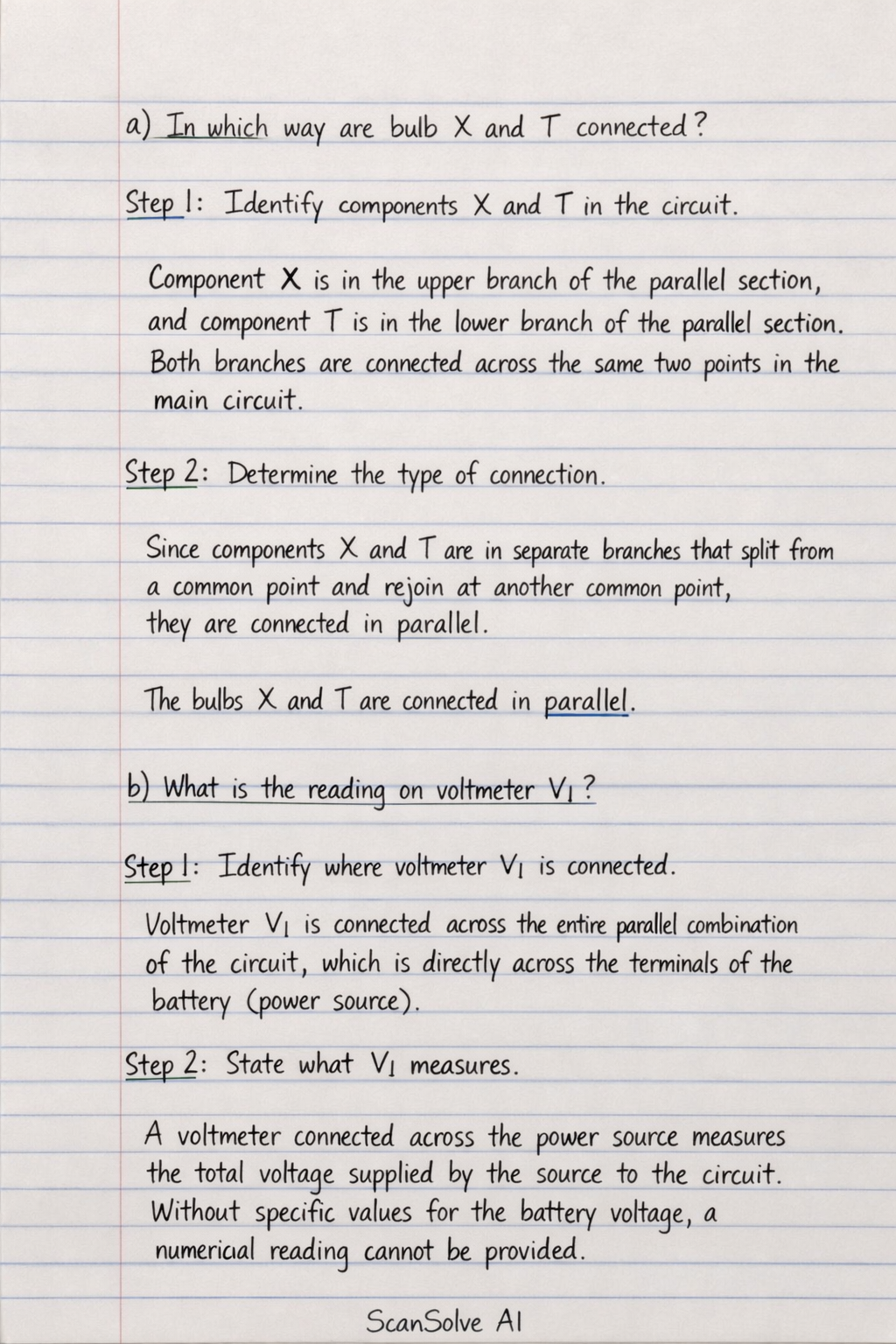
In which way are bulb X and T connected?
Identify components X and T in the circuit.
Component X is in the upper branch of the parallel section, and component T is in the lower branch of the parallel section. Both branches are connected across the same two points in the main circuit.
Determine the type of connection.
Since components X and T are in separate branches that split from a common point and rejoin at another common point, they are connected in parallel.
The bulbs X and T are connected in parallel.
Part b· 2 steps
What is the reading on voltmeter V1?
Identify where voltmeter V1 is connected.
Voltmeter V1 is connected across the entire parallel combination of the circuit, which is directly across the terminals of the battery (power source).
State what V1 measures.
A voltmeter connected across the power source measures the total voltage supplied by the source to the circuit. Without specific values for the battery voltage, a numerical reading cannot be provided.
Voltmeter V1 measures the total voltage (electromotive force) supplied by the battery to the circuit.
Part c· 2 steps
Voltmeter V1 is connected in parallel to the circuit and measures the total voltage across the circuit. Do V2 and V3 do...
Identify where voltmeters V2 and V3 are connected.
Voltmeter V2 is connected in parallel across component X. Voltmeter V3 is connected in parallel across component T.
Explain what V2 and V3 measure in relation to V1.
In a parallel circuit, the voltage across each parallel branch is the same as the total voltage across the entire parallel combination. Since V1 measures the total voltage across the parallel section (and the battery), V2 measures the voltage across component X, and V3 measures the voltage across component T. Because X and T are in parallel, the voltage across them is the same as the total voltage.
Therefore, V2 and V3 also measure the total voltage across their respective parallel components, and their readings will be equal to the reading on V1 (assuming ideal wires and components).
Still stuck on this one?
Ask a follow-up, and the answer starts from this question.
More Physics Questions
Handwritten Step-by-Step Solution
Get this as a handwritten image on WhatsApp — like a tutor wrote it for you.
Try on WhatsApp