
We read your photo as:
A 60 kg boy throws a 5 kg package eastward with a velocity of 4 m/s. Describe the motion of the boy and the law that governs it, and calculate the boy's recoil velocity.
ScanSolve AI Answer
Step-by-step solution
3 steps2013 November Paper 1 Q4
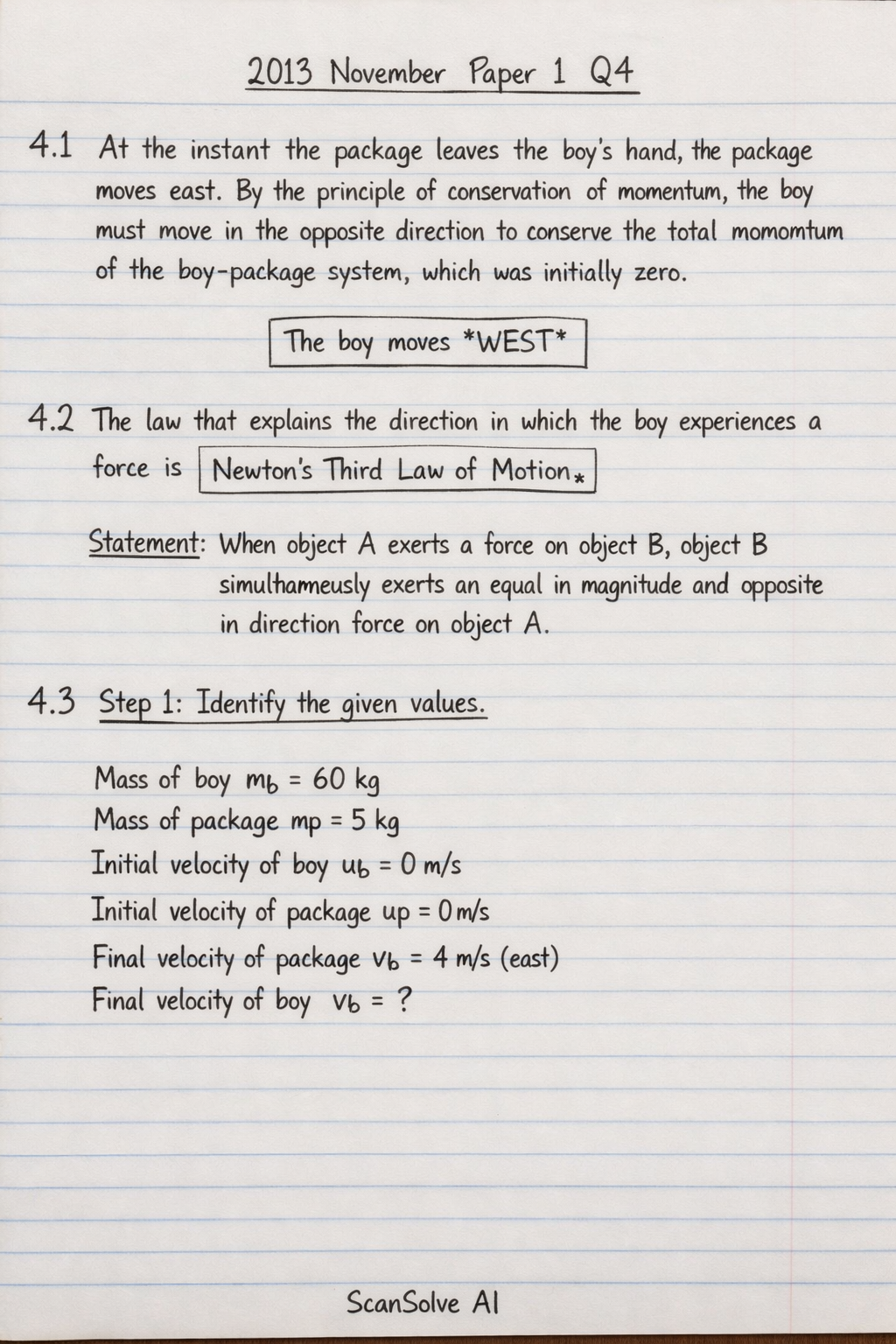
4.1 At the instant the package leaves the boy's hand, the package moves east. By the principle of conservation of momentum, the boy must move in the opposite direction to conserve the total momentum of the boy-package system, which was initially zero.
The boy moves
4.2 The law that explains the direction in which the boy experiences a force is .
Statement: When object A exerts a force on object B, object B simultaneously exerts an equal in magnitude and opposite in direction force on object A.
4.3 Step 1: Identify the given values.
Mass of boy
Mass of package
Initial velocity of boy
Initial velocity of package
Final velocity of package (east, let's take east as positive)
Final velocity of boy
Apply the principle of conservation of linear momentum.
The magnitude of the velocity of the boy is (rounded to two decimal places).
4.4
4.4.1 If the boy throws the same package at a higher velocity in the same direction, the momentum of the package () will increase. To conserve the total momentum of the system (which remains zero), the magnitude of the boy's momentum () must also increase. Since the boy's mass () is constant, his velocity () must increase in magnitude.
The answer to QUESTION 4.3 will4.4.2 If the boy throws a package of double the mass at the same velocity as in QUESTION 4.3, the momentum of the package () will double. To conserve the total momentum of the system, the magnitude of the boy's momentum () must also double. Since the boy's mass () is constant, his velocity () must double in magnitude.
The answer to QUESTION 4.3 will
Explanation: The momentum of the package () will double. By the principle of conservation of linear momentum, the magnitude of the boy's momentum () must also double. Since the boy's mass () remains constant, his velocity () must increase.
2015 Metro South Prelim Paper Q4
4.1 The principle of conservation of linear momentum states that:
4.2 Step 1: Identify the given values.
Mass of wooden block
Initial velocity of wooden block (to the right, let's take right as positive)
Mass of crate
Initial velocity of crate
Final velocity of crate (to the right)
Final velocity of wooden blockApply the principle of conservation of linear momentum.
The magnitude of the velocity of the wooden block immediately after the collision is
4.3 Step 1: Identify the given values for the crate.
Mass of crate
Initial velocity of crate
Final velocity of crate
Time of collision
Force exerted on the crateApply the impulse-momentum theorem to the crate.
The force the wooden block exerts on the crate during the collision is
Still stuck on this one?
Ask a follow-up, and the answer starts from this question.
More Physics Questions
Handwritten Step-by-Step Solution
Get this as a handwritten image on WhatsApp — like a tutor wrote it for you.
Try on WhatsApp