
We read your photo as:
Calculate the normal force (N).
ScanSolve AI Answer
Answer
Step-by-step solution
3 stepsTo find the coefficient of static friction, we need to determine the normal force and then use the relationship between the applied force and the maximum static friction.
Calculate the normal force ().
Since the object is on a horizontal surface, the normal force is equal to the weight of the object.
The weight () is given by , where is the mass and is the acceleration due to gravity ().Relate the applied force to the maximum static friction force.
The problem states that the object is pulled by a force of . For the object to be on the verge of moving (or if it's being pulled but not yet accelerating, implying it's at the maximum static friction), the applied force is equal to the maximum static friction force ().
Calculate the coefficient of static friction ().
The formula for the maximum static friction force is .
We can rearrange this to solve for :Rounding to three significant figures:
The coefficient of static friction is:
Try one yourself
A new problem that tests the same skill.
Still stuck on this one?
Ask a follow-up, and the answer starts from this question.
More Physics Questions
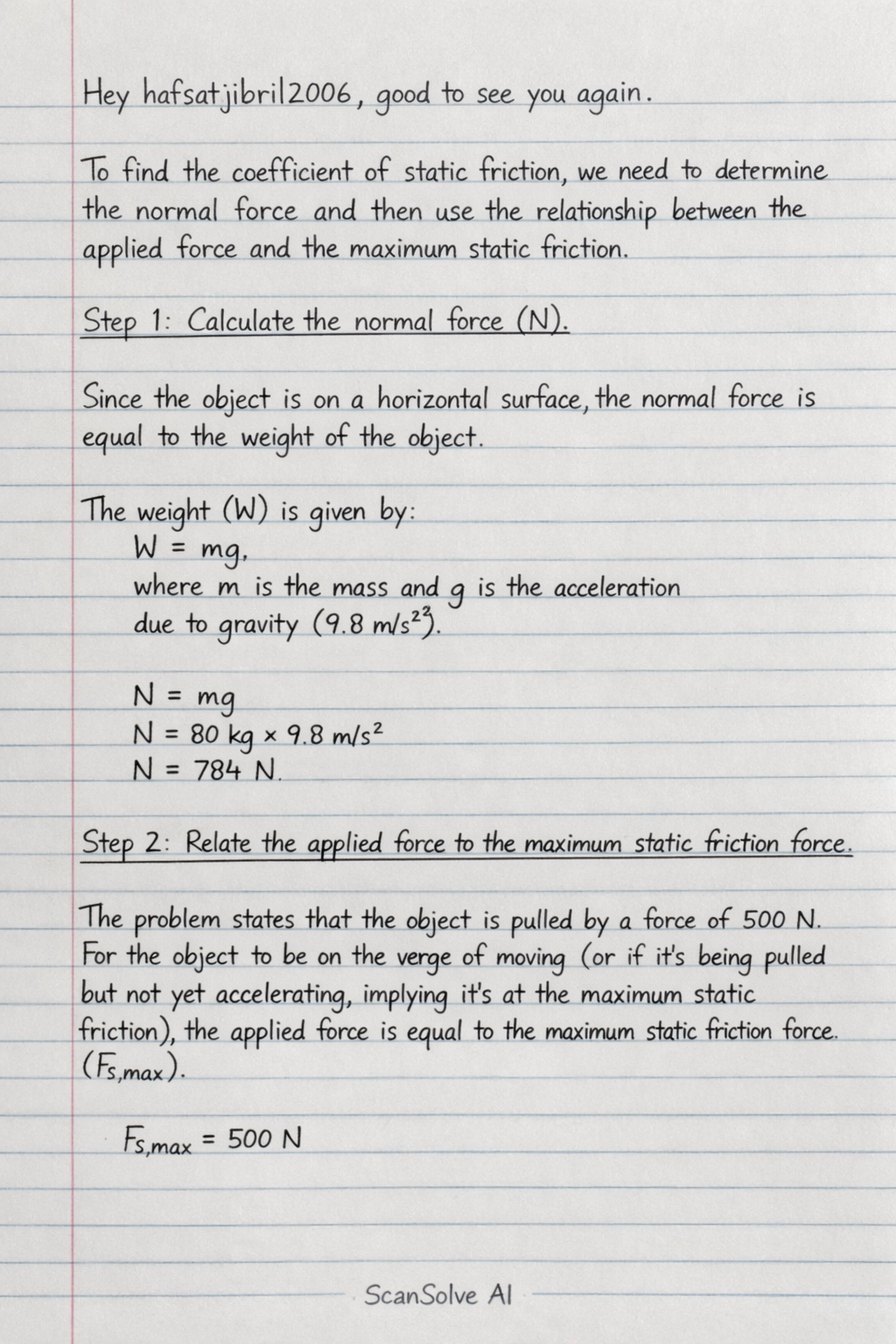
Handwritten Step-by-Step Solution
Get this as a handwritten image on WhatsApp — like a tutor wrote it for you.
Try on WhatsApp