
We read your photo as:
Calculate the number of 10 MW solar plants needed to match Nigeria's 4,300 MW capacity and the useful output of a 1000 MW coal plant operating at 35% efficiency.
ScanSolve AI Answer
Answer
Step-by-step solution
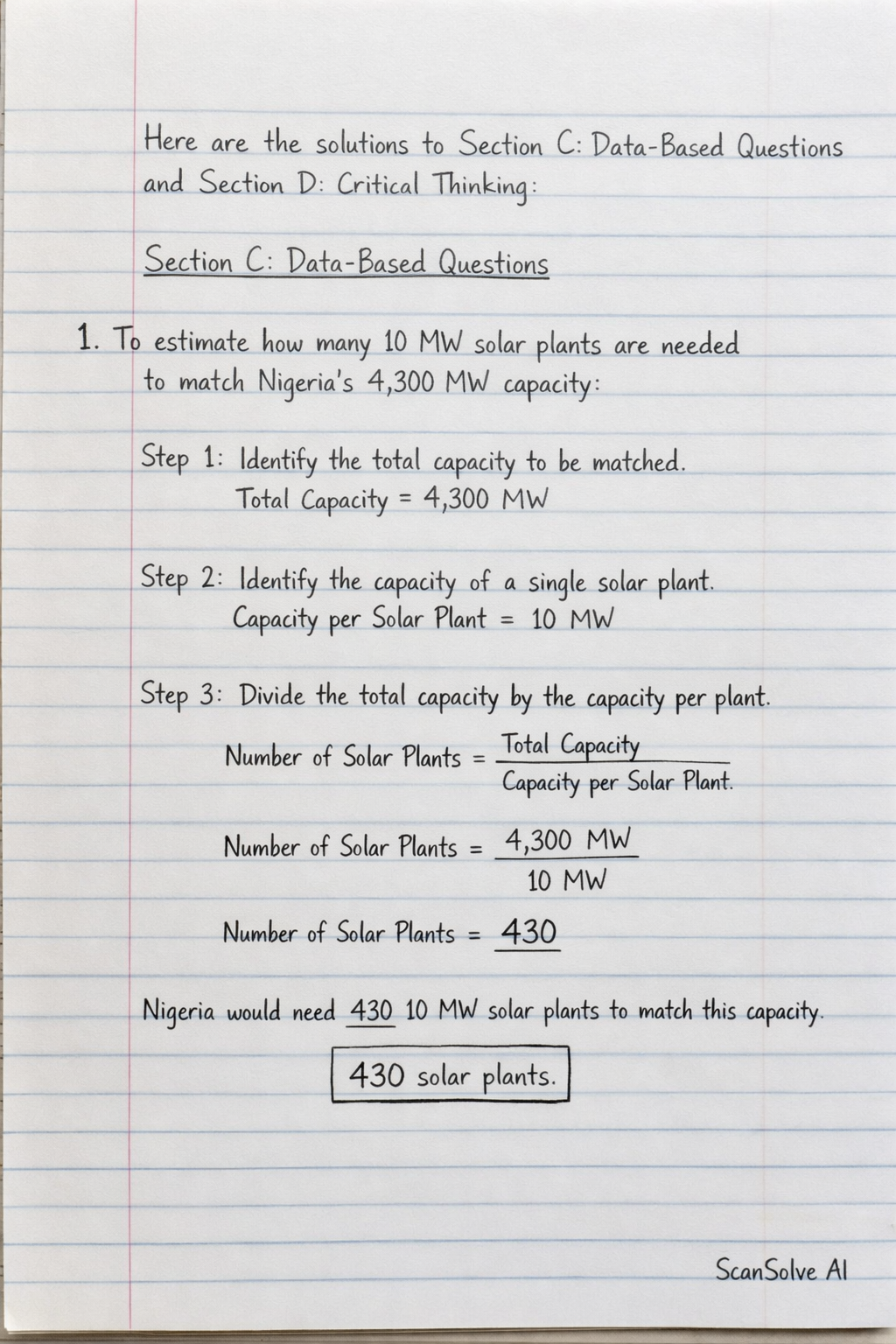
6 stepsHere are the solutions to Section C: Data-Based Questions and Section D: Critical Thinking:
Section C: Data-Based Questions
- To estimate how many 10 MW solar plants are needed to match Nigeria's 4,300 MW capacity:
Identify the total capacity to be matched.
$$ \text{Total Capacity} = 4,300 \text{ MW} $$Identify the capacity of a single solar plant.
$$ \text{Capacity per Solar Plant} = 10 \text{ MW} $$Divide the total capacity by the capacity per plant.
$$ \text{Number of Solar Plants} = \frac{\text{Total Capacity}}{\text{Capacity per Solar Plant}} $$ $$ \text{Number of Solar Plants} = \frac{4,300 \text{ MW}}{10 \text{ MW}} $$ $$ \text{Number of Solar Plants} = 430 $$ Nigeria would need **430** 10 MW solar plants to match this capacity. $$ \boxed{\text{430 solar plants}} $$2. To calculate the useful output from a coal plant operating at 35% efficiency with a 1000 MW input:
Convert the efficiency percentage to a decimal.
$$ \text{Efficiency} = 35\% = 0.35 $$Identify the input power.
$$ \text{Input Power} = 1000 \text{ MW} $$Multiply the input power by the efficiency to find the useful output.
$$ \text{Useful Output} = \text{Input Power} \times \text{Efficiency} $$ $$ \text{Useful Output} = 1000 \text{ MW} \times 0.35 $$ $$ \text{Useful Output} = 350 \text{ MW} $$ The useful output from the coal plant is **350 MW**. $$ \boxed{\text{350 MW}} $$Section D: Critical Thinking
-
Nigeria's prioritization of gas or renewable energy for future development involves a trade-off. Natural gas offers a relatively cleaner fossil fuel option than coal, with established infrastructure and dispatchable power, which can provide immediate energy security and support industrial growth. However, it is still a finite fossil fuel contributing to climate change. Renewable energy offers long-term sustainability, reduced environmental impact, and energy independence, but requires significant initial investment, grid modernization, and solutions for intermittency. A balanced approach, leveraging gas as a transition fuel while aggressively investing in renewables, might be optimal for both short-term stability and long-term sustainability.
-
Energy security significantly affects economic growth in industrial nations by ensuring a reliable and affordable supply of energy, which is crucial for industrial operations, transportation, and daily life. When energy supplies are stable and prices predictable, businesses can plan investments, maintain production, and foster innovation. Conversely, energy insecurity—due to supply disruptions, price volatility, or over-reliance on external sources—can lead to increased operational costs, reduced competitiveness, inflation, and economic instability, hindering growth and development.
-
Try one yourself
A new problem that tests the same skill.
Still stuck on this one?
Ask a follow-up, and the answer starts from this question.
More Physics Questions
Handwritten Step-by-Step Solution
Get this as a handwritten image on WhatsApp — like a tutor wrote it for you.
Try on WhatsApp