
We read your photo as:
Determine the number of electrons from the electron configuration.
Physics
ScanSolve AI Answer
Answers
2 partsb
c
Step-by-step solution
3 stepsDetermine the number of electrons from the electron configuration.
From the previous problem, the electron configuration of the atom is .
The total number of electrons in this atom is the sum of the superscripts:Determine the number of protons.
For a neutral atom, the number of protons is equal to the number of electrons.
Therefore, the number of protons in this atom is 12.b) Number of protons:
Determine the atomic number.
The atomic number (Z) is defined as the number of protons in the nucleus of an atom.
Since the atom has 12 protons, its atomic number is 12.c) Atomic number:
Was this helpful?
Try one yourself
A new problem that tests the same skill.
Still stuck on this one?
Ask a follow-up, and the answer starts from this question.
Got a different question?Ask your own question
More Physics Questions
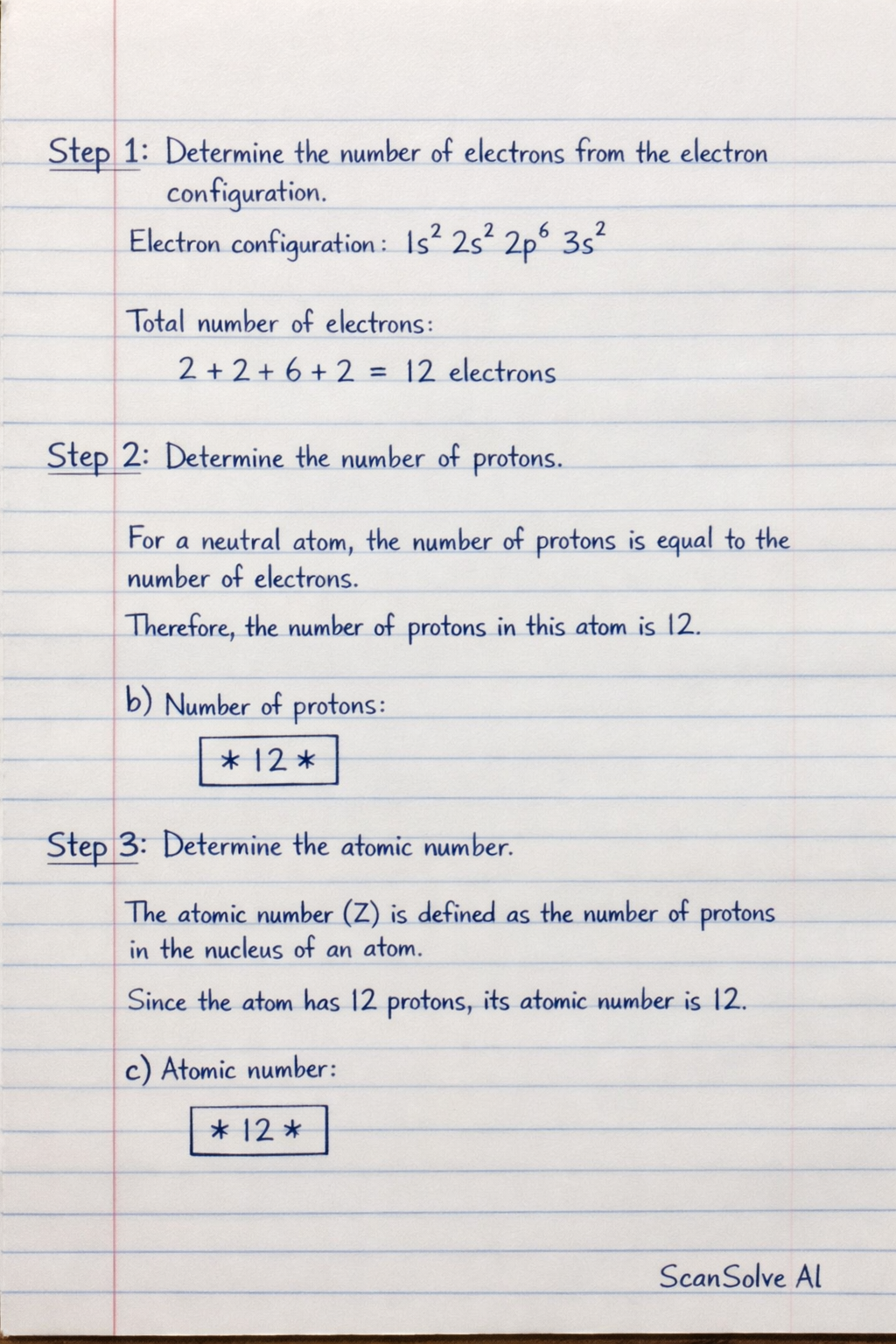
Handwritten Step-by-Step Solution
Get this as a handwritten image on WhatsApp — like a tutor wrote it for you.
Try on WhatsApp