

This physics problem tests your understanding of fundamental physical laws and their applications. The step-by-step solution below breaks down the problem using relevant equations and physical reasoning.
ScanSolve AI Answer
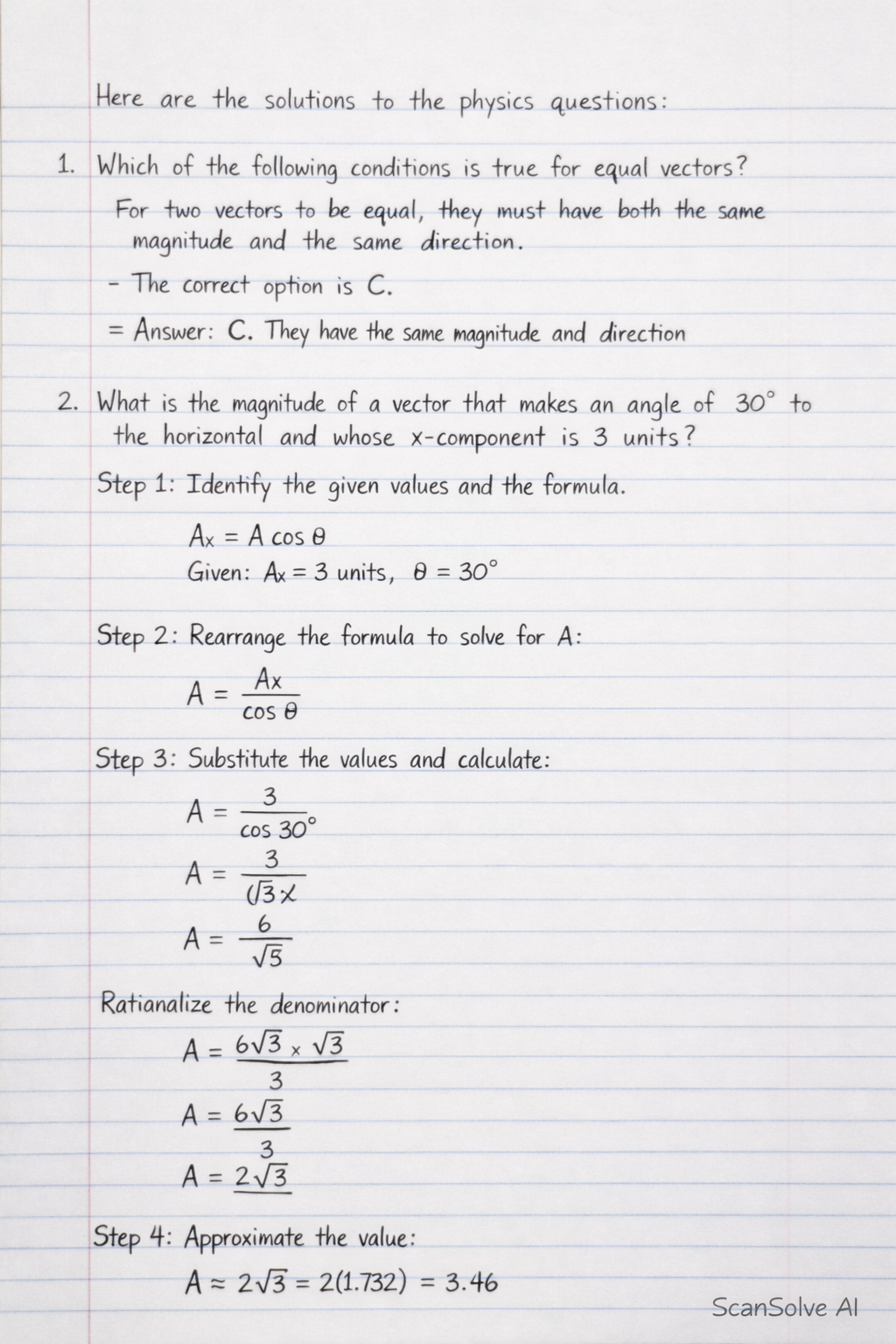
Here are the solutions to the physics questions: 1. Which of the following conditions is true for equal vectors? For two vectors to be equal, they must have both the same magnitude and the same direction. The correct option is C. Answer: C. They have the same magnitude and direction 2. What is the magnitude of a vector that makes an angle of 30^ to the horizontal and whose x-component is 3 units? Step 1: Identify the given values and the formula. The x-component of a vector A is given by A_x = A , where A is the magnitude of the vector and is the angle it makes with the horizontal. Given: A_x = 3 units, = 30^. Step 2: Rearrange the formula to solve for A. A = (A_x)/( ) Step 3: Substitute the values and calculate. A = (3)/( 30^) = (3)/(sqrt(3))2 = (6)/(sqrt(3)) To rationalize the denominator, multiply the numerator and denominator by sqrt(3): A = 6sqrt(3)3 = 2sqrt(3) Step 4: Approximate the value. A ≈ 2 × 1.732 = 3.464 units The closest option is C. Answer: C. 3.46 units 3. Which one of the following represents a scalar quantity? A scalar quantity has only magnitude, while a vector quantity has both magnitude and direction. A. Change in momentum is a vector. B. Velocity is a vector. C. Speed is a scalar. D. Acceleration is a vector. The correct option is C. Answer: C. The speed of a car travelling at 100 km/h. 4. Which of the following groups consists only of vectors? A vector quantity has both magnitude and direction. A. Pressure is a scalar. B. Momentum, force, and velocity are all vectors. C. Speed is a scalar. D. Temperature is a scalar. The correct option is B. Answer: B. Momentum, force, velocity 5. What is vector resolution? Vector resolution is the process of breaking down a single vector into its perpendicular components, typically along the x and y axes. The correct option is B. Answer: B. Breaking a vector into its components along the coordinate axes. 6. If a vector has a magnitude of 10 units and makes a 30^ angle with the horizontal, what is the magnitude of its vertical component? Step 1: Identify the given values and the formula. The vertical component of a vector A is given by A_y = A , where A is the magnitude of the vector and is the angle it makes with the horizontal. Given: A = 10 units, = 30^. Step 2: Substitute the values and calculate. A_y = 10 30^ = 10 × (1)/(2) = 5 units The correct option is A. Answer: A. 5 units 7. A vector is resolved into components along the x and y axes. What is true about the components? The magnitudes of the components (A_x = A and A_y = A ) depend directly on the angle the vector makes with the axes. They are not always equal, nor is one always larger than the other, and they are certainly not independent of the vector's direction. The correct option is B. Answer: B. They are dependent on the angle made by the vector with the axes. 8. Which of the following pairs of components would correctly resolve a vector of magnitude 15 units making a 45^ angle with the horizontal? Step 1: Identify the given values and the formulas for components. Given: A = 15 units, = 45^. The x-component is A_x = A . The y-component is A_y = A . Step 2: Calculate the x-component. A_x = 15 45^ = 15 × sqrt(2)2 ≈ 15 × 0.7071 ≈ 10.61 units Step 3: Calculate the y-component. A_y = 15 45^ = 15 × sqrt(2)2 ≈ 15 × 0.7071 ≈ 10.61 units The correct option is B. Answer: B. 10.6 units along x, 10.6 units along y 9. What is the first step in the graphical method of vector addition? The graphical method of vector addition involves drawing vectors to scale. The very first step is to represent each vector accurately with its correct magnitude and direction. The correct option is B. Answer: B. Draw vectors to scale with appropriate directions. That's 2 down. 3 left today — send the next one.