
We read your photo as:
Which of the following has the dimensional formula [M1 L2 T⁻³]?
ScanSolve AI Answer
Answer
Power
SECTION - A
i) The dimensional formula for Power is .
Power is defined as work done per unit time. Work has dimensions of Force Distance, which is . Dividing by time gives .
The correct option is a) Power.
ii) The magnitude of the scalar product of two unit vectors perpendicular to each other is zero.
Let the two unit vectors be and . Since they are unit vectors, and . Since they are perpendicular, the angle between them is .
The scalar product is given by:
The correct option is a) zero.
iii) Poisson's Ratio is the ratio of the lateral strain to longitudinal strain (also known as linear strain).
Poisson's ratio () is defined as .
The correct option is d) Linear Strain.
iv) Specific Latent Heat is expressed in Joules per kilogram (J/Kg).
Specific latent heat () is the amount of heat energy () absorbed or released per unit mass () during a phase change, without a change in temperature.
The SI unit for heat energy is Joules (J) and for mass is kilograms (Kg).
The correct option is b) J/Kg.
v) Speed of the sound is maximum in solids.
Sound waves are mechanical waves that require a medium to travel. The speed of sound generally increases with the stiffness (elasticity) of the medium and decreases with its density. Solids are typically more rigid and less compressible than liquids or gases, allowing sound to travel fastest through them. Sound cannot travel in a vacuum.
The correct option is d) solid.
vi) A charge of is placed at the centre of two concentric spheres with radius 2.0 cm and 4.0 cm respectively. The ratio of the flux through them will be 1:1.
According to Gauss's Law, the electric flux () through any closed surface is directly proportional to the total electric charge () enclosed within that surface, and independent of the size or shape of the surface.
Since both concentric spheres enclose the same charge (), the electric flux through both spheres will be identical.
The correct option is c) 1 : 1.
vii) The Ohmic conductor is Nichrome Wire.
An Ohmic conductor is a material that obeys Ohm's Law, meaning its resistance remains constant over a wide range of applied voltages and currents. Nichrome wire is commonly used in heating elements and resistors because it exhibits this property. Transistors and vacuum tubes are non-Ohmic devices. Electrolytes do not strictly follow Ohm's law.
The correct option is d) Nichrome Wire.
viii) The line passing through the two poles of a magnetic dipole is called the Magnetic Axis.
For a bar magnet or any magnetic dipole, the magnetic axis is the imaginary line that connects the North and South poles.
The correct option is b) Magnetic Axis.
Try one yourself
A new problem that tests the same skill.
Still stuck on this one?
Ask a follow-up, and the answer starts from this question.
More Physics Questions
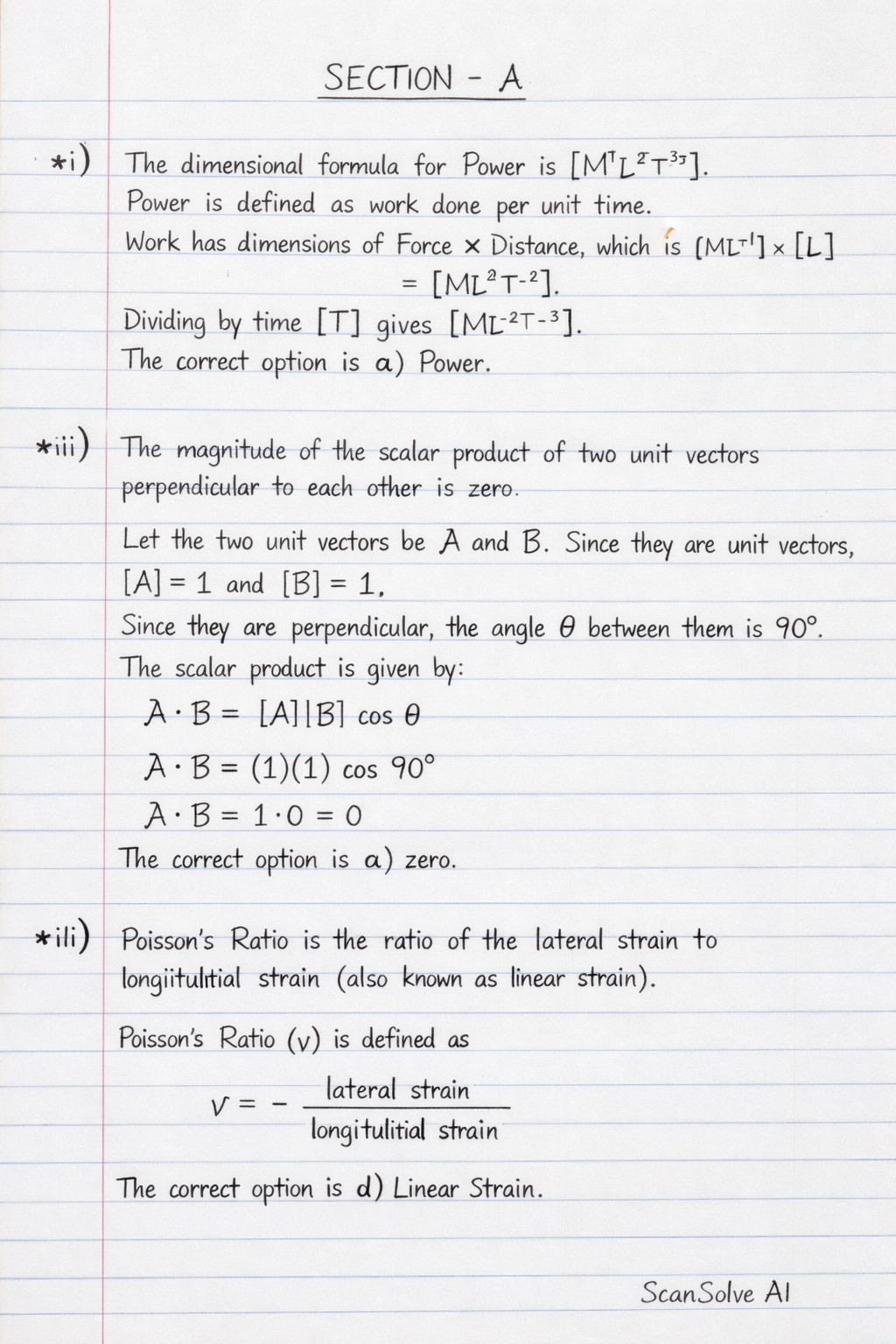
Handwritten Step-by-Step Solution
Get this as a handwritten image on WhatsApp — like a tutor wrote it for you.
Try on WhatsApp