
We read your photo as:
Which of the following is required for the conservation of momentum in a system of colliding objects?
ScanSolve AI Answer
Step-by-step solution
9 stepshere are the solutions for questions 46-49.
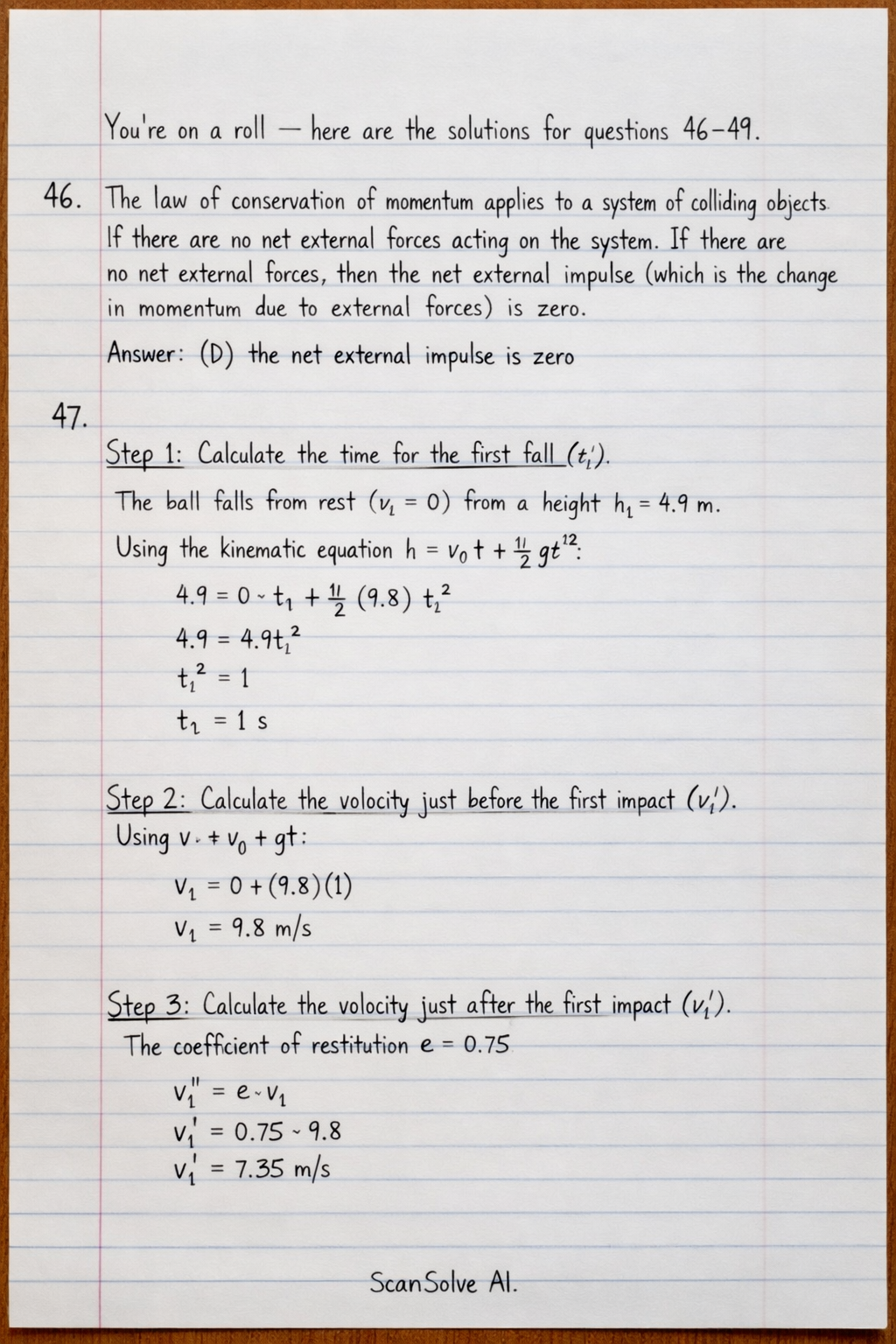
46. The law of conservation of momentum applies to a system of colliding objects if there are no net external forces acting on the system. If there are no net external forces, then the net external impulse (which is the change in momentum due to external forces) is zero.
- Answer: (D) the net external impulse is zero
47.
Calculate the time for the first fall ().
The ball falls from rest () from a height .
Using the kinematic equation :Calculate the velocity just before the first impact ().
Using :
Calculate the velocity just after the first impact ().
The coefficient of restitution is given by .
This is the initial upward velocity for the second bounce.
Calculate the time for the second flight (up and down, ).
The time to reach the peak height after bouncing is .
The total time for the ball to go up and come back down to the surface for the second hit is .
Calculate the total time until the second hit.
Total time = .
- Answer: (C)
48.
Write the formulas for kinetic energy and momentum.
Kinetic energy:
Momentum:Express kinetic energy in terms of momentum.
From , we get . Substitute this into the kinetic energy formula:
Use the condition that kinetic energies are equal ().
Solve for the ratio of momenta.
Taking the square root of both sides:
So, the ratio of their momentum is .
- Answer: (A)
49. An inelastic collision is characterized by the conservation of momentum, but the kinetic energy of the system is not conserved. Some kinetic energy is converted into other forms of energy, such as heat, sound, or deformation.
- Answer: (D) momentum is conserved but kinetic energy is not conserved
Still stuck on this one?
Ask a follow-up, and the answer starts from this question.
More Physics Questions
Handwritten Step-by-Step Solution
Get this as a handwritten image on WhatsApp — like a tutor wrote it for you.
Try on WhatsApp