
We read your photo as:
Which of the following statements about mass is correct? a) 5 Kg b) Changes with gravity c) 10 Kg d) Depends on velocity
ScanSolve AI Answer
Answer
Step-by-step solution
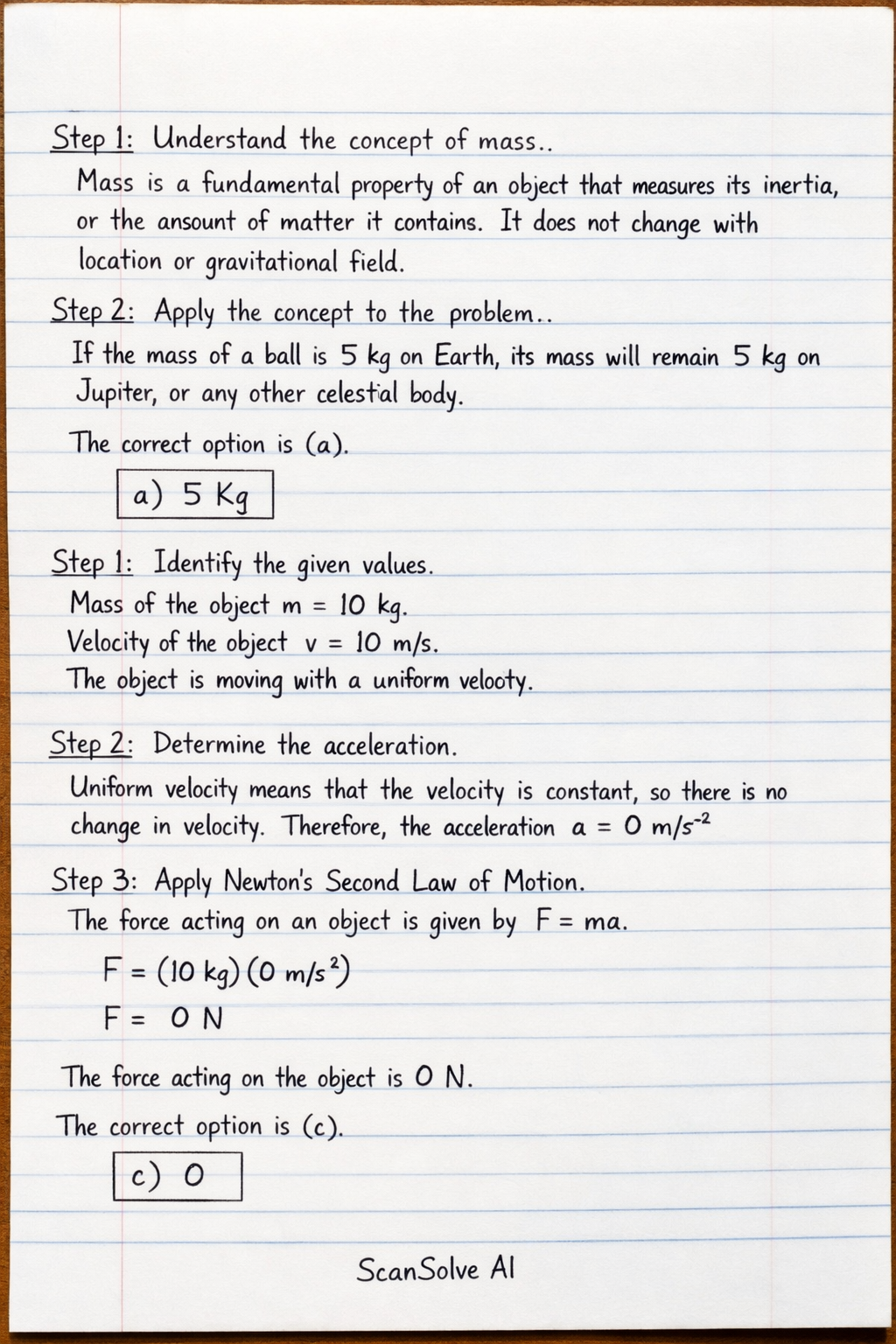
8 stepsUnderstand the concept of mass.
Mass is a fundamental property of an object that measures its inertia, or the amount of matter it contains. It does not change with location or gravitational field.
Apply the concept to the problem.
If the mass of a ball is 5 kg on Earth, its mass will remain 5 kg on Jupiter, or any other celestial body.
The correct option is (a).
Identify the given values.
Mass of the object kg.
Velocity of the object m/s.
The object is moving with a uniform velocity.Determine the acceleration.
Uniform velocity means that the velocity is constant, so there is no change in velocity. Therefore, the acceleration m/s.
Apply Newton's Second Law of Motion.
The force acting on an object is given by .
The force acting on the object is 0 N.
The correct option is (c).
Recall the formula for kinetic energy.
The kinetic energy () of an object is given by the formula:
where is the mass and is the speed.
Consider the initial kinetic energy.
Let the initial speed be .
The initial kinetic energy is .Consider the new kinetic energy when the speed is doubled.
The new speed is .
The new kinetic energy is .When the speed is doubled, the kinetic energy is quadrupled.
The correct option is (b).
Try one yourself
A new problem that tests the same skill.
Still stuck on this one?
Ask a follow-up, and the answer starts from this question.
More Physics Questions
Handwritten Step-by-Step Solution
Get this as a handwritten image on WhatsApp — like a tutor wrote it for you.
Try on WhatsApp