
We read your photo as:
Which of the following statements about refrigeration are TRUE and which are FALSE?
ScanSolve AI Answer
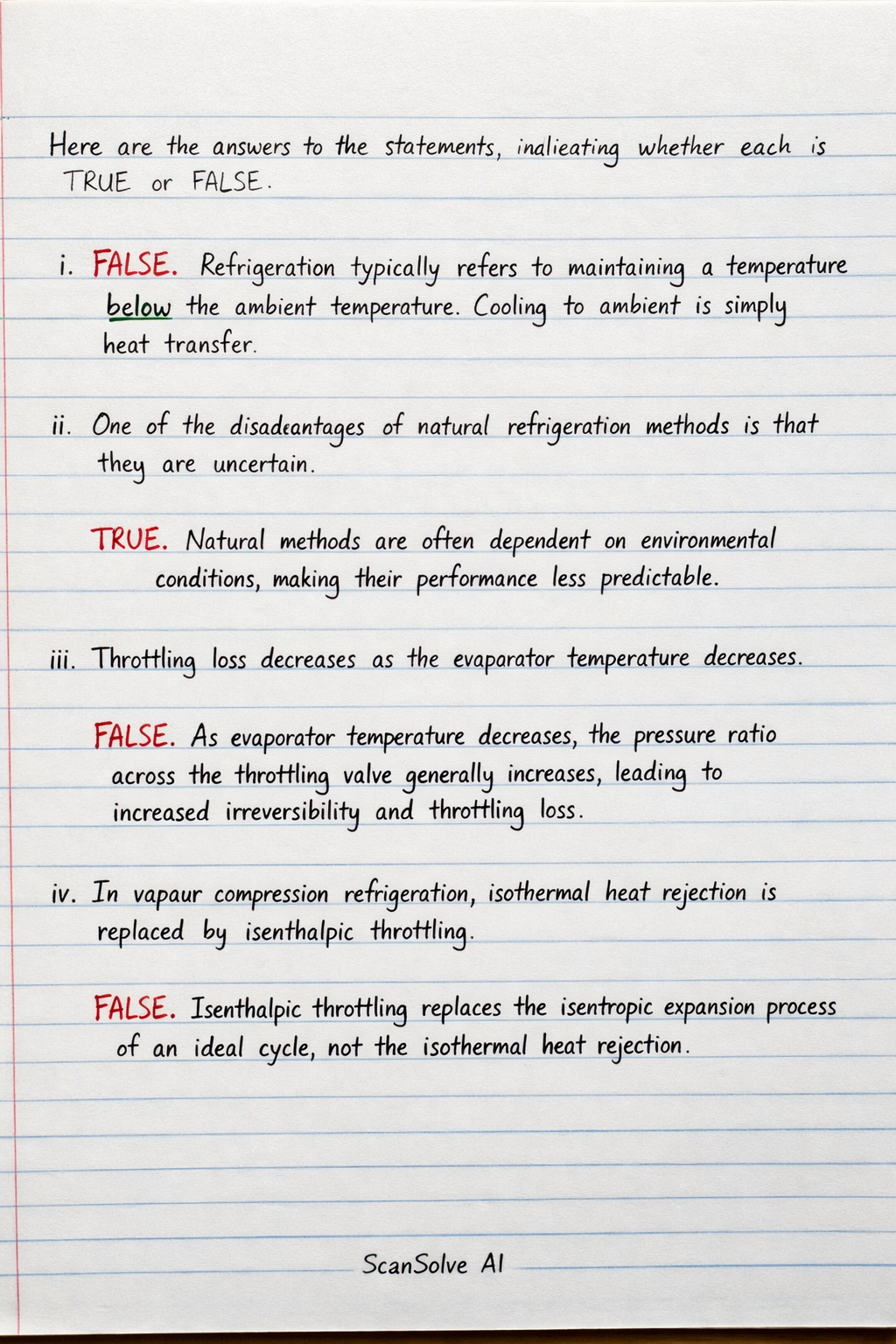
Here are the answers to the statements, indicating whether each is TRUE or FALSE:
-
i. Cooling of a hot cup of coffee by leaving it on a table is refrigeration.
- FALSE. Refrigeration typically refers to maintaining a temperature below the ambient temperature. Cooling to ambient is simply heat transfer.
-
ii. One of the disadvantages of natural refrigeration methods is that they are uncertain.
- TRUE. Natural methods are often dependent on environmental conditions, making their performance less predictable.
-
iii. Throttling loss decreases as the evaporator temperature decreases.
- FALSE. As evaporator temperature decreases, the pressure ratio across the throttling valve generally increases, leading to increased irreversibility and throttling loss.
-
iv. In vapour compression refrigeration, isothermal heat rejection is replaced by isenthalpic throttling.
- FALSE. Isenthalpic throttling replaces the isentropic expansion process of an ideal cycle, not the isothermal heat rejection.
-
v. The COP of Carnot refrigeration is always lower than the COP of vapour compression refrigeration system.
- FALSE. The Carnot COP is the maximum possible COP; actual vapor compression systems have a COP lower than or equal to the Carnot COP.
-
vi. Superheating increases both the work input and refrigeration effect.
- TRUE. Superheating increases the enthalpy at the compressor inlet (), which increases both the refrigeration effect () and the compressor work ().
-
vii. The higher the volumetric flow rate, the lower the capacity of the compressor.
- TRUE. If "volumetric flow rate" refers to the specific volume of the refrigerant at the compressor inlet, a higher specific volume means a lower mass flow rate for a given compressor displacement, thus reducing the refrigeration capacity.
-
viii. At low evaporator temperature, effect of condensing temperature is very high.
- TRUE. The COP is more sensitive to changes in condensing temperature when the evaporator temperature is low.
-
ix. In actual system, the temperature of the heat sink will be several degrees higher than the condensing temperature for heat transfer to take place.
- FALSE. For heat to be rejected, the condensing temperature must be higher than the heat sink temperature.
-
x. A system with subcooling, the vapour fraction at the inlet evaporator is reduced.
- TRUE. Subcooling reduces the enthalpy of the liquid entering the expansion valve, which in turn reduces the amount of flash gas (vapor fraction) at the evaporator inlet.
-
xi. During sensible heating, the enthalpy increases.
- TRUE. Sensible heating increases the temperature of a substance without phase change, which directly increases its enthalpy.
-
xii. Useful superheating increase refrigeration effect and decrease work of compression.
- FALSE. Useful superheating increases both the refrigeration effect and the work of compression.
-
xiii. For the same system, degree of superheating is lower than degree of subcooling.
- FALSE. There is no general rule; the degrees of superheating and subcooling depend on the specific system design and operating conditions.
-
xiv. A SHF of 1.0 implies a pure sensible heat transfer.
- TRUE. Sensible Heat Factor (SHF) of 1.0 means that the latent heat transfer is zero, indicating only sensible heat transfer.
-
xv. During sensible cooling of air, both dry bulb and wet bulb temperatures decrease.
- TRUE. Sensible cooling lowers the dry bulb temperature. If no dehumidification occurs, the wet bulb temperature will also decrease.
-
xvi. In zone of vaso-motor regulation against cold, blood vessels adjacent to skin dilate.
- FALSE. Against cold, vasoconstriction occurs to reduce blood flow to the skin and conserve heat. Vasodilation occurs in
Still stuck on this one?
Ask a follow-up, and the answer starts from this question.
More Physics Questions
Handwritten Step-by-Step Solution
Get this as a handwritten image on WhatsApp — like a tutor wrote it for you.
Try on WhatsApp