
We read your photo as:
Which of the following topics is covered in the image? (a) Work, Energy and Power (b) Thermal Physics (c) Waves and Sound (d) Optics (e) Electricity (f) Magnetism and Electromagnetic Induction (g) Modern Physics
Physics
ScanSolve AI Answer
Step-by-step solution
3 stepsHere are the answers to Question 4 based on the image provided:
-
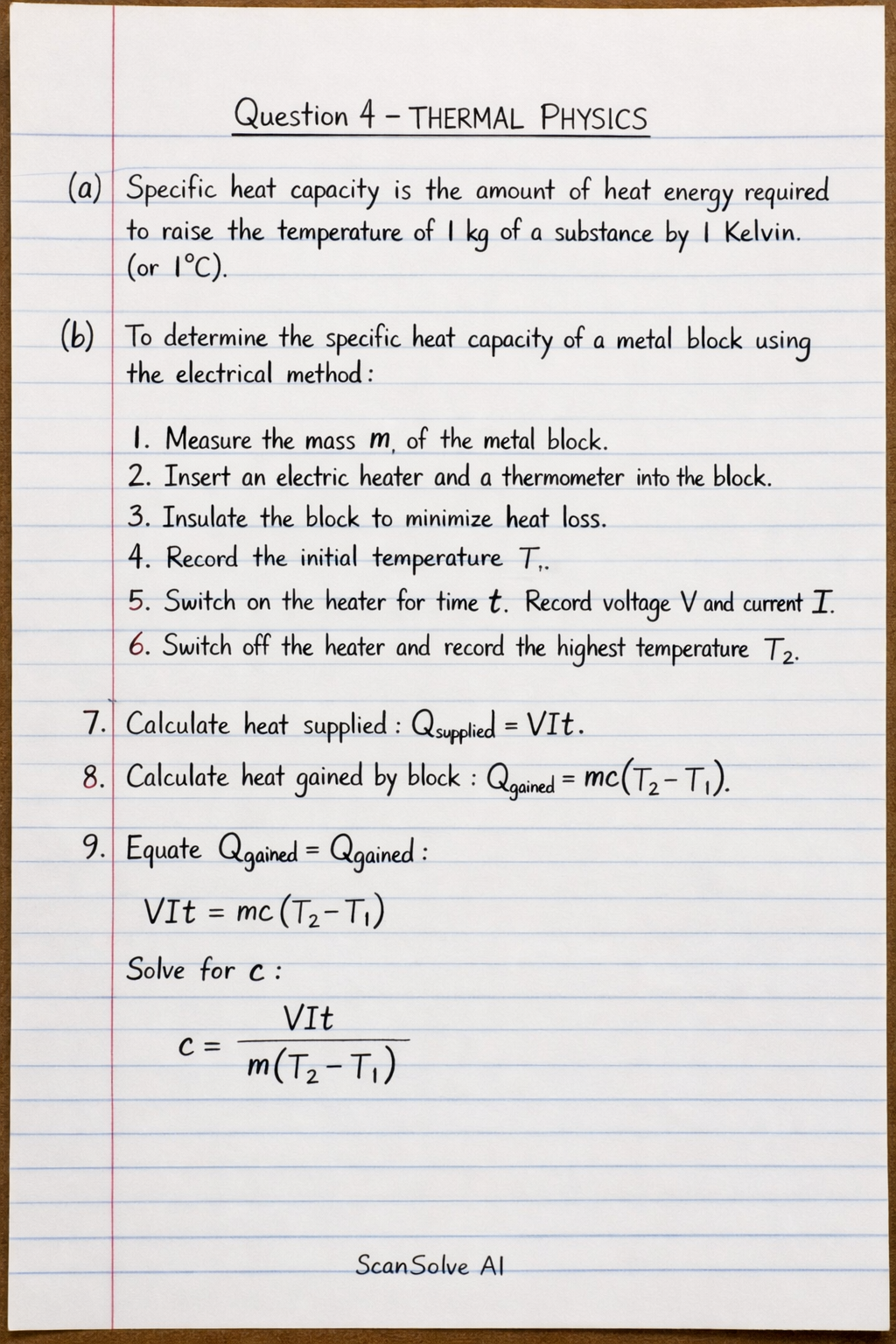
Question 4 - THERMAL PHYSICS
-
a) Specific heat capacity is the amount of heat energy required to raise the temperature of 1 kg of a substance by 1 Kelvin (or 1 degree Celsius).
-
b) To determine the specific heat capacity of a metal block using the electrical method:
- Measure the mass () of the metal block.
- Insert an electric heater and a thermometer into the block.
- Insulate the block to minimize heat loss.
- Record the initial temperature ().
- Switch on the heater for a measured time (), recording the voltage () and current ().
- Switch off the heater and record the highest temperature () reached.
- Calculate heat supplied: .
- Calculate heat gained by block: .
- Equate heat supplied to heat gained () and solve for .
-
c) Calculate the heat supplied.
-
Identify the given values.
Mass $m = 2.0 \text{ kg}$ Initial temperature $T_1 = 25^\circ\text{C}$ Final temperature $T_2 = 85^\circ\text{C}$ Specific heat capacity $c = 900 \text{ J kg}^{-1} \text{ K}^{-1}$ Change in temperature $\Delta T = T_2 - T_1 = 85^\circ\text{C} - 25^\circ\text{C} = 60^\circ\text{C} = 60 \text{ K}$.Use the formula for heat supplied.
$$ Q = mc\Delta T $$Substitute the values and calculate.
    $$
    Q = (2.0 \text{ kg}) \times (900 \text{ J kg}^{-1} \text{ K}^{-1}) \times (60 \text{ K})
    $$
    $$
    Q = 108000 \text{ J}
    $$
    The heat supplied is $\boxed{\text{108000 J}}$.

*   **d)** **Sea breeze** is a local wind that blows from the sea towards the land during the day. This occurs because land heats up faster than the sea, causing the air above the land to rise and create a low-pressure area. Cooler, denser air from over the sea (a high-pressure area) then flows in to replace the rising air, forming the breeze.
Was this helpful?
Still stuck on this one?
Ask a follow-up, and the answer starts from this question.
Got a different question?Ask your own question
More Physics Questions
QAnswer this physics questions a b c and d in it's short formQA loud speaker converts which form of energy into which form? (a) Sound energy into Electrical…Qc) Physics is the natural science that studies matter, its fundamental constituents, its motion and…QA form of energy produced by vibrating bodies is called (a) light waves (b) sound waves (c) kinetic…Q⸻ PHYSICS – ORDINARY LEVEL MULTIPLE CHOICE QUESTIONS (10 ITEMS) Which of the following is a scalar…
Browse by topic:Electromagnetism
Handwritten Step-by-Step Solution
Get this as a handwritten image on WhatsApp — like a tutor wrote it for you.
Try on WhatsApp