
We read your photo as:
Show on a diagram the forces acting on a sphere moving in a viscous liquid, and calculate the volume of an oil drop given its diameter.
ScanSolve AI Answer
Answer
Step-by-step solution
6 stepsHere are the solutions to your questions:
Part c
The diagram in below shows a sphere moving in a viscous liquid in a tall measuring cylinder. Show on the diagram the forces acting on the sphere.
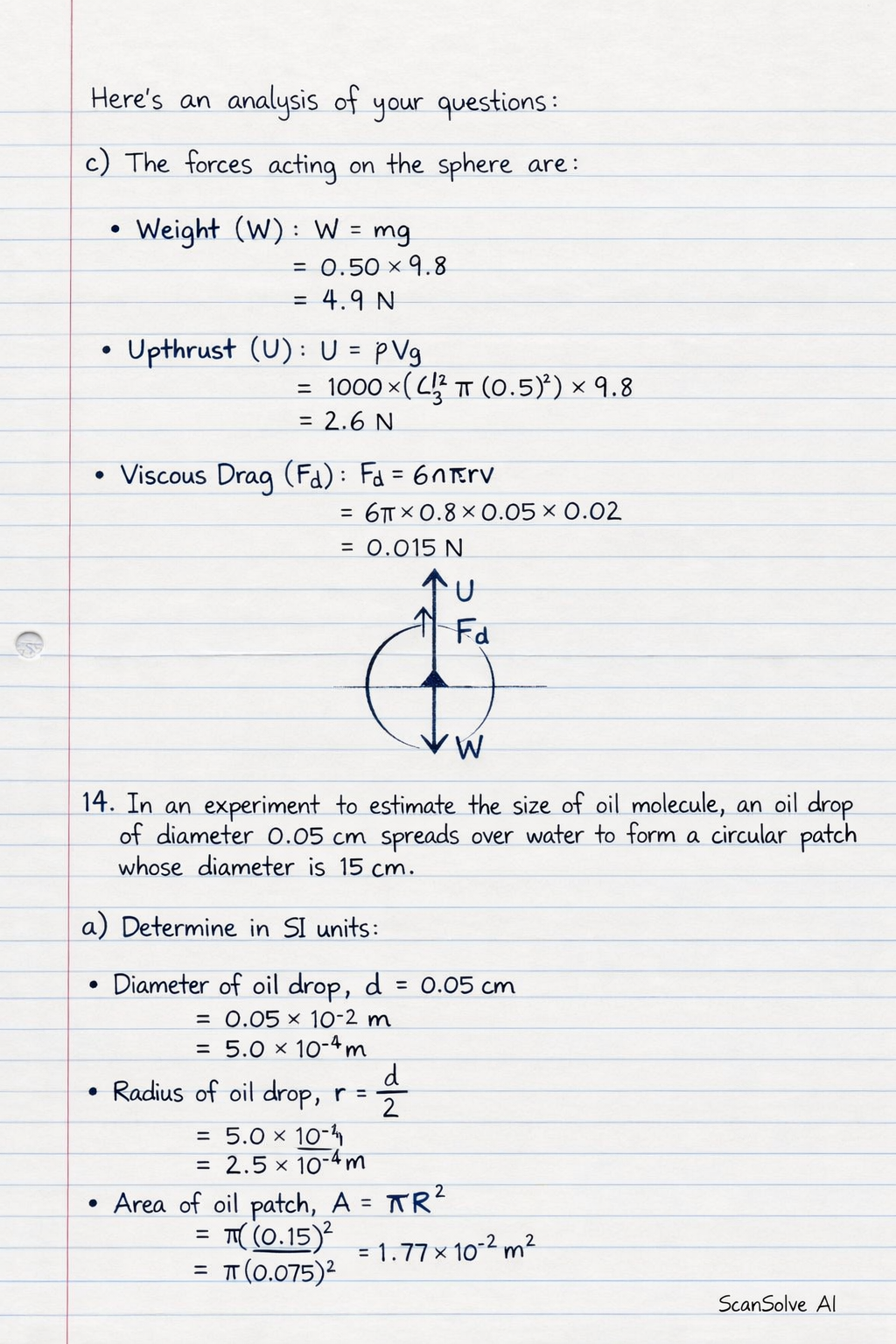
The forces acting on the sphere are:
- Weight (): Acts vertically downwards from the center of the sphere.
- Upthrust (): Acts vertically upwards from the center of the sphere, due to the displaced liquid.
- Viscous Drag (): Acts vertically upwards, opposing the motion of the sphere through the viscous liquid.
(Please draw these three forces as arrows originating from the center of the sphere on your diagram: one arrow pointing down labeled 'W', and two arrows pointing up labeled 'U' and 'F_d'.)
14. In an experiment to estimate the size of oil molecule an oil drop of diameter 0.05cm spreads over water to form a circular patch whose diameter is 15cm.
Part a
Determine in SI units
- (i) Volume of the drop.
Convert the diameter of the oil drop to SI units (meters) and find its radius.
Diameter of drop, $D_{drop} = 0.05 \text{ cm} = 0.05 \times 10^{-2} \text{ m} = 5 \times 10^{-4} \text{ m}$ Radius of drop, $r_{drop} = \frac{D_{drop}}{2} = \frac{5 \times 10^{-4} \text{ m}}{2} = 2.5 \times 10^{-4} \text{ m}$Calculate the volume of the spherical oil drop using the formula .
$$ V_{drop} = \frac{4}{3}\pi (2.5 \times 10^{-4} \text{ m})^3 $$ $$ V_{drop} = \frac{4}{3}\pi (15.625 \times 10^{-12} \text{ m}^3) $$ $$ V_{drop} \approx 6.54 \times 10^{-11} \text{ m}^3 $$ The volume of the drop is $\boxed{6.54 \times 10^{-11} \text{ m}^3}$.- (ii) Area of the patch.
Convert the diameter of the circular patch to SI units (meters) and find its radius.
Diameter of patch, $D_{patch} = 15 \text{ cm} = 15 \times 10^{-2} \text{ m} = 0.15 \text{ m}$ Radius of patch, $R_{patch} = \frac{D_{patch}}{2} = \frac{0.15 \text{ m}}{2} = 0.075 \text{ m}$Calculate the area of the circular patch using the formula .
$$ A_{patch} = \pi (0.075 \text{ m})^2 $$ $$ A_{patch} = \pi (0.005625 \text{ m}^2) $$ $$ A_{patch} \approx 1.77 \times 10^{-2} \text{ m}^2 $$ The area of the patch is $\boxed{1.77 \times 10^{-2} \text{ m}^2}$.- (iii) Size of the oil molecule.
Assume the oil spreads to form a monolayer (a single layer of molecules) on the water surface.
The thickness of this monolayer represents the size of the oil molecule (). The volume of this monolayer is equal to the volume of the original oil drop.
Rearrange the formula to solve for and substitute the calculated values.
$$
h = \frac{V_{drop}}{A_{patch}}
$$
$$
h = \frac{6.54498 \times 10^{-11} \text{ m}^3}{1.76714 \times 10^{-2} \text{ m}^2}
$$
$$
h \approx 3.70 \times 10^{-9} \text{ m}
$$
The size of the oil molecule is $\boxed{3.70 \times 10^{-9} \text{ m}}$.
Try one yourself
A new problem that tests the same skill.
Still stuck on this one?
Ask a follow-up, and the answer starts from this question.
More Physics Questions
Handwritten Step-by-Step Solution
Get this as a handwritten image on WhatsApp — like a tutor wrote it for you.
Try on WhatsApp