
We read your photo as:
Describe the operation of a full-wave rectifier circuit, including the role of a smoothing capacitor.
ScanSolve AI Answer
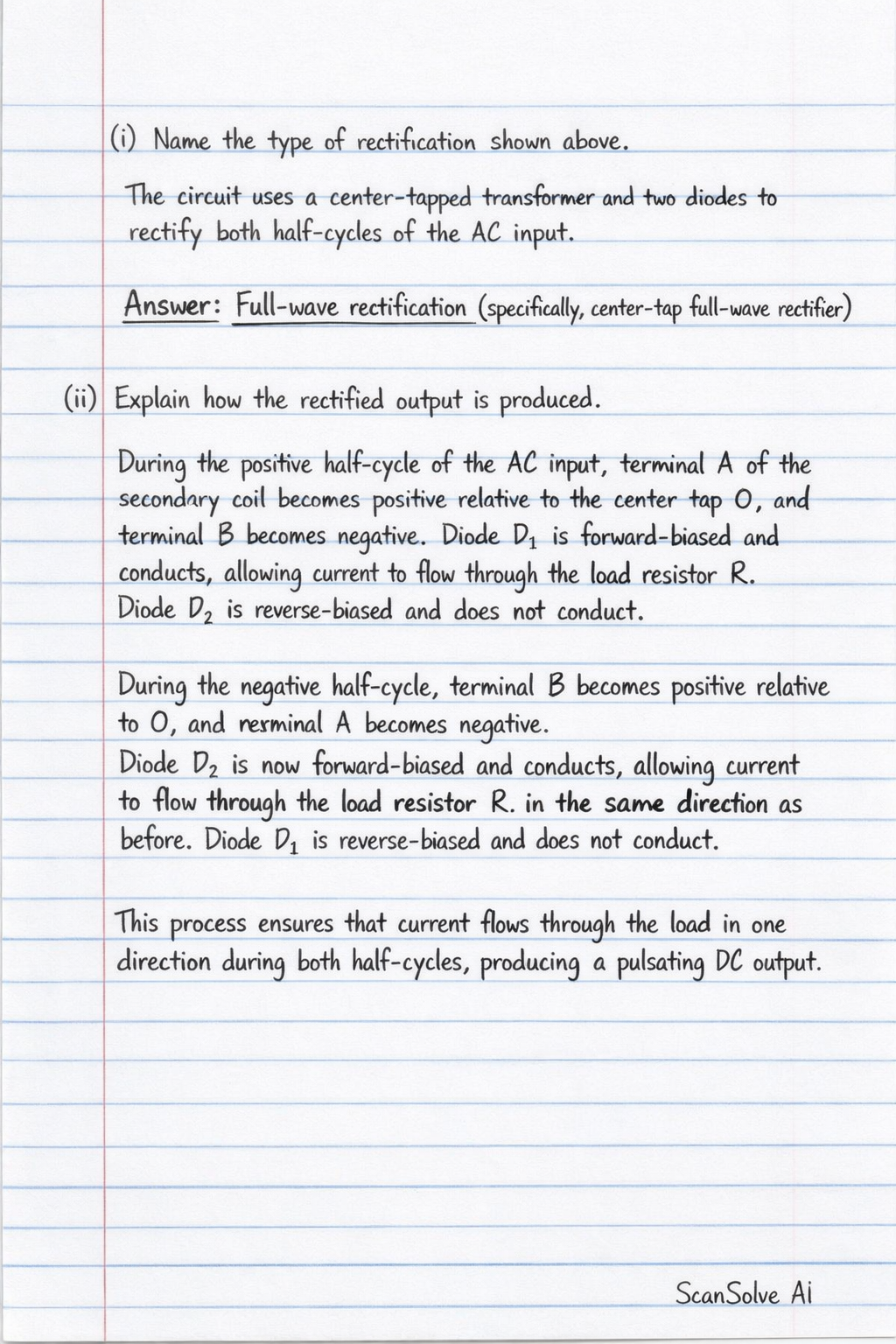
(i) Name the type of rectification shown above.
The circuit uses a center-tapped transformer and two diodes to rectify both half-cycles of the AC input.
Answer: Full-wave rectification (specifically, center-tap full-wave rectifier)
(ii) Explain how the rectified output is produced.
During the positive half-cycle of the AC input, terminal A of the secondary coil becomes positive relative to the center tap O, and terminal B becomes negative. Diode is forward-biased and conducts, allowing current to flow through the load resistor R. Diode is reverse-biased and does not conduct.
During the negative half-cycle, terminal B becomes positive relative to O, and terminal A becomes negative. Diode is now forward-biased and conducts, allowing current to flow through the load resistor R in the same direction as before. Diode is reverse-biased and does not conduct. This process ensures that current flows through the load in one direction during both half-cycles, producing a pulsating DC output.
(iii) State the purpose of capacitor, C in the circuit.
The capacitor C acts as a smoothing filter. It charges when the rectified voltage is high and discharges through the load when the voltage drops, thereby reducing the ripple in the output voltage and producing a smoother DC output.
Still stuck on this one?
Ask a follow-up, and the answer starts from this question.
More Physics Questions
Handwritten Step-by-Step Solution
Get this as a handwritten image on WhatsApp — like a tutor wrote it for you.
Try on WhatsApp