
We read your photo as:
Determine the original mass of a radioactive substance given its half-life and remaining mass, list two medical uses of radioactivity, and solve nuclear equations.
ScanSolve AI Answer
Step-by-step solution
10 stepshere are the answers to the questions:
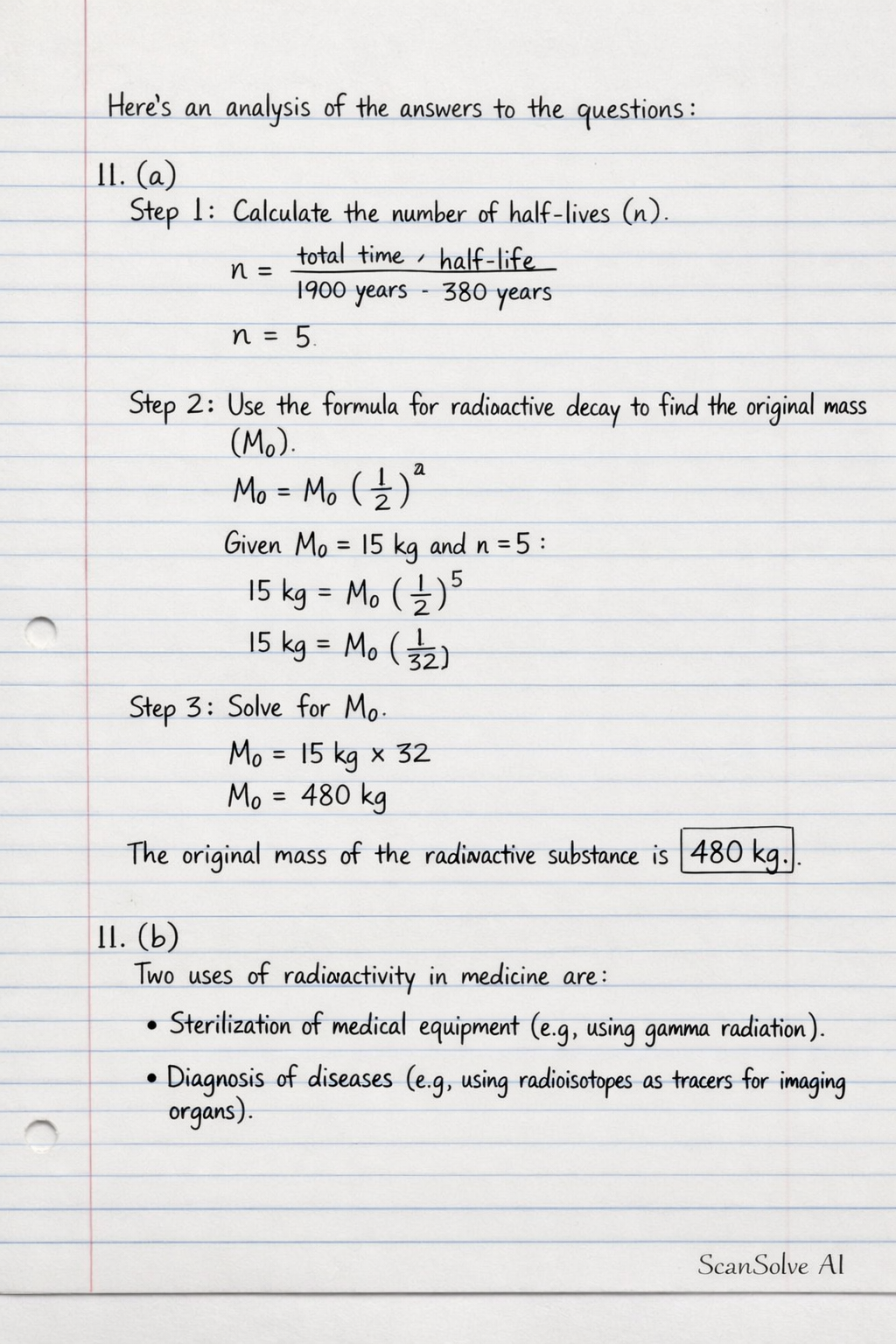
11. (a)
Calculate the number of half-lives ().
Use the formula for radioactive decay to find the original mass ().
Given and :
Solve for .
The original mass of the radioactive substance is .
11. (b)
Two uses of radioactivity in medicine are:- Sterilization of medical equipment (e.g., using gamma radiation).
- Diagnosis of diseases (e.g., using radioisotopes as tracers for imaging organs).
12.
The nuclear equation is:Balance the mass numbers (superscripts) to find Y.
Balance the atomic numbers (subscripts) to find X.
The values are and .
13. (a) (i)
To draw a graph of disintegration rate against time, plot the following points with Time (hours) on the x-axis and Rate of disintegration (counts s⁻¹) on the y-axis:- (0, 730)
- (5, 570)
- (10, 455)
- (15, 365)
- (20, 292)
- (25, 232) Draw a smooth curve connecting these points.
13. (a) (ii)
Determine the initial disintegration rate from the table.
Initial rate at time = 0 hours is 730 counts s⁻¹.
Calculate half of the initial rate.
Half of 730 counts s⁻¹ is counts s⁻¹.
Find the time at which the disintegration rate is 365 counts s⁻¹ from the table.
From the table, at 15 hours, the rate of disintegration is 365 counts s⁻¹.
The half-life of bismuth is .13. (a) (iii)
If half the amount of sample of bismuth were used, the initial disintegration rate would be halved. The curve would start at 365 counts s⁻¹ (instead of 730 counts s⁻¹) and follow the same decay pattern, but all disintegration rate values would be half of the original values. The half-life would remain the same.13. (b)
One application of radioactivity in:- (i) Medicine: Radiotherapy for cancer treatment.
- (ii) Agriculture: Pest control through sterilization of male insects.
- (iii) Tracers: Detecting leaks in underground pipes.
- (iv) Nuclear power station: Generating electricity through nuclear fission.
13. (c)
Two dangers associated with radioactivity are:- Genetic mutations and birth defects in offspring due to damage to reproductive cells.
- Radiation sickness from high doses, leading to nausea, vomiting, hair loss, and potentially death.
14. (a)
The two charged particles emitted by a radioactive isotope are:- Alpha particle: or (positive charge)
- Beta particle: or (negative charge)
14. (b)
The nuclear equation is:Balance the mass numbers (superscripts).
Balance the atomic numbers (subscripts).
The mass number of the resulting nuclide is and the atomic number is .
15.
The diagram in Figure 6 is not provided in the image, so this question cannot be answered.
Still stuck on this one?
Ask a follow-up, and the answer starts from this question.
More Physics Questions
Handwritten Step-by-Step Solution
Get this as a handwritten image on WhatsApp — like a tutor wrote it for you.
Try on WhatsApp