
We read your photo as:
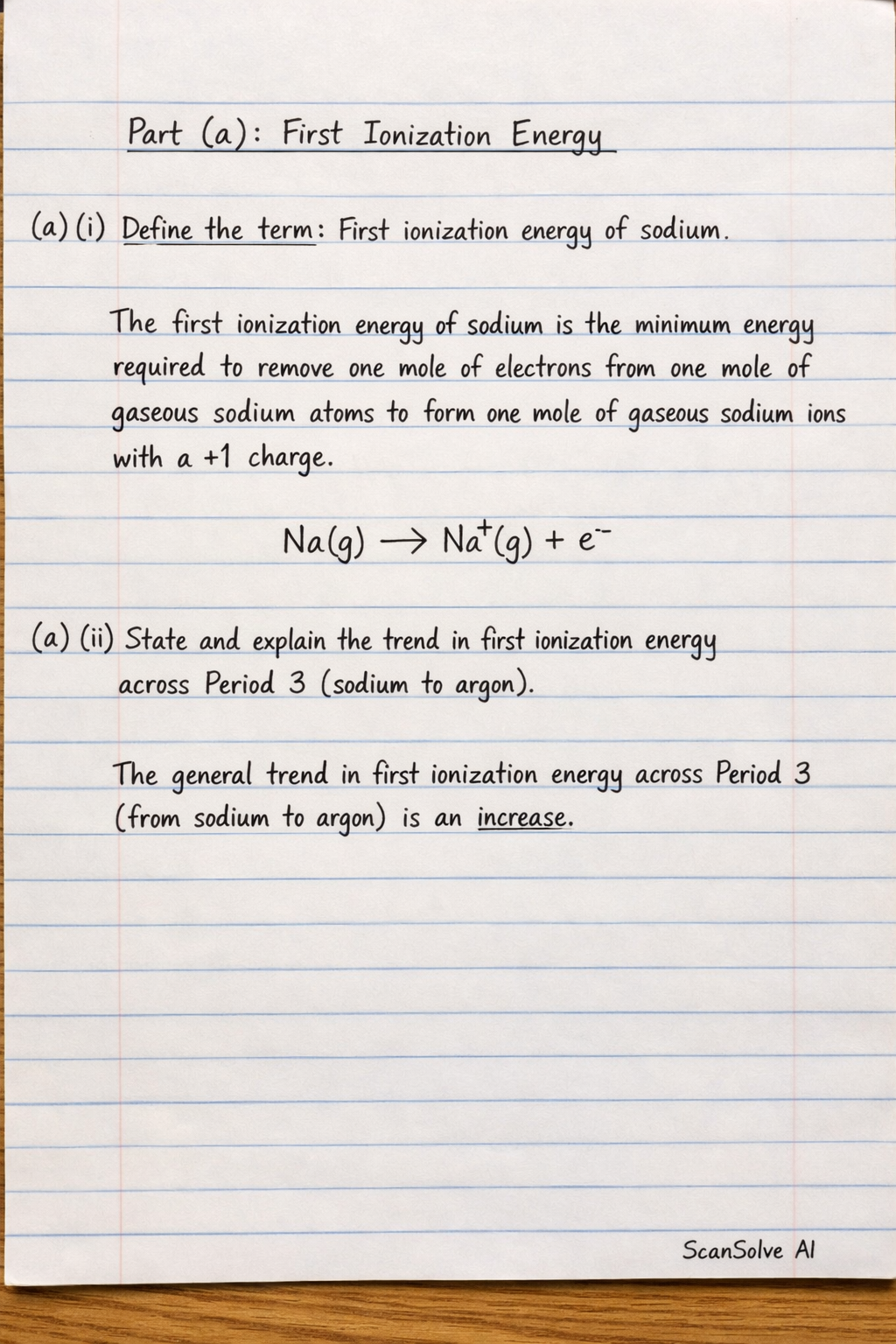
Part (a): First Ionization Energy
ScanSolve AI Answer
Here's the solution to the question. Please note that the question states "Period 2 (sodium to argon)", which is a contradiction. Sodium to Argon are elements in Period 3 of the periodic table. I will answer based on the elements sodium to argon (i.e., Period 3), assuming "Period 2" was a typo.
Part (a): First Ionization Energy
a) (i) Define the term: First ionization energy of sodium.
The first ionization energy of sodium is the minimum energy required to remove one mole of electrons from one mole of gaseous sodium atoms to form one mole of gaseous sodium ions with a +1 charge.
a) (ii) State and explain the trend in first ionization energy across Period 3 (sodium to argon).
The general trend in first ionization energy across Period 3 (from sodium to argon) is an increase.
Explanation:
As you move across Period 3 from left to right:
- The nuclear charge (number of protons) increases.
- The number of electron shells remains constant, meaning the outermost electrons are in the same principal energy level.
- The shielding effect by inner electrons remains relatively constant. These factors lead to a stronger electrostatic attraction between the increasing positive nuclear charge and the valence electrons. More energy is therefore required to remove an electron, resulting in an increase in first ionization energy.
However, there are slight deviations from this general trend:
- A slight drop occurs from Magnesium (Group 2) to Aluminium (Group 13) because Aluminium's outermost electron is in a p-orbital, which is slightly higher in energy and experiences more shielding than the s-orbital electrons in Magnesium, making it easier to remove.
- Another slight drop occurs from Phosphorus (Group 15) to Sulfur (Group 16) because Sulfur has a paired electron in one of its p-orbitals. The repulsion between these paired electrons makes it easier to remove one of them compared to the singly occupied p-orbitals in Phosphorus.
Still stuck on this one?
Ask a follow-up, and the answer starts from this question.
More Physics Questions
Handwritten Step-by-Step Solution
Get this as a handwritten image on WhatsApp — like a tutor wrote it for you.
Try on WhatsApp