
We read your photo as:
Perform a dimensional analysis of a spring scale, considering both static and dynamic scenarios.
ScanSolve AI Answer
Step-by-step solution
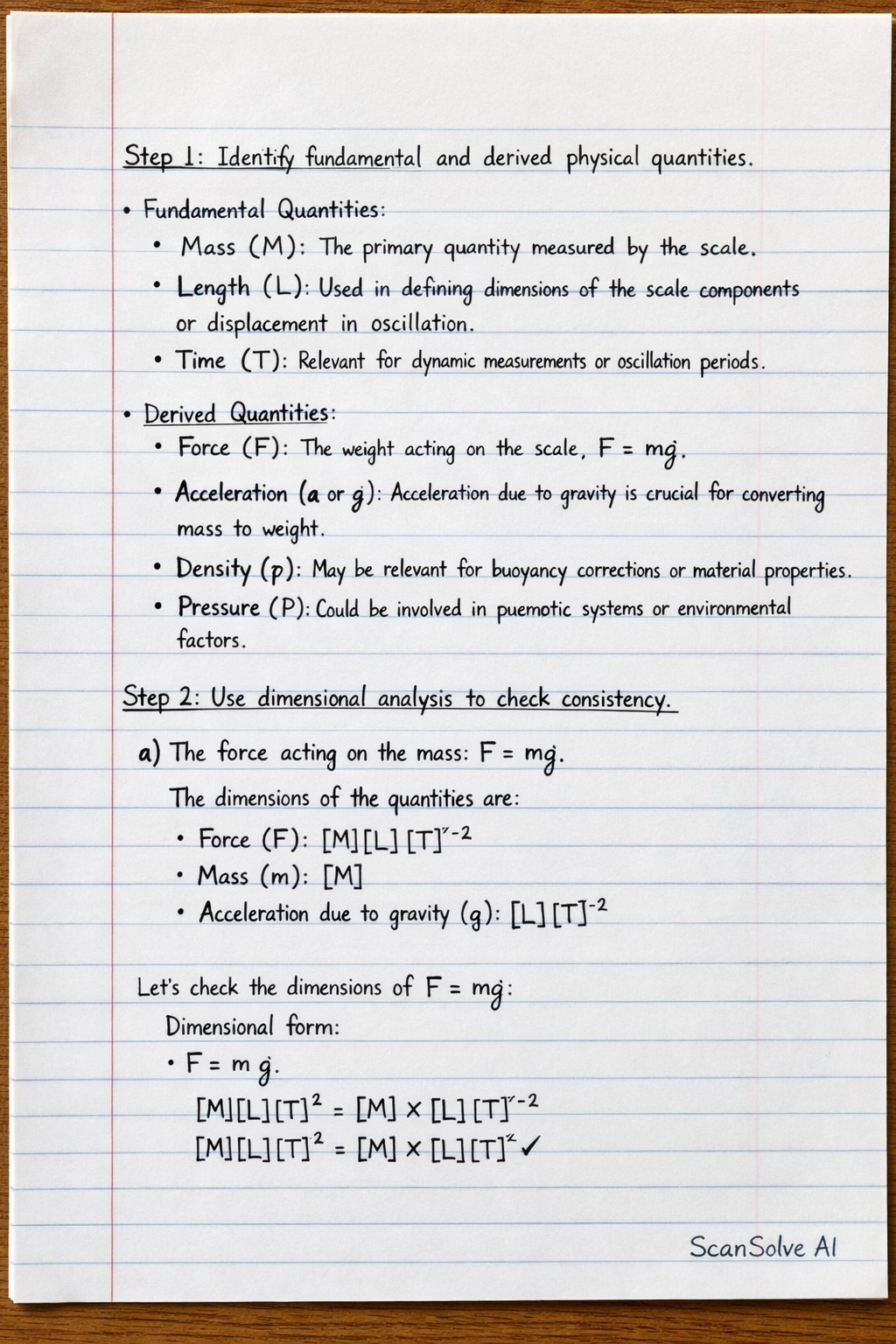
2 stepsStep 1: Identify fundamental and derived physical quantities.
- Fundamental Quantities:
- Mass (): The primary quantity measured by the scale.
- Length (): Used in defining dimensions of the scale components or displacement in oscillation.
- Time (): Relevant for dynamic measurements or oscillation periods.
- Derived Quantities:
- Force (): The weight acting on the scale, .
- Acceleration ( or ): Acceleration due to gravity is crucial for converting mass to weight.
- Density (): May be relevant for buoyancy corrections or material properties.
- Pressure (): Could be involved in pneumatic systems or environmental factors.
Step 2: Use dimensional analysis to check consistency.
Part a
The force acting on the mass:
The dimensions of the quantities are:
- Force ():
- Mass ():
- Acceleration due to gravity ():
Substitute the dimensions into the equation:
The dimensions on both sides of the equation are equal.
Therefore, the equation is dimensionally consistent.
Part b· 2 steps
The oscillation period of the scale's pan:
The dimensions of the quantities are:
- Period ():
- Length ():
- Acceleration due to gravity ():
- is a dimensionless constant.
Substitute the dimensions into the equation:
The dimensions on both sides of the equation are equal.
Therefore, the equation is dimensionally consistent.
Explain why dimensional analysis is crucial.
Dimensional analysis is crucial because it allows engineers to verify the fundamental correctness of physical equations without needing specific numerical values or conducting experiments. It helps identify errors early in the design phase, ensuring that the relationships between physical quantities are consistent. This prevents costly mistakes, saves time, and ensures the theoretical model aligns with physical reality before building a prototype.
Discuss potential design challenges due to errors in dimensions and how they can be corrected.
Potential Design Challenges:
- Incorrect Measurements: If the formulas used in the scale's software or hardware have dimensional errors, the scale will consistently provide inaccurate mass readings, leading to unreliable results.
- Structural Failure: Components designed with incorrect dimensions (e.g., wrong units for length or force) might not withstand expected loads, leading to mechanical failure or reduced lifespan.
- System Malfunction: Interfacing different parts of the scale (e.g., sensors, actuators) that were designed using inconsistent dimensional assumptions can lead to operational failures or poor performance.
- Calibration Issues: An improperly dimensioned system will be difficult or impossible to calibrate accurately, undermining the scale's precision.
Correction Methods:
- Rigorous Dimensional Analysis: Perform thorough dimensional analysis on all equations and formulas used in the design process, ensuring consistency across all calculations.
- Standardized Units: Adhere strictly to a single system of units (e.g., SI units) throughout the entire design and manufacturing process to avoid conversion errors.
- Cross-Verification: Have multiple engineers independently check calculations and dimensional consistency.
- Prototyping and Testing: Build and test prototypes to identify and correct any discrepancies between theoretical models and physical behavior.
- Quality Control: Implement strict quality control measures during manufacturing to ensure components are produced to the specified dimensions and tolerances.
Still stuck on this one?
Ask a follow-up, and the answer starts from this question.
More Physics Questions
Handwritten Step-by-Step Solution
Get this as a handwritten image on WhatsApp — like a tutor wrote it for you.
Try on WhatsApp