
We read your photo as:
Explain the phenomena observed in J.J. Thomson's cathode ray experiments: ray bending, shadow formation, paddle rotation, low pressure necessity, and evidence for particle nature.
ScanSolve AI Answer
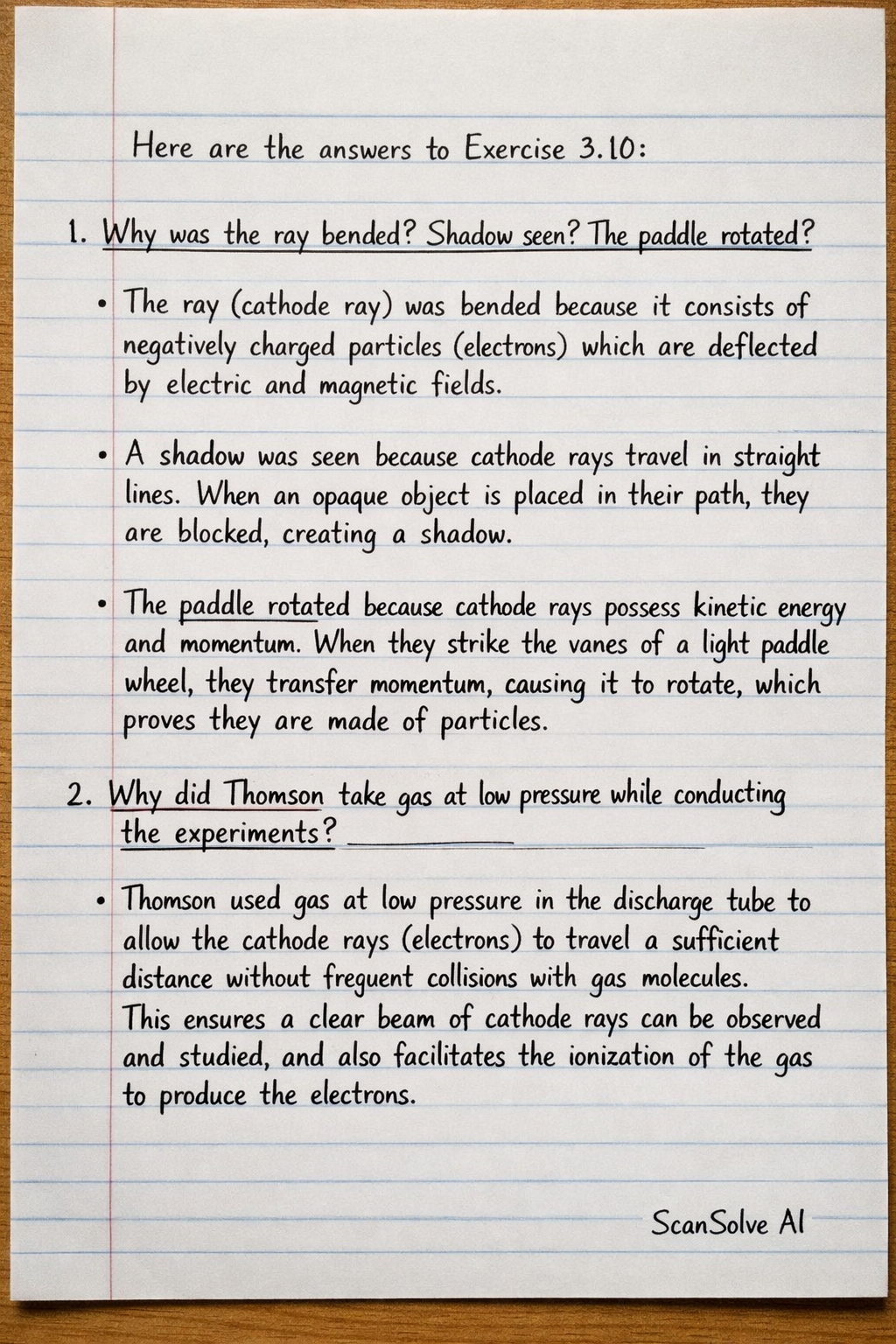
Here are the answers to .10:
-
Why was the ray bended? Shadow seen? The paddle rotated?
- The ray (cathode ray) was bended because it consists of negatively charged particles (electrons) which are deflected by electric and magnetic fields.
- A shadow was seen because cathode rays travel in straight lines. When an opaque object is placed in their path, they are blocked, creating a shadow.
- The paddle rotated because cathode rays possess kinetic energy and momentum. When they strike the vanes of a light paddle wheel, they transfer momentum, causing it to rotate, which proves they are made of particles.
-
Why did Thomson take gas at low pressure while conducting the experiments? Thomson used gas at low pressure in the discharge tube to allow the cathode rays (electrons) to travel a sufficient distance without frequent collisions with gas molecules. This ensures a clear beam of cathode rays can be observed and studied, and also facilitates the ionization of the gas to produce the electrons.
-
How did Thomson discover the particle nature of electrons? Thomson discovered the particle nature of electrons through his experiments with cathode rays. He observed that:
- Cathode rays were deflected by electric and magnetic fields, indicating they were charged particles.
- They caused a light paddle wheel to rotate, demonstrating they possessed mass and momentum.
- He measured their charge-to-mass ratio (), which was constant regardless of the gas used or the material of the electrodes, suggesting that these particles were fundamental constituents of all matter.
-
What happened to the cathode rays when they were allowed to pass through electric and magnetic fields? What does this prove? When cathode rays passed through electric and magnetic fields, they were deflected. In an electric field, they were deflected towards the positive plate. In a magnetic field, they were deflected in a direction consistent with negatively charged particles. This proves that cathode rays consist of negatively charged particles.
Still stuck on this one?
Ask a follow-up, and the answer starts from this question.
More Physics Questions
Handwritten Step-by-Step Solution
Get this as a handwritten image on WhatsApp — like a tutor wrote it for you.
Try on WhatsApp