
We read your photo as:
Explain the phenomenon of beats in sound waves and how the human ear perceives them, including an example.
Physics
ScanSolve AI Answer
Step-by-step solution
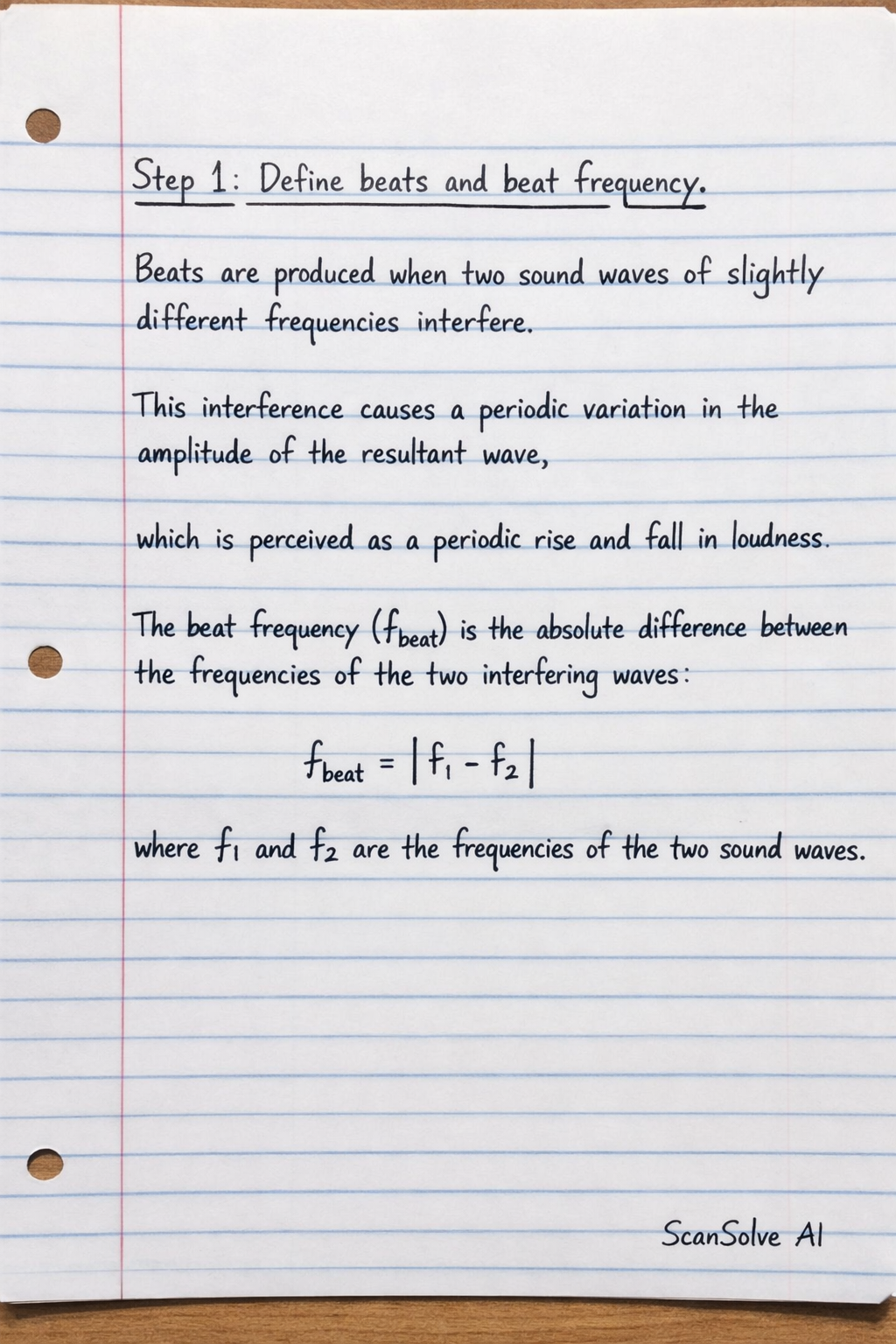
3 stepsDefine beats and beat frequency.
Beats are produced when two sound waves of slightly different frequencies interfere. This interference causes a periodic variation in the amplitude of the resultant wave, which is perceived as a periodic rise and fall in loudness. The beat frequency () is the absolute difference between the frequencies of the two interfering waves:
where and are the frequencies of the two sound waves.
Explain the perception of beats by the human ear.
The human ear can only distinguish individual beats when the rate of loudness variation is slow enough.
- When the frequency difference () is less than approximately 10 Hz, the loudness changes at a slow pace, allowing our ears to perceive a distinct, pulsing sound.
- When the frequency difference () is greater than 10 Hz, the loudness changes too rapidly. The individual pulses of loudness merge into a continuous sound, and our ears cannot distinguish them as separate beats. Instead, we perceive a rough or dissonant sound, or sometimes two distinct tones if the frequency difference is very large.
Exemplify the concept.
Consider two tuning forks:
- If one tuning fork has a frequency of and another has , the beat frequency is . Our ears can easily perceive these 2 beats per second as a clear pulsing sound.
- If one tuning fork has a frequency of and another has , the beat frequency is . In this case, the loudness changes 15 times per second, which is too fast for the human ear to distinguish as individual beats. We would hear a continuous, possibly rough, sound rather than distinct pulses.
The final answer is
Was this helpful?
Still stuck on this one?
Ask a follow-up, and the answer starts from this question.
Got a different question?Ask your own question
More Physics Questions
QHow the human ear worksQExplain how we see, the diffraction limit, and how sound travels through the ear.QIdentify and explain the functions of parts A, B, C, D, and E of the human ear.QDescribe the main parts of the human eye and ear and explain how they work. Discuss the differences…QThe diagram below shows parts of human ear. Give one function of part: (a) A (b) E (c) F. Write down…
Handwritten Step-by-Step Solution
Get this as a handwritten image on WhatsApp — like a tutor wrote it for you.
Try on WhatsApp