
Physics 1.A 400N box is being pushed across a level floor at a constant speed by a force P of 100N at an angle of 30⁰ to the horizontal. What is the coefficient of kinetic friction between the box and the floor? A. 0.19 B. 0.35 C. 0.12 D. 0.25 2.A 5 kg box rests on a horizontal surface with a coefficient of static friction of 0.4. What is the minimum horizontal force required to just start moving the box? A. 10 N B. 15 N C. 20 N D. 25 N 3.A 10 kg body is placed on an inclined plane of 30°. If the coefficient of friction is 0.2, what is the net force acting down the plane? (Take g = 10 m/s²) A. 30 N B. 40 N C. 50 N D. 60 N 4.Which of the following does not affect the frictional force between two surfaces? A. Normal force B. Nature of surfaces C. Area of contact D. Coefficient of friction 5.Which of these pairs can balance a 10 N force? A. 8 N and 6 N at 90° B. 5 N and 5 N at 60° C. 7 N and 7 N at 120° D. 3 N and 3 N at 180° Chemistry 6.A gas sample with an initial volume of 3.25dm-³ is the heated and allowed to expand to 9.75dm-³ at constant pressure. What is the ratio of the final absolute temperature to the initial absolute temperature A. 3:1 B. 5:2 C. 5:4 D. 8:3 7.Which of the following statements is correct A. At constant, temperature, the volume increases as the pressure decreases B. At constant pressure, the volume increases as the temperature increases C. The average kinetic energy of a gas is directly proportional to its temperature D. All of the above 8.Which of the following statements is NOT correct regarding Le Chatelier’s Principle? A. Increasing pressure favors fewer gas molecules B. Increasing temperature favors endothermic reactions C. Catalysts shift equilibrium positions D. Removing a product shifts equilibrium to the right 9.What mass of calcium carbonate is required to produce 44 g of CO₂? A. 40 g B. 50 g C. 100 g D. 110 g (Ca=40, C=12, O=16) 10.For the endothermic reaction: C(s) + CO₂(g) ⇌ 2CO(g) What happens when temperature increases? A. Yield of CO decreases B. Yield of CO increases C. Reaction shifts left D. No effect
Physics
ScanSolve AI Answer
Here are the solutions to your physics and chemistry questions:
Physics
1. A 400N box is being pushed across a level floor at a constant speed by a force P of 100N at an angle of 30⁰ to the horizontal. What is the coefficient of kinetic friction between the box and the floor?
Step 1: Resolve the applied force P into horizontal and vertical components.
The applied force at an angle of below the horizontal (since it's "pushed at an angle").
Horizontal component: $P_x = P \cos(30^\circ) = 100 N \times \cos(
Was this helpful?
Still stuck on this one?
Ask a follow-up, and the answer starts from this question.
Got a different question?Ask your own question
More Physics Questions
QJune 2026 50 O-Level Chemistry MCQs The number of protons in an atom is called its A. Mass number B…QHere’s CHM 101 – General Chemistry I, ABSU Uturu, First Semester 2023/2024 — all questions written…QWhich reaction will produce more product when pressure is increased? A) 2HgO(s) -> 2Hg(l) + O2(g) B)…QThe volume of the container is now decreased to 2,50 dm 3, while the temperature is kept at a…Q1 Explain why the reaction is exothermic. 15.2 Calculate the average rate of reaction. 15.3…
Browse by topic:Mechanics
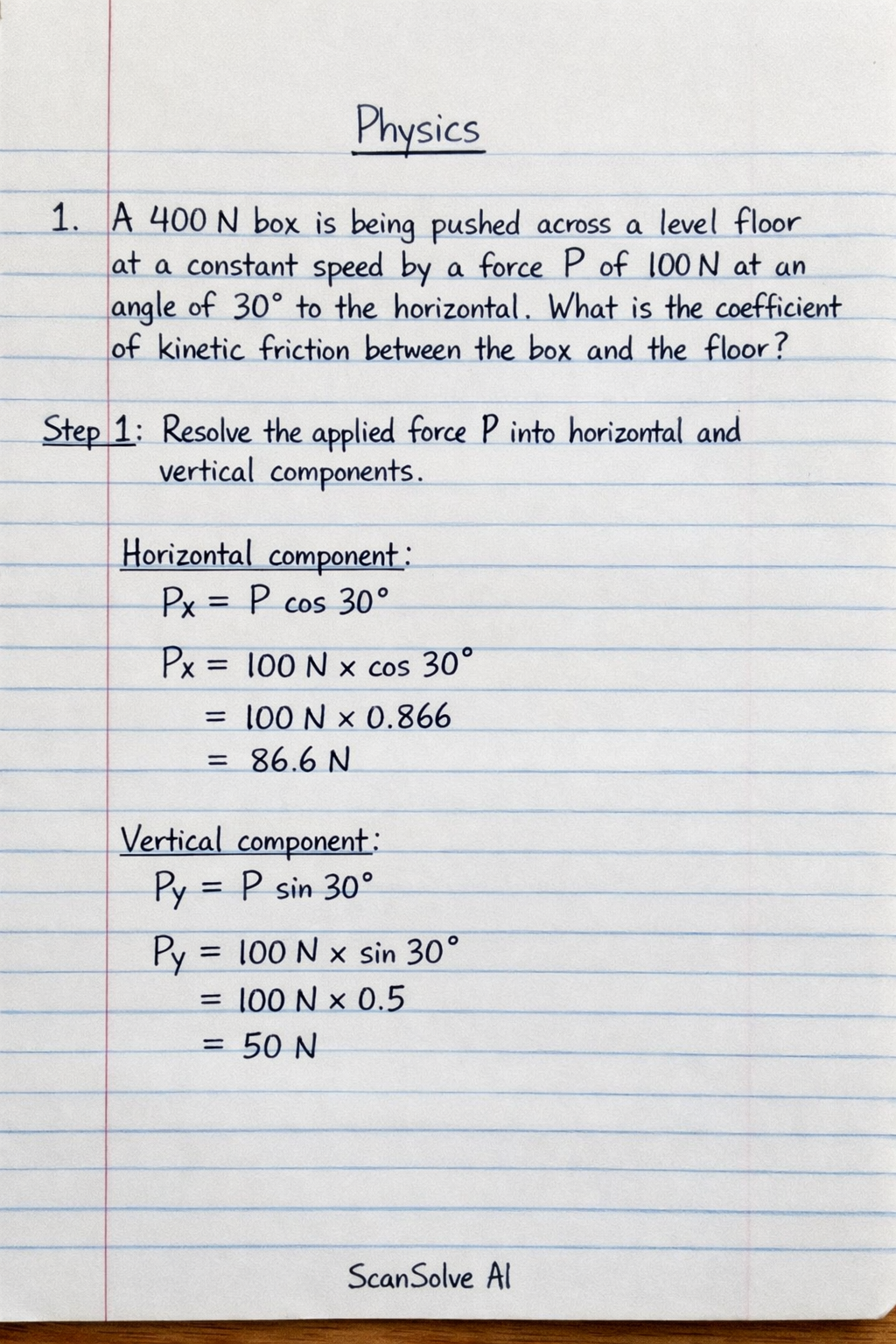
Handwritten Step-by-Step Solution
Get this as a handwritten image on WhatsApp — like a tutor wrote it for you.
Try on WhatsApp