
PHYSICS TRIAL QUESTIONS✍️ A sphere held at the surface of'a column of water is released to fall through the water. List the forces that act on the sphere. A cube of wood of side 0.3 cm floats in water. Calculate the distance from the top of the cube to the water surface. [Density of wood -700 kg m-3, Density of water 1000 kg m-3) b. State two applications of the induction coil. A capacitor of capacitance 1.20 uf is connected in series with a non-inductive resistance of 300Q across an ac. supply of 20 Vr.m.s, 1000 Hz: draw a circuit diagram for the arrangement; An electron of charpe 1 6% 10exponent -19 C enters a magnetic field of strength 0.8 Wh m-2 and makes an orbit of radius, r, in the field. If the electron moves with a speed of 2.9×10exponent 7 mx-1, calculate the: radius, r, of the orbit; (ii) centripetal force experienced by the charge. [Me = 9.11x 10exponent -31 kg) Define the term angular magnification as used in relation to a telescope in normal adjustment. An astronomical telescope in normal adjustment consists of two thin lenses which are 82.5 cm apart. If the angular magnification of the instrument is 10; name the type of thin lens used; calculate the focal lengths of each lens. (ii) State: one difference between circular and rotational motion; two conditions for which the acceleration of a body can be zero. SOLUTIONS LOADING….✍️
ScanSolve AI Answer
Step-by-step solution
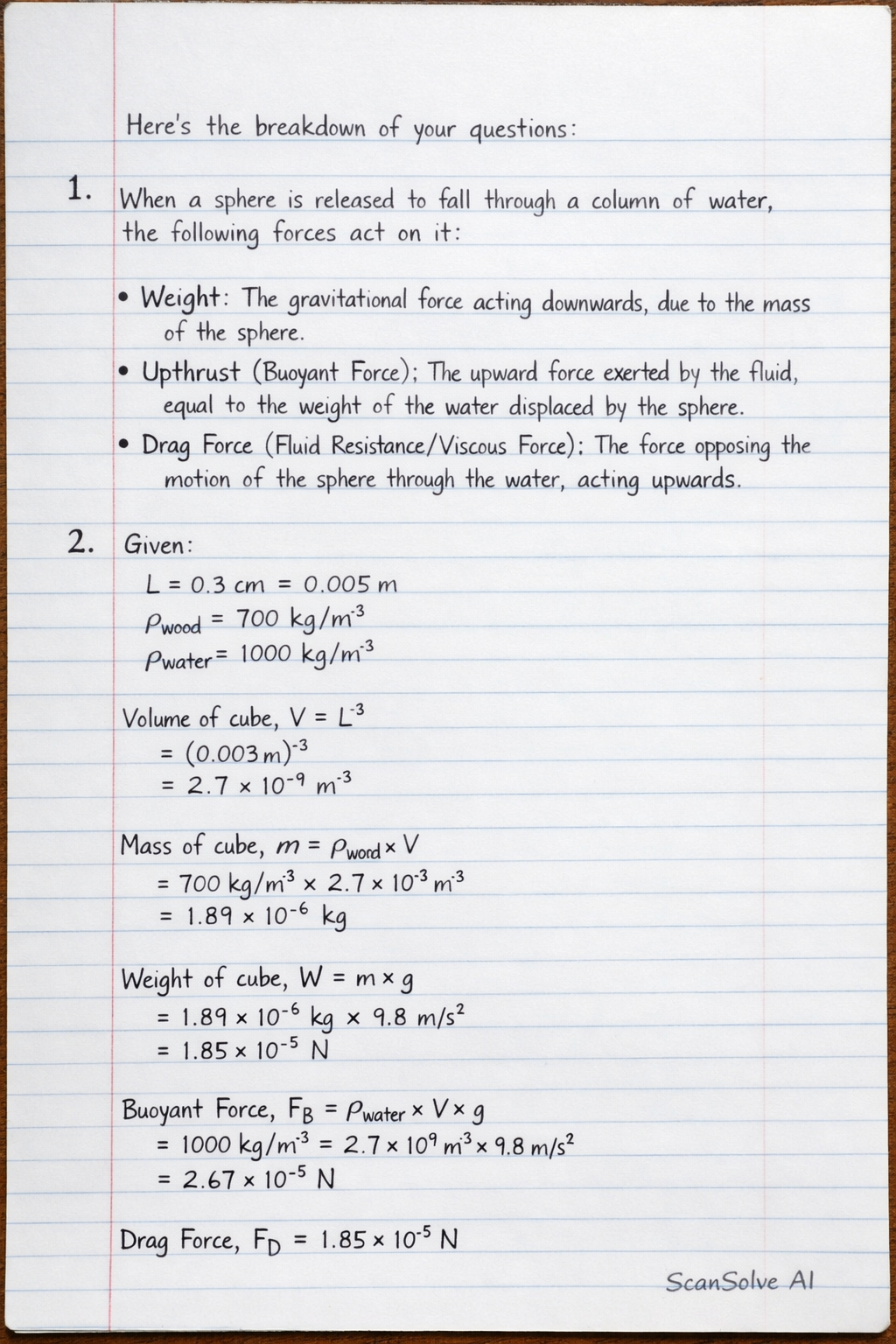
8 stepsHere's the breakdown of your questions:
1.
When a sphere is released to fall through a column of water, the following forces act on it:
- Weight: The gravitational force acting downwards, due to the mass of the sphere.
- Upthrust (Buoyant Force): The upward force exerted by the fluid, equal to the weight of the water displaced by the sphere.
- Drag Force (Fluid Resistance/Viscous Force): The force opposing the motion of the sphere through the water, acting upwards.
2.
Given:
Side of cube,
Density of wood,
Density of water,
Determine the submerged height of the cube.
For a floating object, the weight of the object equals the upthrust.
Weight of cube =
Upthrust =
Equating the forces:Substitute the values:
Calculate the distance from the top of the cube to the water surface.
This is the portion of the cube that is above the water.
Distance above water = Total height of cube - Submerged heightConverting to centimeters:
The distance from the top of the cube to the water surface is .
2. (b)
Two applications of the induction coil are:- Ignition systems in internal combustion engines (e.g., spark plugs in cars).
- X-ray tubes and other high-voltage discharge tubes.
3. (i)
Given:
Capacitance,
Resistance,
RMS voltage,
Frequency,Circuit diagram for a capacitor and a non-inductive resistance connected in series across an AC supply:
\begin{tikzpicture}
    \draw (0,0) to[R=$R$] (2,0) to[C=$C$] (4,0);
    \draw (4,0) -- (4.5,0);
    \draw (0,0) -- (-0.5,0);
    \draw (-0.5,0) to[sV=$V_{rms}$] (-0.5,2) -- (4.5,2) -- (4.5,0);
\end{tikzpicture}
(Note: The diagram above is a textual representation. In a proper drawing, the AC source would be a circle with a sine wave symbol inside, connected to the series R-C components.)
4.
Given:
Charge of electron,
Magnetic field strength,
Speed of electron,
Mass of electron,4. (i) Radius, r, of the orbit
Equate the magnetic force to the centripetal force.
When a charged particle moves perpendicular to a uniform magnetic field, the magnetic force provides the centripetal force for circular motion.
Solve for the radius .
Substitute the given values:
The radius of the orbit is .
4. (ii) Centripetal force experienced by the charge
Use the formula for magnetic force (which is equal to centripetal force).
Substitute the given values:
The centripetal force experienced by the charge is .
5.
Angular magnification (or magnifying power) as used in relation to a telescope in normal adjustment is defined as the ratio of the angle subtended by the final image at the eye to the angle subtended by the object at the unaided eye. For a telescope in normal adjustment, the final image is formed at infinity. It can also be expressed as the ratio of the focal length of the objective lens to the focal length of the eyepiece.5. (i)
Given:
Distance between lenses,
Angular magnification,5. (i) (a) Name the type of thin lens used
The type of thin lens used in an astronomical telescope is a converging lens (or convex lens) for both the objective and the eyepiece.5. (i) (b) Calculate the focal lengths of each lens
Set up equations based on the given information.
For an astronomical telescope in normal adjustment:
- Angular magnification:
- Distance between lenses: Where is the focal length of the objective lens and is the focal length of the eyepiece.
Substitute the given values into the equations.
From (1):
From (2):Solve the system of equations.
Substitute into the second equation:
Now find :
The focal length of the objective lens is and the focal length of the eyepiece is .
5. (ii)
5. (ii) (i) One difference between circular and rotational motion- Circular motion describes the movement of a point mass or a particle along a circular path, where the object's center of mass traces a circle. Rotational motion describes the movement of a rigid body about an internal axis, where the entire body spins.
5. (ii) (ii) Two conditions for which the acceleration of a body can be zero
The acceleration of a body is zero when:- The body is at rest (its velocity is zero and constant).
- The body is moving with a constant velocity (constant speed in a straight line).
Still stuck on this one?
Ask a follow-up, and the answer starts from this question.
More Physics Questions
Handwritten Step-by-Step Solution
Get this as a handwritten image on WhatsApp — like a tutor wrote it for you.
Try on WhatsApp