ScanSolve logoScanSolve
Toggle sidebar
  • Homework
  • Tutor
  • Humanizer
  • AI Detector
  • Questions
  • Blog
  • History
  • Mobile App

  • Homework
  • Tutor
  • Humanizer
  • AI Detector

  • Questions
  • Math homework helpMath
    Physics homework helpPhysics
    Chemistry homework helpChemistry
    Biology homework helpBiology
    Computer Science homework helpComputer Science
    History homework helpHistory
    More homework helpMore
  • Blog
  • History

  • Mobile App
ScanSolvePLUS
  • Unlimited answers
  • ScanSolve AI Pro
Start Free Trial →
Try on WhatsApp
Home > Physics Homework Help > Solution

Write the principle of conservation of linear momentum.

Asked on March 28, 2026|Physics

This physics problem tests your understanding of fundamental physical laws and their applications. The step-by-step solution below breaks down the problem using relevant equations and physical reasoning.

ScanSolve AI AnswerAnswered on March 28, 2026
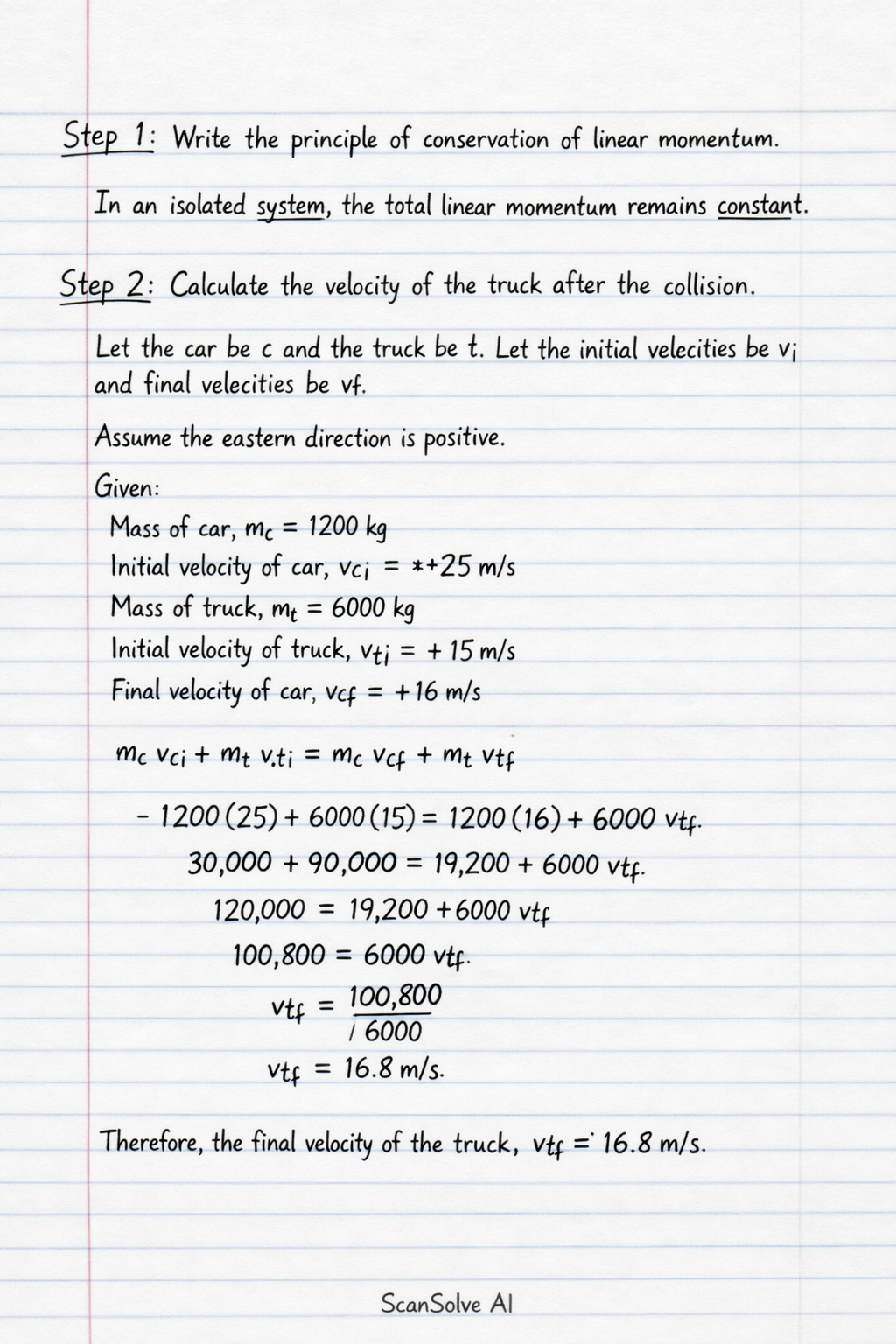
Step 1: Write the principle of conservation of linear momentum. In an isolated system, the total linear momentum remains constant. Step 2: Calculate the velocity of the truck after the collision. Let the car be $c$ and the truck be $t$. Let the initial velocities be $v_i$ and final velocities be $v_f$. Assume the eastern direction is positive. Given: Mass of car, $m_c = 1200$ kg Initial velocity of car, $v_{ci} = +25$ m/s Mass of truck, $m_t = 6000$ kg Initial velocity of truck, $v_{ti} = +15$ m/s Final velocity of car, $v_{cf} = +16$ m/s According to the principle of conservation of linear momentum: $$m_c v_{ci} + m_t v_{ti} = m_c v_{cf} + m_t v_{tf}$$ Substitute the known values: $$(1200 \text{ kg})(25 \text{ m/s}) + (6000 \text{ kg})(15 \text{ m/s}) = (1200 \text{ kg})(16 \text{ m/s}) + (6000 \text{ kg}) v_{tf}$$ $$30000 \text{ kg}\cdot\text{m/s} + 90000 \text{ kg}\cdot\text{m/s} = 19200 \text{ kg}\cdot\text{m/s} + (6000 \text{ kg}) v_{tf}$$ $$120000 \text{ kg}\cdot\text{m/s} = 19200 \text{ kg}\cdot\text{m/s} + (6000 \text{ kg}) v_{tf}$$ $$120000 - 19200 = 6000 v_{tf}$$ $$100800 = 6000 v_{tf}$$ $$v_{tf} = \frac{100800}{6000}$$ $$v_{tf} = 16.8 \text{ m/s}$$ The velocity is positive, indicating it is in the eastern direction. The velocity of the truck after the collision is $\boxed{\text{16.8 m/s to the east}}$. Step 3: Calculate the mechanical energy lost during the car-truck collision. First, calculate the total initial kinetic energy ($KE_i$): $$KE_i = \frac{1}{2} m_c v_{ci}^2 + \frac{1}{2} m_t v_{ti}^2$$ $$KE_i = \frac{1}{2} (1200 \text{ kg}) (25 \text{ m/s})^2 + \frac{1}{2} (6000 \text{ kg}) (15 \text{ m/s})^2$$ $$KE_i = \frac{1}{2} (1200)(625) + \frac{1}{2} (6000)(225)$$ $$KE_i = 375000 \text{ J} + 675000 \text{ J}$$ $$KE_i = 1050000 \text{ J}$$ Next, calculate the total final kinetic energy ($KE_f$): $$KE_f = \frac{1}{2} m_c v_{cf}^2 + \frac{1}{2} m_t v_{tf}^2$$ Using $v_{tf} = 16.8$ m/s from Step 2: $$KE_f = \frac{1}{2} (1200 \text{ kg}) (16 \text{ m/s})^2 + \frac{1}{2} (6000 \text{ kg}) (16.8 \text{ m/s})^2$$ $$KE_f = \frac{1}{2} (1200)(256) + \frac{1}{2} (6000)(282.24)$$ $$KE_f = 153600 \text{ J} + 846720 \text{ J}$$ $$KE_f = 1000320 \text{ J}$$ Finally, calculate the mechanical energy lost: $$\text{Energy lost} = KE_i - KE_f$$ $$\text{Energy lost} = 1050000 \text{ J} - 1000320 \text{ J}$$ $$\text{Energy lost} = 49680 \text{ J}$$ The mechanical energy lost during the collision is $\boxed{\text{49680 J}}$. Step 4: Explain why mechanical energy is lost. Mechanical energy is lost in an inelastic collision because it is converted into other forms of energy, such as heat, sound, and potential energy of deformation (due to the crumpling of the car and truck).

Related Physics Questions

  • Instruction says the momentum versus time graph of object A ,originally moving horizontally EAST, is shown below
  • What is amplitude
  • What is gravity?
  • Calculate the speed of the 1.5 kg trolley at point P using the principle of conservation of mechanical energy.
  • Identify the circuit configuration when K is closed.
  • If a device that draws 8A is used in a circuit with a 5A fuse, the current will exceed the fuse's rating. The fuse wire...
See all Physics questions

This step-by-step solution was generated by ScanSolve AI. Need help with more physics problems? Browse Physics solutions or ask your own question.

Home›Physics Homework Help›Write the principle of conservation of linear momentum.
Q

Write the principle of conservation of linear momentum.

March 28, 2026|Physics
Write the principle of conservation of linear momentum.

Write the principle of conservation of linear momentum.

ScanSolve AI

ScanSolve AI Answer

Answered on March 28, 2026

Step 1: Write the principle of conservation of linear momentum. In an isolated system, the total linear momentum remains constant.

Step 2: Calculate the velocity of the truck after the collision. Let the car be ccc and the truck be ttt. Let the initial velocities be viv_ivi​ and final velocities be vfv_fvf​. Assume the eastern direction is positive. Given: Mass of car, mc=1200m_c = 1200mc​=1200 kg Initial velocity of car, vci=+25v_{ci} = +25vci​=+25 m/s Mass of truck, mt=6000m_t = 6000mt​=6000 kg Initial velocity of truck, vti=+15v_{ti} = +15vti​=+15 m/s Final velocity of car, vcf=+16v_{cf} = +16vcf​=+16 m/s

According to the principle of conservation of linear momentum: mcvci+mtvti=mcvcf+mtvtfm_c v_{ci} + m_t v_{ti} = m_c v_{cf} + m_t v_{tf}mc​vci​+mt​vti​=mc​vcf​+mt​vtf​ Substitute the known values: (1200kg)(25m/s)+(6000kg)(15m/s)=(1200kg)(16m/s)+(6000kg)vtf(1200 kg)(25 m/s) + (6000 kg)(15 m/s) = (1200 kg)(16 m/s) + (6000 kg) v_{tf}(1200kg)(25m/s)+(6000kg)(15m/s)=(1200kg)(16m/s)+(6000kg)vtf​ 30000kg\cdotm/s+90000kg\cdotm/s=19200kg\cdotm/s+(6000kg)vtf30000 kg\cdotm/s + 90000 kg\cdotm/s = 19200 kg\cdotm/s + (6000 kg) v_{tf}30000kg\cdotm/s+90000kg\cdotm/s=19200kg\cdotm/s+(6000kg)vtf​ 120000kg\cdotm/s=19200kg\cdotm/s+(6000kg)vtf120000 kg\cdotm/s = 19200 kg\cdotm/s + (6000 kg) v_{tf}120000kg\cdotm/s=19200kg\cdotm/s+(6000kg)vtf​ 120000−19200=6000vtf120000 - 19200 = 6000 v_{tf}120000−19200=6000vtf​ 100800=6000vtf100800 = 6000 v_{tf}100800=6000vtf​ vtf=1008006000v_{tf} = \frac{100800}{6000}vtf​=6000100800​ vtf=16.8 m/sv_{tf} = 16.8 \text{ m/s}vtf​=16.8 m/s The velocity is positive, indicating it is in the eastern direction. The velocity of the truck after the collision is 16.8m/stotheeast\boxed{16.8 m/s to the east}16.8m/stotheeast​.

Step 3: Calculate the mechanical energy lost during the car-truck collision. First, calculate the total initial kinetic energy (KEiKE_iKEi​): KEi=12mcvci2+12mtvti2KE_i = \frac{1}{2} m_c v_{ci}^2 + \frac{1}{2} m_t v_{ti}^2KEi​=21​mc​vci2​+21​mt​vti2​ KEi=12(1200kg)(25m/s)2+12(6000kg)(15m/s)2KE_i = \frac{1}{2} (1200 kg) (25 m/s)^2 + \frac{1}{2} (6000 kg) (15 m/s)^2KEi​=21​(1200kg)(25m/s)2+21​(6000kg)(15m/s)2 KEi=12(1200)(625)+12(6000)(225)KE_i = \frac{1}{2} (1200)(625) + \frac{1}{2} (6000)(225)KEi​=21​(1200)(625)+21​(6000)(225) KEi=375000J+675000 JKE_i = 375000 J + 675000 \text{ J}KEi​=375000J+675000 J KEi=1050000 JKE_i = 1050000 \text{ J}KEi​=1050000 J Next, calculate the total final kinetic energy (KEfKE_fKEf​): KEf=12mcvcf2+12mtvtf2KE_f = \frac{1}{2} m_c v_{cf}^2 + \frac{1}{2} m_t v_{tf}^2KEf​=21​mc​vcf2​+21​mt​vtf2​ Using vtf=16.8v_{tf} = 16.8vtf​=16.8 m/s from Step 2: KEf=12(1200kg)(16m/s)2+12(6000kg)(16.8m/s)2KE_f = \frac{1}{2} (1200 kg) (16 m/s)^2 + \frac{1}{2} (6000 kg) (16.8 m/s)^2KEf​=21​(1200kg)(16m/s)2+21​(6000kg)(16.8m/s)2 KEf=12(1200)(256)+12(6000)(282.24)KE_f = \frac{1}{2} (1200)(256) + \frac{1}{2} (6000)(282.24)KEf​=21​(1200)(256)+21​(6000)(282.24) KEf=153600J+846720 JKE_f = 153600 J + 846720 \text{ J}KEf​=153600J+846720 J KEf=1000320 JKE_f = 1000320 \text{ J}KEf​=1000320 J Finally, calculate the mechanical energy lost: Energy lost=KEi−KEf\text{Energy lost} = KE_i - KE_fEnergy lost=KEi​−KEf​ Energy lost=1050000J−1000320 J\text{Energy lost} = 1050000 J - 1000320 \text{ J}Energy lost=1050000J−1000320 J Energy lost=49680 J\text{Energy lost} = 49680 \text{ J}Energy lost=49680 J The mechanical energy lost during the collision is 49680J\boxed{49680 J}49680J​.

Step 4: Explain why mechanical energy is lost. Mechanical energy is lost in an inelastic collision because it is converted into other forms of energy, such as heat, sound, and potential energy of deformation (due to the crumpling of the car and truck).

Need help with your own homework?

Get instant step-by-step solutions to any question. Free to start.

Ask Your Question
Handwritten step-by-step solution

Handwritten Step-by-Step Solution

Get this solution as a handwritten image on WhatsApp — just like a tutor wrote it for you.

Try on WhatsApp

More Physics Questions

Instruction says the momentum versus time graph of object A ,originally moving horizontally EAST, is…What is amplitudeWhat is gravity?Calculate the speed of the 1.5 kg trolley at point P using the principle of conservation of mechanic…Identify the circuit configuration when K is closed.If a device that draws 8A is used in a circuit with a 5A fuse, the current will exceed the fuse's ra…
See all Physicsquestions →
Physics: Write the principle of conservation of linear momentum. — Step-by-Step Solution | ScanSolve