
We read your photo as:
Describe the purpose and functions of a choke coil in AC circuits. Distinguish between intrinsic and extrinsic semiconductors.
Physics
ScanSolve AI Answer
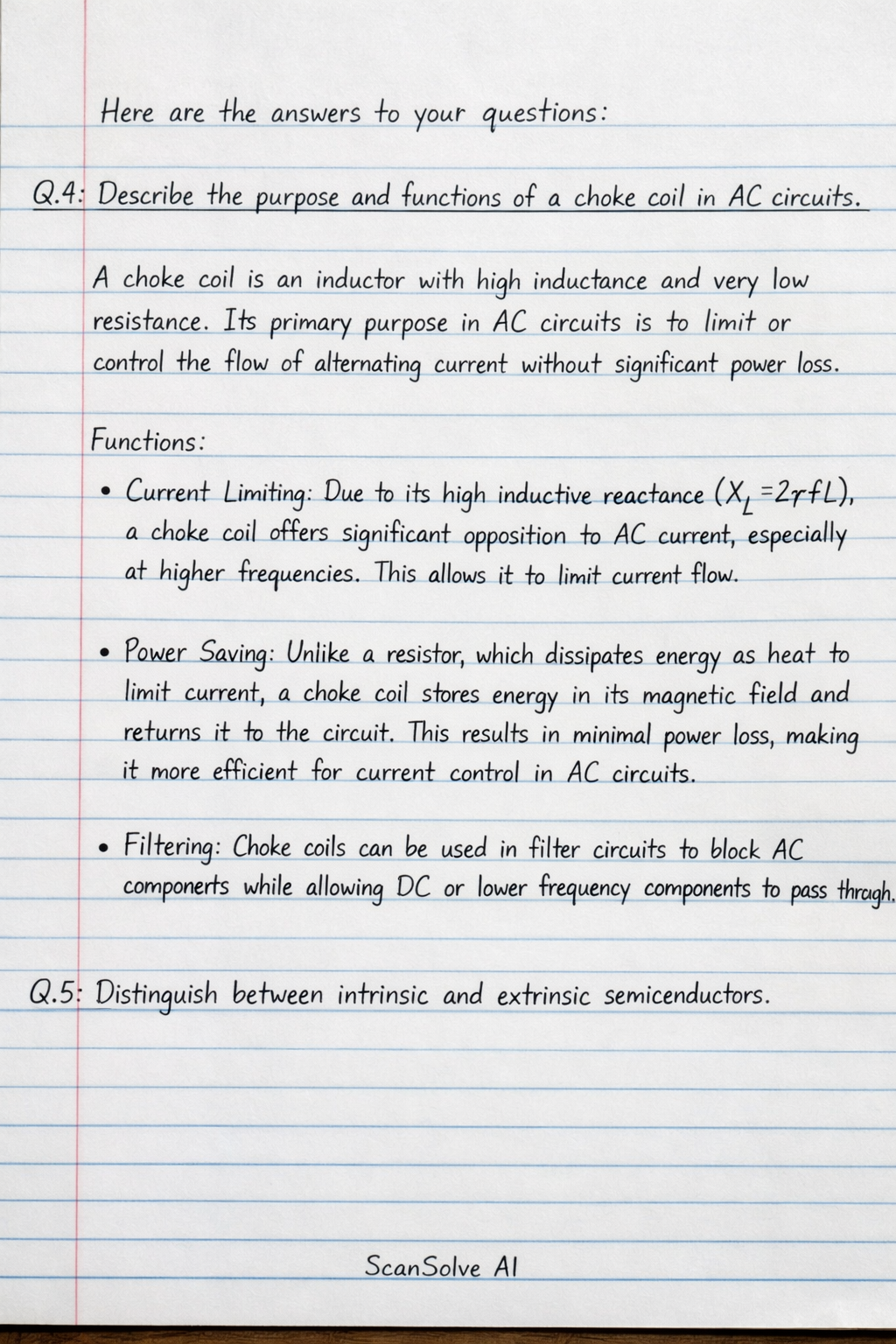
Here are the answers to your questions:
Q.4: Describe the purpose and functions of a choke coil in AC circuits.
A choke coil is an inductor with high inductance and very low resistance. Its primary purpose in AC circuits is to limit or control the flow of alternating current without significant power loss.
Functions:
- Current Limiting: Due to its high inductive reactance (), a choke coil offers significant opposition to AC current, especially at higher frequencies. This allows it to limit current flow.
- Power Saving: Unlike a resistor, which dissipates energy as heat to limit current, a choke coil stores energy in its magnetic field and returns it to the circuit. This results in minimal power loss, making it more efficient for current control in AC circuits.
- Filtering: Choke coils can be used in filter circuits to block AC components while allowing DC or lower frequency components to pass through.
Q.5: Distinguish between intrinsic and extrinsic semiconductors.
-
Intrinsic Semiconductors:
- These are pure semiconductors (e.g., pure silicon or germanium) with no added impurities.
- Their electrical conductivity is inherently low at room temperature and increases with temperature as more electron-hole pairs are generated.
- The number of free electrons is equal to the number of holes ().
-
Extrinsic Semiconductors:
- These are doped semiconductors, meaning small amounts of specific impurities (dopants) are added to an intrinsic semiconductor.
- Doping significantly increases their conductivity and allows for control over whether electrons or holes are the majority charge carriers.
- There are two types:
- N-type: Doped with pentavalent impurities (e.g., phosphorus, arsenic), which donate free electrons, making electrons the majority carriers ().
- P-type: Doped with trivalent impurities (e.g., boron, gallium), which create holes, making holes the majority carriers ().
Was this helpful?
Still stuck on this one?
Ask a follow-up, and the answer starts from this question.
Got a different question?Ask your own question
More Physics Questions
QDistinguish between intrinsic and extrinsic semiconductors, and explain the biasing of a diode and…QDistinguish between intrinsic and extrinsic semiconductors, and solve a problem involving current…QDefine intrinsic and extrinsic semiconductors. Explain the concept of biasing a diode.QIntrinsic Semiconductors: These are pure semiconductors, meaning they consist only of a single…QWhat are the definitions and differences between semiconductors, intrinsic/extrinsic semiconductors…
Browse by topic:Electrical Engineering
Handwritten Step-by-Step Solution
Get this as a handwritten image on WhatsApp — like a tutor wrote it for you.
Try on WhatsApp