ScanSolve logoScanSolve
Toggle sidebar
  • Homework
  • Tutor
  • Humanizer
  • AI Detector
  • Questions
  • Blog
  • History
  • Mobile App

  • Homework
  • Tutor
  • Humanizer
  • AI Detector

  • Questions
  • Math homework helpMath
    Physics homework helpPhysics
    Chemistry homework helpChemistry
    Biology homework helpBiology
    Computer Science homework helpComputer Science
    History homework helpHistory
    More homework helpMore
  • Blog
  • History

  • Mobile App
ScanSolvePLUS
  • Unlimited answers
  • ScanSolve AI Pro
Start Free Trial →
Try on WhatsApp
Home > Physics Homework Help > Solution

What will happen if the student drops the stone into the water instead of lowering it gently?

Asked on March 26, 2026|Physics

This physics problem tests your understanding of fundamental physical laws and their applications. The step-by-step solution below breaks down the problem using relevant equations and physical reasoning.

ScanSolve AI AnswerAnswered on March 26, 2026
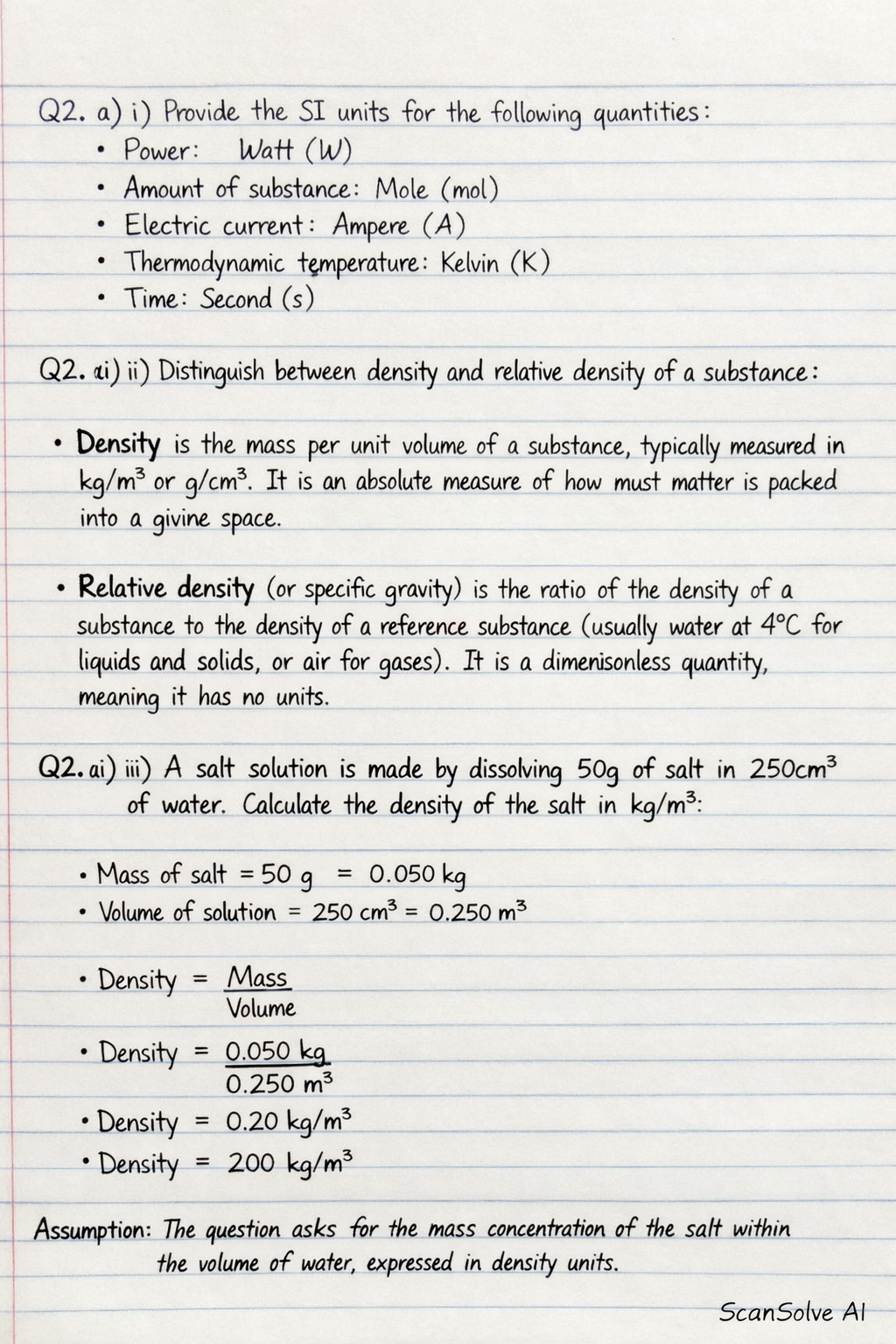
Here are the answers to the questions: Q2. a) i) Provide the SI units for the following quantities: Power: Watt (W) Amount of substance: Mole (mol) Electric current: Ampere (A) Thermodynamic temperature: Kelvin (K) Time: Second (s) Q2. a) ii) Distinguish between density and relative density of a substance. Density is the mass per unit volume of a substance, typically measured in $kg/m^3$ or $g/cm^3$. It is an absolute measure of how much matter is packed into a given space. Relative density (or specific gravity) is the ratio of the density of a substance to the density of a reference substance (usually water at $4^\circ C$ for liquids and solids, or air for gases). It is a dimensionless quantity, meaning it has no units. Q2. a) iii) A salt solution is made by dissolving 50g of salt in 250cm³ of water. Calculate the density of the salt in kg/m³. Assumption: The question asks for the mass concentration of the salt within the volume of water, expressed in density units. Step 1: Identify the given values. Mass of salt ($m$) = $50\,g$ Volume of water ($V$) = $250\,cm^3$ Step 2: Calculate the mass concentration in $g/cm^3$. $$ \text{Concentration} = \frac{m}{V} $$ $$ \text{Concentration} = \frac{50\,g}{250\,cm^3} $$ $$ \text{Concentration} = 0.2\,g/cm^3 $$ Step 3: Convert the concentration from $g/cm^3$ to $kg/m^3$. We know that $1\,kg = 1000\,g$ and $1\,m = 100\,cm$, so $1\,m^3 = (100\,cm)^3 = 1,000,000\,cm^3$. $$ 0.2\,\frac{g}{cm^3} \times \frac{1\,kg}{1000\,g} \times \frac{1,000,000\,cm^3}{1\,m^3} $$ $$ 0.2 \times \frac{1}{1000} \times 1,000,000\,\frac{kg}{m^3} $$ $$ 0.2 \times 1000\,\frac{kg}{m^3} $$ $$ \text{Concentration} = 200\,\frac{kg}{m^3} $$ The density of the salt (mass concentration) is $\boxed{\text{200 kg/m}^3}$. Q2. a) iv) Give three (3) examples of vector quantities. 1. Displacement 2. Velocity 3. Force Q2. b) i) What are isotopes? Isotopes are atoms of the same element that have the same number of protons (atomic number) but different numbers of neutrons, resulting in different mass numbers. They exhibit similar chemical properties but may have different physical properties. Q2. b) ii) Name the three (3) main particles of an atom with their respective charges. 1. Proton: Positive charge ($+1$) 2. Neutron: No charge (neutral, $0$) 3. Electron: Negative charge ($-1$) Q2. b) iii) Name the type of bond present in each of the following: The substances for this question are not visible in the provided image. Therefore, this question cannot be answered.

Related Physics Questions

  • Calculate the speed of the 1.5 kg trolley at point P using the principle of conservation of mechanical energy.
  • Identify the circuit configuration when K is closed.
  • If a device that draws 8A is used in a circuit with a 5A fuse, the current will exceed the fuse's rating. The fuse wire...
  • 151. All components of the electromagnetic spectrum in vacuum have the same
  • Define variables for their current ages.
  • What is 1+1?
See all Physics questions

This step-by-step solution was generated by ScanSolve AI. Need help with more physics problems? Browse Physics solutions or ask your own question.

Home›Physics Homework Help›What will happen if the student drops the stone into the wat…
Q

What will happen if the student drops the stone into the water instead of lowering it gently?

March 26, 2026|Physics
What will happen if the student drops the stone into the water instead of lowering it gently?

What will happen if the student drops the stone into the water instead of lowering it gently?

ScanSolve AI

ScanSolve AI Answer

Answered on March 26, 2026

Here are the answers to the questions:

Q2. a) i) Provide the SI units for the following quantities:

  • Power: Watt (W)
  • Amount of substance: Mole (mol)
  • Electric current: Ampere (A)
  • Thermodynamic temperature: Kelvin (K)
  • Time: Second (s)

Q2. a) ii) Distinguish between density and relative density of a substance.

  • Density is the mass per unit volume of a substance, typically measured in kg/m3kg/m^3kg/m3 or g/cm3g/cm^3g/cm3. It is an absolute measure of how much matter is packed into a given space.
  • Relative density (or specific gravity) is the ratio of the density of a substance to the density of a reference substance (usually water at 4∘C4^\circ C4∘C for liquids and solids, or air for gases). It is a dimensionless quantity, meaning it has no units.

Q2. a) iii) A salt solution is made by dissolving 50g of salt in 250cm³ of water. Calculate the density of the salt in kg/m³.

Assumption: The question asks for the mass concentration of the salt within the volume of water, expressed in density units.

Step 1: Identify the given values. Mass of salt (mmm) = 50 g50\,g50g Volume of water (VVV) = 250 cm3250\,cm^3250cm3

Step 2: Calculate the mass concentration in g/cm3g/cm^3g/cm3. Concentration=mVConcentration = \frac{m}{V}Concentration=Vm​ Concentration=50 g250 cm3Concentration = \frac{50\,g}{250\,cm^3}Concentration=250cm350g​ Concentration=0.2 g/cm3Concentration = 0.2\,g/cm^3Concentration=0.2g/cm3

Step 3: Convert the concentration from g/cm3g/cm^3g/cm3 to kg/m3kg/m^3kg/m3. We know that 1 kg=1000 g1\,kg = 1000\,g1kg=1000g and 1 m=100 cm1\,m = 100\,cm1m=100cm, so 1 m3=(100 cm)3=1,000,000 cm31\,m^3 = (100\,cm)^3 = 1,000,000\,cm^31m3=(100cm)3=1,000,000cm3. 0.2 gcm3×1 kg1000 g×1,000,000 cm31 m30.2\,\frac{g}{cm^3} \times \frac{1\,kg}{1000\,g} \times \frac{1,000,000\,cm^3}{1\,m^3}0.2cm3g​×1000g1kg​×1m31,000,000cm3​ 0.2×11000×1,000,000 kgm30.2 \times \frac{1}{1000} \times 1,000,000\,\frac{kg}{m^3}0.2×10001​×1,000,000m3kg​ 0.2×1000 kgm30.2 \times 1000\,\frac{kg}{m^3}0.2×1000m3kg​ Concentration=200 kgm3Concentration = 200\,\frac{kg}{m^3}Concentration=200m3kg​

The density of the salt (mass concentration) is 200kg/m3\boxed{200 kg/m^3}200kg/m3​.

Q2. a) iv) Give three (3) examples of vector quantities.

  1. Displacement
  2. Velocity
  3. Force

Q2. b) i) What are isotopes? Isotopes are atoms of the same element that have the same number of protons (atomic number) but different numbers of neutrons, resulting in different mass numbers. They exhibit similar chemical properties but may have different physical properties.

Q2. b) ii) Name the three (3) main particles of an atom with their respective charges.

  1. Proton: Positive charge (+1+1+1)
  2. Neutron: No charge (neutral, 000)
  3. Electron: Negative charge (−1-1−1)

Q2. b) iii) Name the type of bond present in each of the following: The substances for this question are not visible in the provided image. Therefore, this question cannot be answered.

Need help with your own homework?

Get instant step-by-step solutions to any question. Free to start.

Ask Your Question
Handwritten step-by-step solution

Handwritten Step-by-Step Solution

Get this solution as a handwritten image on WhatsApp — just like a tutor wrote it for you.

Try on WhatsApp

More Physics Questions

Calculate the speed of the 1.5 kg trolley at point P using the principle of conservation of mechanic…Identify the circuit configuration when K is closed.If a device that draws 8A is used in a circuit with a 5A fuse, the current will exceed the fuse's ra…151. All components of the electromagnetic spectrum in vacuum have the sameDefine variables for their current ages.What is 1+1?
See all Physicsquestions →