
We read your photo as:
Questions (a) What is the effect of large displacement angles of the pendulum bob on the experiment? (b) Why is a spherical bob preferred to bobs of other shapes for use in this experiment? (c) State two examples of simple harmonic motion other than the simple pendulum.
ScanSolve AI Answer
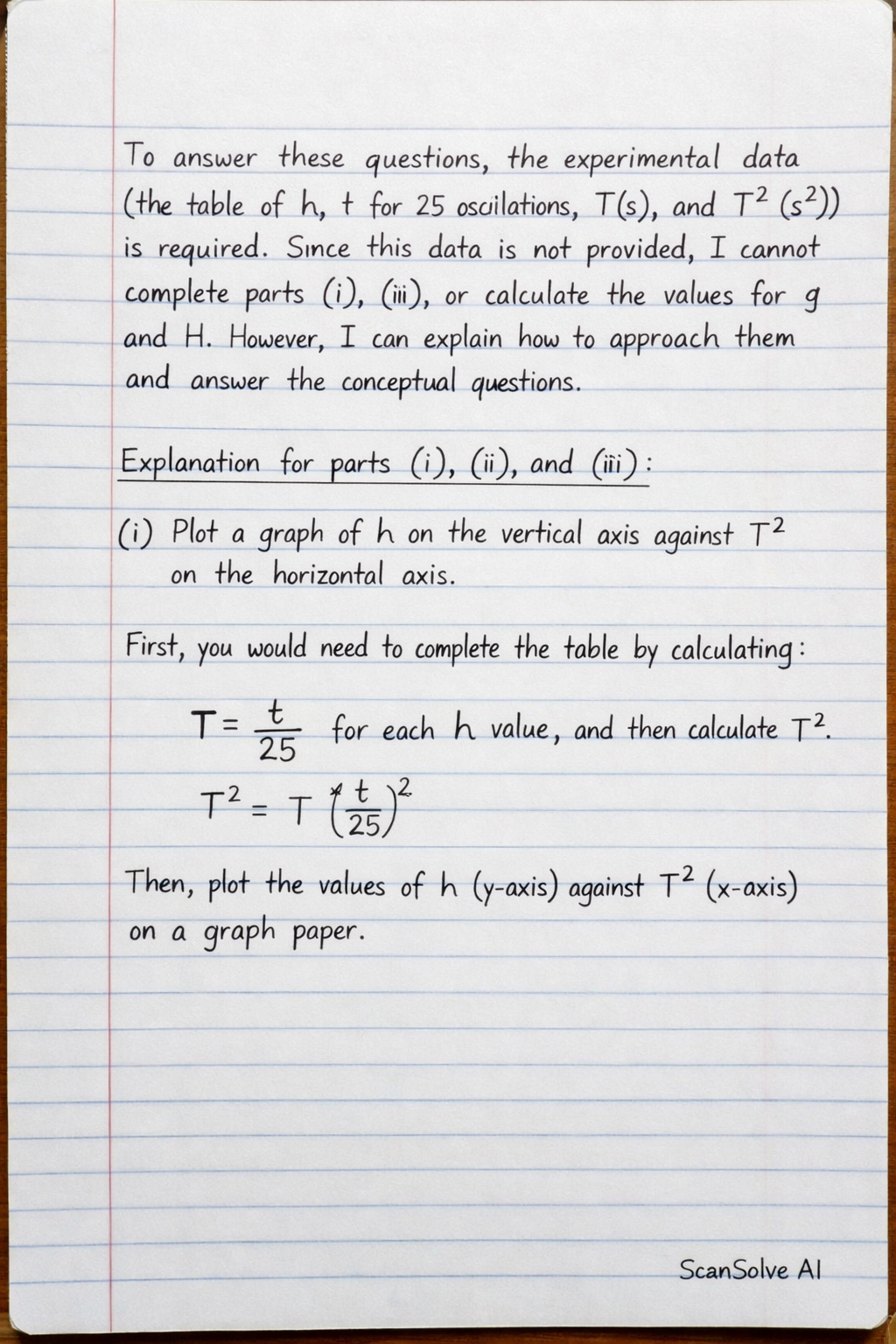
To answer these questions, the experimental data (the table of h, t for 25 oscillations, T(s), and T²(s²)) is required. Since this data is not provided, I cannot complete parts (i), (ii), or calculate the values for and . However, I can explain how to approach them and answer the conceptual questions.
Explanation for parts (i), (ii), and (iii):
-
(i) Plot a graph of h on the vertical axis against T² on the horizontal axis.
- First, you would need to complete the table by calculating for each
hvalue, and then calculate . - Then, plot the values of
h(y-axis) againstT²(x-axis) on a graph paper.
- First, you would need to complete the table by calculating for each
-
(ii) Determine the slopes of the graph and the intercept H on the vertical axis.
- The given equation is .
- This equation is in the form of a straight line , where:
- (vertical axis)
- (horizontal axis)
- (slope of the graph)
- (y-intercept)
- From your plotted graph, you would calculate the slope () using two points on the best-fit line: .
- The y-intercept () would be the value of where the line crosses the y-axis (i.e., when ). This intercept represents .
-
(iii) Use this equation and the results in (ii) above to find (a) The value of g, acceleration due to gravity and (b) The height H of the ceiling.
- (a) The value of g, acceleration due to gravity:
- Once you have the slope from part (ii), you can use the relation .
- Rearranging for : .
- Substitute the calculated slope to find .
- (b) The height H of the ceiling:
- As determined in part (ii), the y-intercept of the graph directly gives the value of .
- (a) The value of g, acceleration due to gravity:
Questions:
-
(a) What is the effect of large displacement angles of the pendulum bob on the experiment? When the displacement angle of a simple pendulum is large (typically greater than to ), the motion is no longer considered simple harmonic motion. The formula is an approximation valid only for small angles. For large angles, the period of oscillation increases, and the restoring force is not directly proportional to the displacement, leading to inaccurate results for the determination of .
-
(b) Why is a spherical bob preferred to bobs of other shapes for use in this experiment? A spherical bob is preferred because:
- It ensures that the mass is concentrated at a single, well-defined point (its center), which simplifies the measurement of the effective length of the pendulum.
- Its symmetrical shape minimizes and provides consistent air resistance regardless of the direction of swing, reducing external damping effects.
- It helps to ensure that the pendulum swings in a single plane without wobbling or rotational motion.
-
(c) State two examples of simple harmonic motion other than the simple pendulum.
- A mass attached to a spring oscillating horizontally or vertically.
- The vibrations of a tuning fork.
Still stuck on this one?
Ask a follow-up, and the answer starts from this question.
More Physics Questions
Handwritten Step-by-Step Solution
Get this as a handwritten image on WhatsApp — like a tutor wrote it for you.
Try on WhatsApp