
We read your photo as:
Recall the formula for kinetic energy.
ScanSolve AI Answer
Answer
Step-by-step solution
4 stepsRecall the formula for kinetic energy.
The kinetic energy (K.E.) of an object is given by the formula:
where is the mass and is the speed.
Rearrange the formula to solve for speed squared ().
Multiply both sides by 2:
Divide both sides by :
Analyze the relationship between speed and mass.
The problem states that the car and the truck have the same kinetic energy. This means K.E. is constant for both vehicles. Also, 2 is a constant.
Therefore, we can see that is inversely proportional to :This implies that if the mass () is smaller, the speed squared () must be larger to maintain the same kinetic energy. Consequently, the speed () will also be larger.
Apply the relationship to the car and truck.
We are given that the truck has more mass than the car.
Since , the object with less mass will have a greater speed.
The car has less mass than the truck.Therefore, the car has greater speed.
The car has greater speed.
Try one yourself
A new problem that tests the same skill.
Still stuck on this one?
Ask a follow-up, and the answer starts from this question.
More Physics Questions
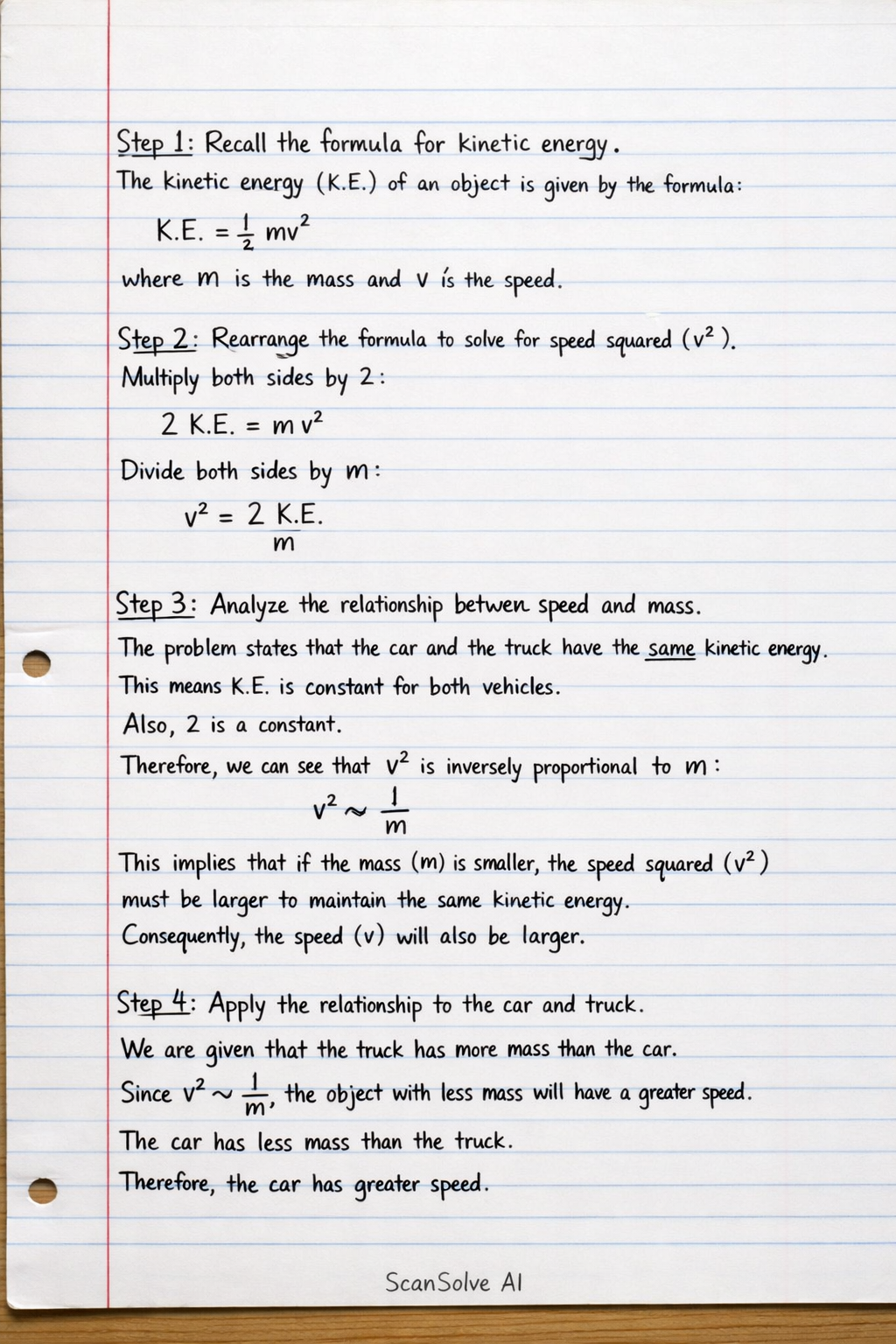
Handwritten Step-by-Step Solution
Get this as a handwritten image on WhatsApp — like a tutor wrote it for you.
Try on WhatsApp