
We read your photo as:
Relative to resonance in sound wave, write the equation to determine the wavelength of sound in: (i) a close tube; (ii) an open tube.
ScanSolve AI Answer
This answer stops before the end.
It was cut off when it was first written. Ask ScanSolve this question again for the full working.
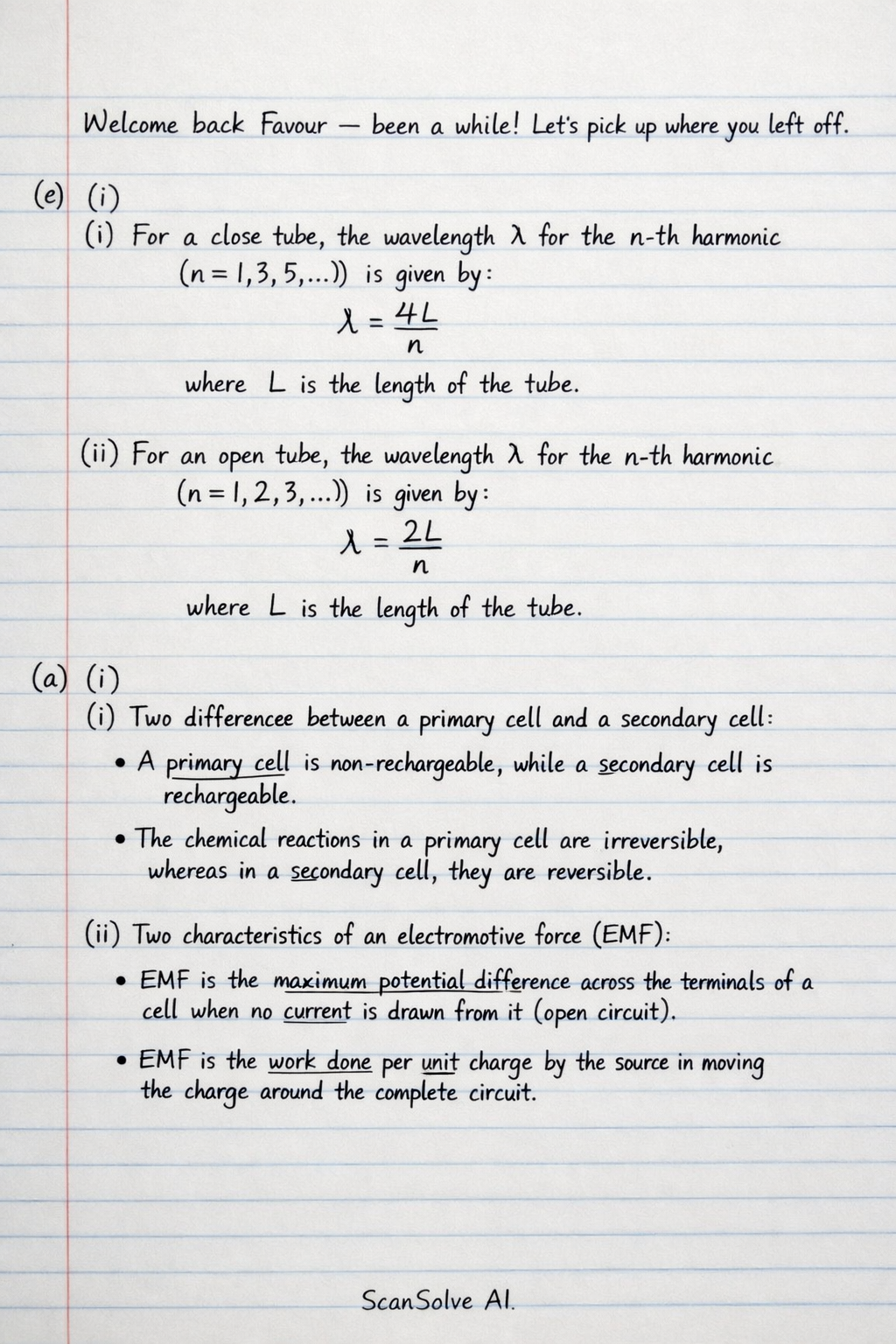
(e)
(i) For a close tube, the wavelength at resonance for the -th harmonic (where is an odd integer, ) is given by:
where is the length of the tube.
(ii) For an open tube, the wavelength at resonance for the -th harmonic (where is an integer, ) is given by:
where is the length of the tube.
(a)
(i) Two differences between a primary cell and a secondary cell:
- A primary cell is non-rechargeable, while a secondary cell is rechargeable.
- The chemical reactions in a primary cell are irreversible, whereas in a secondary cell, they are reversible.
(ii) Two characteristics of an electromotive force (EMF):
- EMF is the maximum potential difference across the terminals of a cell when no current is drawn from it (open circuit).
- EMF is the work done per unit charge by the source in moving the charge around the complete circuit.
(iii) Electrical symbols:
I. Inductor:
\boxed{\text{—}\begin{tikzpicture}[baseline=(current bounding box.center)]\draw (0,0) sin (0.2,0.2) cos (0.4,0) sin (0.6,-0.2) cos (0.8,0) sin (1,0.2) cos (1.2,0);\end{tikzpicture}\text{—}}
II. Rheostat (variable resistor):
\boxed{\text{—}\begin{tikzpicture}[baseline=(current bounding box.center)]\draw (0,0) -- (0.2,0) -- (0.3,0.2) -- (0.5,-0.2) -- (0.7,0.2) -- (0.9,-0.2) -- (1.0,0.2) -- (1.2,0) -- (1.4,0);\draw[->] (0.1,0.3) -- (1.1,-0.1);\end{tikzpicture}\text{—}}
III. Diodes:
Still stuck on this one?
Ask a follow-up, and the answer starts from this question.
More Physics Questions
Handwritten Step-by-Step Solution
Get this as a handwritten image on WhatsApp — like a tutor wrote it for you.
Try on WhatsApp