

This physics problem tests your understanding of fundamental physical laws and their applications. The step-by-step solution below breaks down the problem using relevant equations and physical reasoning.
ScanSolve AI Answer
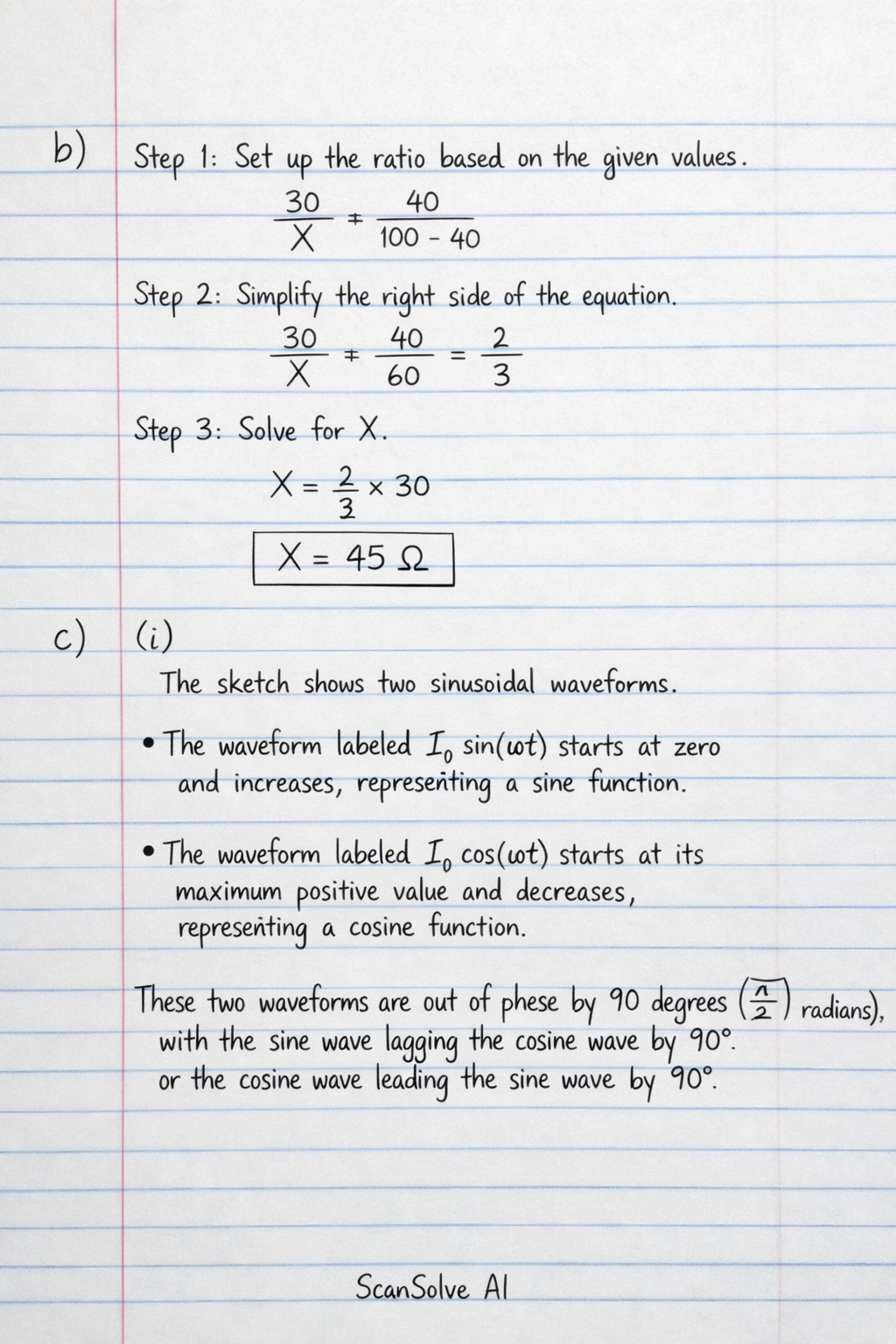
here is the continuation of Question 11: b) Step 1: Set up the ratio based on the given values. (30)/(X) = (40)/(100-40) Step 2: Simplify the right side of the equation. (30)/(X) = (40)/(60) = (2)/(3) Step 3: Solve for X. X = (3)/(2) × 30 X = 45 c) (i) The sketch shows two sinusoidal waveforms. • The waveform labeled I_0 ( t) starts at zero and increases, representing a sine function. • The waveform labeled I_0 ( t) starts at its maximum positive value and decreases, representing a cosine function. These two waveforms are out of phase by 90 degrees (()/(2) radians), with the sine wave lagging the cosine wave by 90^ or the cosine wave leading the sine wave by 90^. c) (ii) I. Step 1: Calculate the power factor, , using the given voltages V_R = 120\,V and V_T = 220\,V. = (V_R)/(V_T) = (120)/(220) ≈ 0.545 Step 2: Calculate the phase angle by taking the inverse cosine. = ^-1(0.545) ≈ 57^ II. Step 1: Use the relationship between resistance R, impedance Z, and phase angle . Assuming R = 20 \, (from a previous part of the question not shown). R = Z Step 2: Rearrange the formula to solve for impedance Z. Z = (R)/( ) Step 3: Substitute the values for R and . Z = (20)/(120)220 = (20 × 220)/(120) Step 4: Calculate the impedance Z. Z = (4400)/(120) = (110)/(3) Z ≈ 36.67 Drop the next question!