This physics problem tests your understanding of fundamental physical laws and their applications. The step-by-step solution below breaks down the problem using relevant equations and physical reasoning.
ScanSolve AI Answer
To find the resultant force, we need to resolve each force into its x and y components, sum these components, and then calculate the magnitude and direction of the resultant vector.
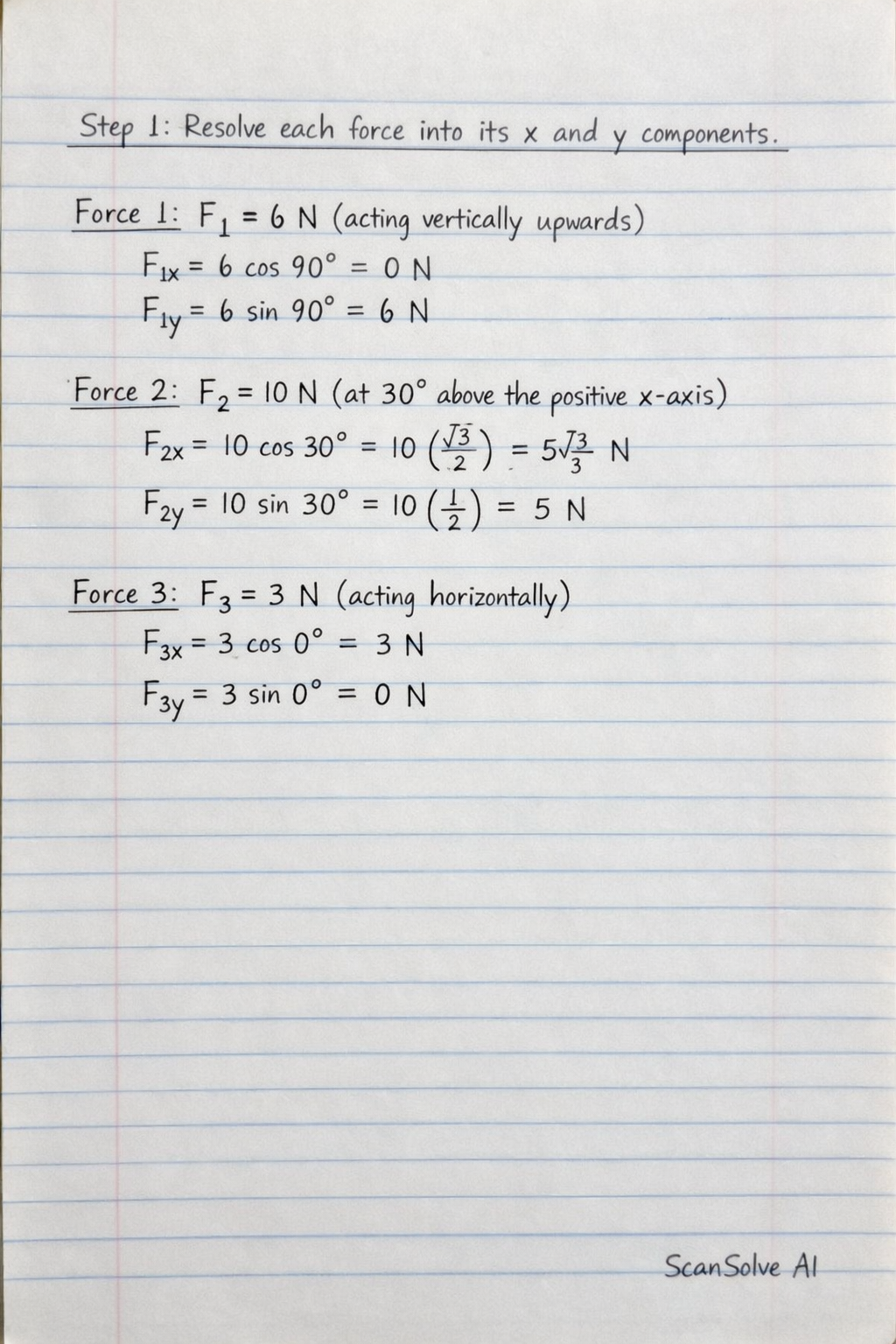
Step 1: Resolve each force into its x and y components.
Force 1: $F_1 = 6\,N$ (acting vertically upwards, along the positive y-axis)
$F_{1x} = 6 \cos(90^\circ) = 0\,N$
$F_{1y} = 6 \sin(90^\circ) = 6\,N$
Force 2: $F_2 = 10\,N$ (acting at $30^\circ$ above the positive x-axis)
$F_{2x} = 10 \cos(30^\circ) = 10 \left(\frac{\sqrt{3}}{2}\right) = 5\sqrt{3}\,N$
$F_{2y} = 10 \sin(30^\circ) = 10 \left(\frac{1}{2}\right) = 5\,N$
Force 3: $F_3 = 3\,N$ (acting horizontally, along the positive x-axis)
$F_{3x} = 3 \cos(0^\circ) = 3\,N$
$F_{3y} = 3 \sin(0^\circ) = 0\,N$
Force 4: $F_4 = 3\,N$ (acting at $60^\circ$ below the negative x-axis)
This force is in the third quadrant. Both x and y components will be negative.
$F_{4x} = -3 \cos(60^\circ) = -3 \left(\frac{1}{2}\right) = -1.5\,N$
$F_{4y} = -3 \sin(60^\circ) = -3 \left(\frac{\sqrt{3}}{2}\right) = -1.5\sqrt{3}\,N$
Step 2: Sum the x-components to find the total x-component ($R_x$).
$$R_x = F_{1x} + F_{2x} + F_{3x} + F_{4x}$$
$$R_x = 0 + 5\sqrt{3} + 3 - 1.5$$
$$R_x = 5\sqrt{3} + 1.5\,N$$
Numerically: $R_x \approx 5(1.732) + 1.5 = 8.66 + 1.5 = 10.16\,N$
Step 3: Sum the y-components to find the total y-component ($R_y$).
$$R_y = F_{1y} + F_{2y} + F_{3y} + F_{4y}$$
$$R_y = 6 + 5 + 0 - 1.5\sqrt{3}$$
$$R_y = 11 - 1.5\sqrt{3}\,N$$
Numerically: $R_y \approx 11 - 1.5(1.732) = 11 - 2.598 = 8.402\,N$
**Step 4: Calculate the magnitude of the resultant
Resolve each force into its x and y components.
|Physics
Resolve each force into its x and y components.
ScanSolve AI Answer
To find the resultant force, we need to resolve each force into its x and y components, sum these components, and then calculate the magnitude and direction of the resultant vector.
Step 1: Resolve each force into its x and y components.
Force 1:F1=6N (acting vertically upwards, along the positive y-axis)
F1x=6cos(90∘)=0N
F1y=6sin(90∘)=6N
Force 2:F2=10N (acting at 30∘ above the positive x-axis)
F2x=10cos(30∘)=10(23)=53N
F2y=10sin(30∘)=10(21)=5N
Force 3:F3=3N (acting horizontally, along the positive x-axis)
F3x=3cos(0∘)=3N
F3y=3sin(0∘)=0N
Force 4:F4=3N (acting at 60∘ below the negative x-axis)
This force is in the third quadrant. Both x and y components will be negative.
F4x=−3cos(60∘)=−3(21)=−1.5N
F4y=−3sin(60∘)=−3(23)=−1.53N
Step 2: Sum the x-components to find the total x-component (Rx).Rx=F1x+F2x+F3x+F4xRx=0+53+3−1.5Rx=53+1.5N
Numerically: Rx≈5(1.732)+1.5=8.66+1.5=10.16N
Step 3: Sum the y-components to find the total y-component (Ry).Ry=F1y+F2y+F3y+F4yRy=6+5+0−1.53Ry=11−1.53N
Numerically: Ry≈11−1.5(1.732)=11−2.598=8.402N
**Step 4: Calculate the magnitude of the resultant
Need help with your own homework?
Get instant step-by-step solutions to any question. Free to start.