
This physics problem tests your understanding of fundamental physical laws and their applications. The step-by-step solution below breaks down the problem using relevant equations and physical reasoning.
ScanSolve AI Answer
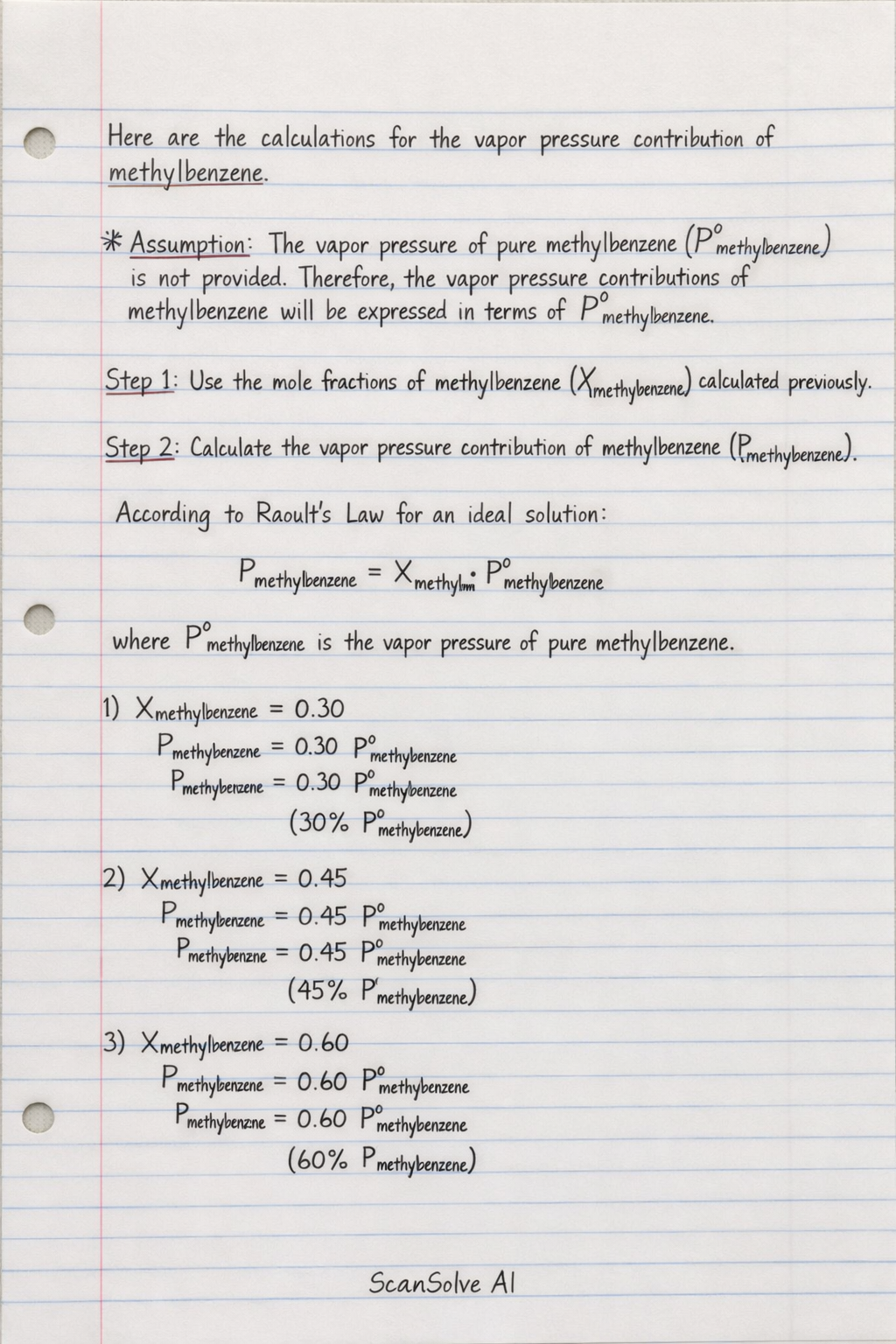
Here are the calculations for the vapor pressure contribution of methylbenzene. Assumption: The vapor pressure of pure methylbenzene (P_methylbenzene^) is not provided. Therefore, the vapor pressure contributions of methylbenzene will be expressed in terms of P_methylbenzene^. Step 1: Use the mole fractions of methylbenzene (X_methylbenzene) calculated previously. Step 2: Calculate the vapor pressure contribution of methylbenzene (P_methylbenzene). According to Raoult's Law for an ideal solution: P_methylbenzene = X_methylbenzene P_methylbenzene^ where P_methylbenzene^ is the vapor pressure of pure methylbenzene. Here are the results for the given concentrations: | X_benzene | X_methylbenzene | P_methylbenzene (Vapor Pressure Contribution) | | :------------------- | :------------------------- | :------------------------------------------------------- | | 0 | 1 | 1 · P_methylbenzene^ = P_methylbenzene^ | | 0.25 | 0.75 | 0.75 · P_methylbenzene^ | | 0.5 | 0.5 | 0.5 · P_methylbenzene^ | | 0.75 | 0.25 | 0.25 · P_methylbenzene^ | | 1 | 0 | 0 · P_methylbenzene^ = 0 | The respective vapor pressure contributions of methylbenzene are P_methylbenzene^, 0.75 P_methylbenzene^, 0.5 P_methylbenzene^, 0.25 P_methylbenzene^, 0.