
We read your photo as:
Calculate the resultant of two vectors V1 = 3 units and V2 = 4 units inclined at angles 30^ , 90^ , and 120^ respectively. Use the formula R = extsqrt(V12 + V22 + 2V1V2 extcos heta).
ScanSolve AI Answer
Answers
4 partsStep-by-step solution
5 stepsPart 9
To find the resultant of two vectors by calculation, use the formula:
where units, units, and is the angle between them.
Note: The "by drawing" part cannot be performed by an AI.
Part a
Inclined at
Substitute the values into the formula.
The resultant is .
Part b
Inclined at
Substitute the values into the formula.
The resultant is .
Part c
Inclined at
Substitute the values into the formula.
The resultant is .
Part 10
A component of a vector is its effective value along a specific direction, obtained by projecting the vector onto that direction. For a vector at an angle to the horizontal, its horizontal component is and its vertical component is .
Illustration with a diagram:
Imagine a vector originating from the origin of a Cartesian coordinate system. Its horizontal component is the projection onto the x-axis, and its vertical component is the projection onto the y-axis, forming a right-angled triangle with the vector as the hypotenuse.
Calculation of components:
Given force N, inclined at to the horizontal.
Calculate the horizontal component ().
The horizontal component is .
Calculate the vertical component ().
The vertical component is .
Try one yourself
A new problem that tests the same skill.
Still stuck on this one?
Ask a follow-up, and the answer starts from this question.
More Physics Questions
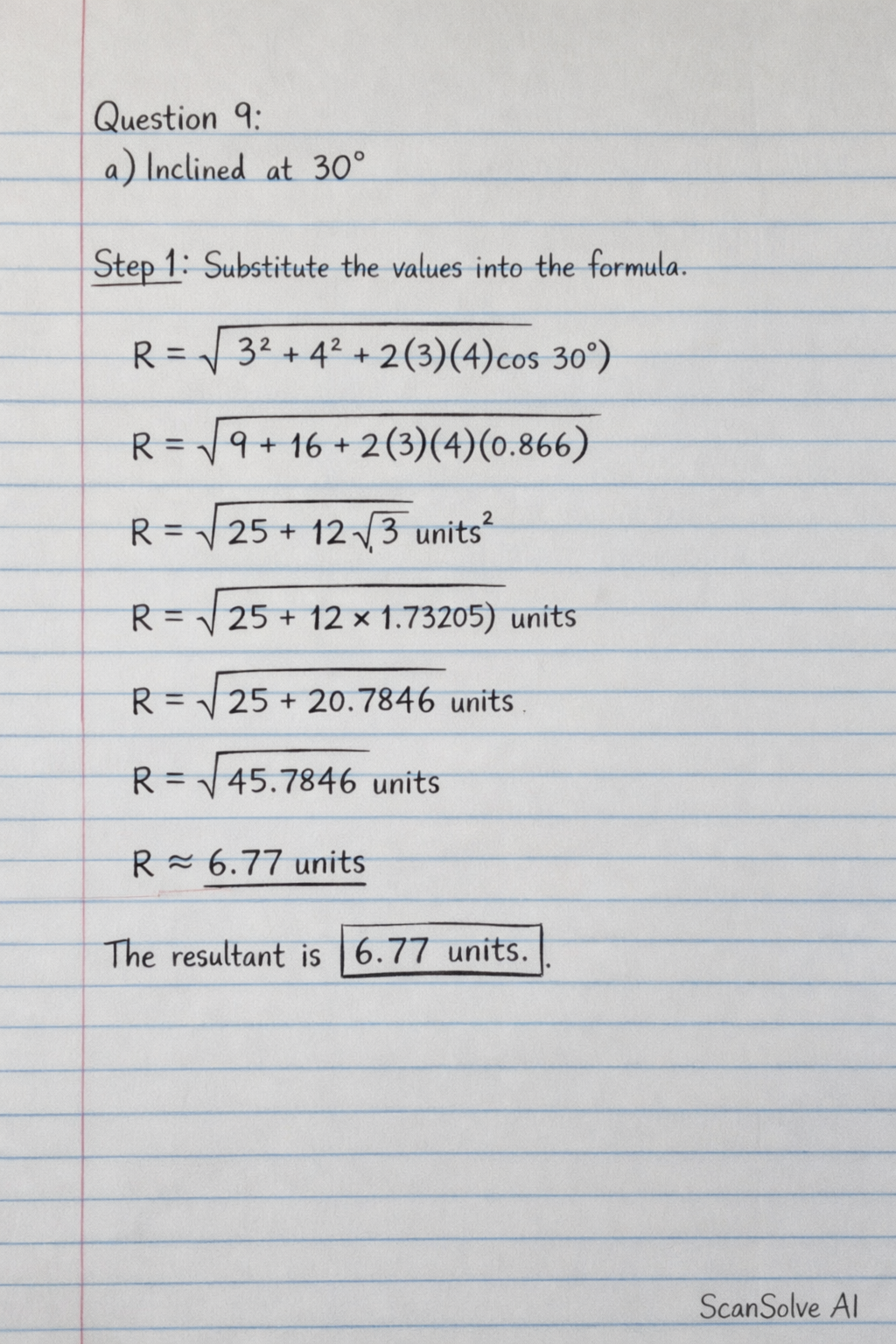
Handwritten Step-by-Step Solution
Get this as a handwritten image on WhatsApp — like a tutor wrote it for you.
Try on WhatsApp