
We read your photo as:
Explain single fixed pulleys, provide examples, discuss mechanical advantage for different pulley types, and calculate rope distance for a single fixed pulley.
ScanSolve AI Answer
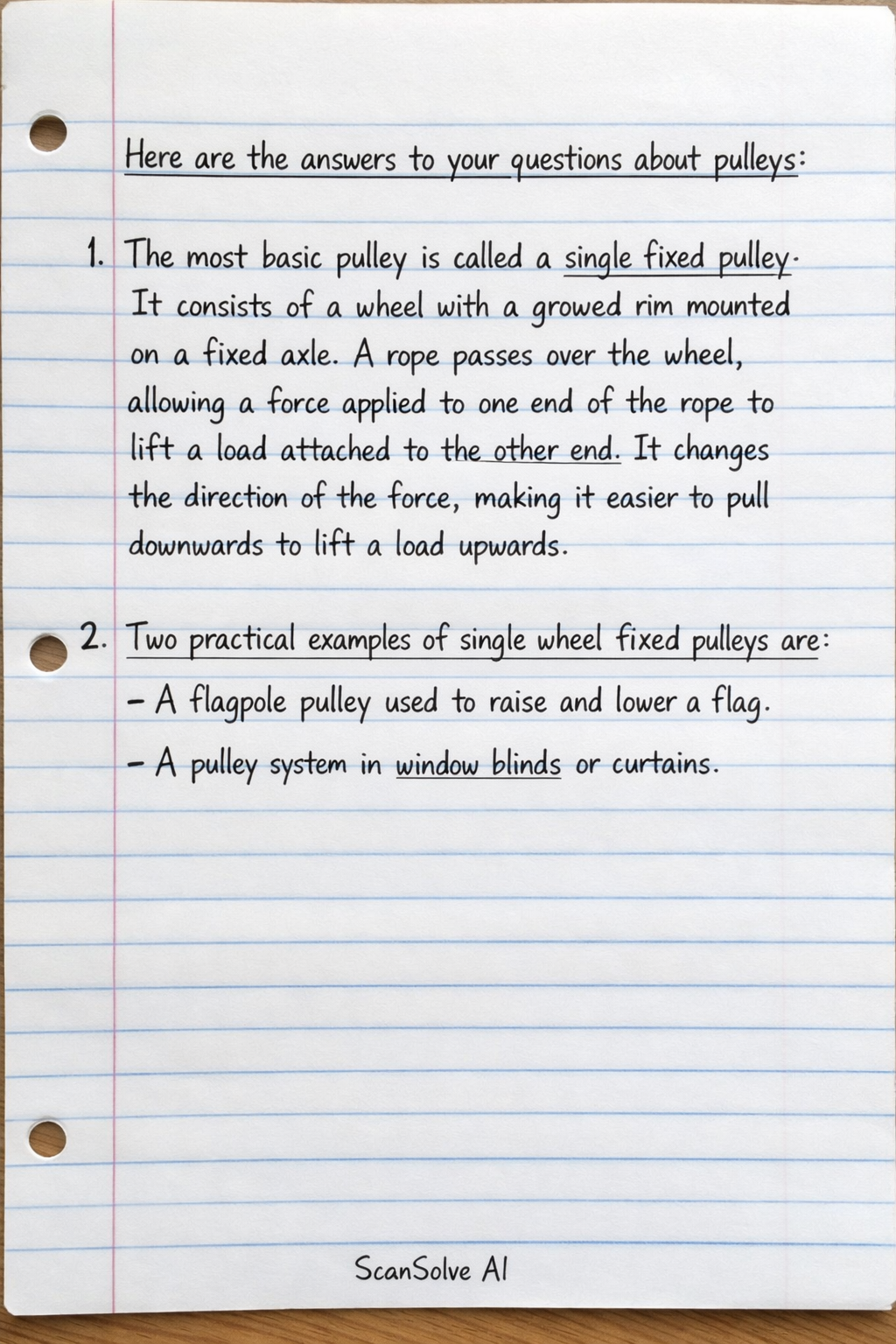
Here are the answers to your questions about pulleys:
-
The most basic pulley is called a single fixed pulley. It consists of a wheel with a grooved rim mounted on a fixed axle. A rope passes over the wheel, allowing a force applied to one end of the rope to lift a load attached to the other end. It changes the direction of the force, making it easier to pull downwards to lift a load upwards.
-
Two practical examples of single wheel fixed pulleys are:
- A flagpole pulley used to raise and lower a flag.
- A pulley system in window blinds or curtains.
-
- Single wheel fixed pulley: Provides a mechanical advantage (MA) of 1. It changes the direction of the force but does not multiply the force.
- Single wheel movable pulley: Provides a mechanical advantage (MA) of 2. It reduces the effort force required by half, but the rope must be pulled twice the distance the load is lifted.
- Block and tackle: The mechanical advantage is equal to the number of rope segments (falls) supporting the movable block and the load. It can provide a mechanical advantage greater than 2, significantly reducing the effort force.
-
- 4.1 For a single wheel fixed pulley, the distance you must pull the rope is equal to the distance the load is lifted.
- To raise the load 2 m, you must pull the rope 2 m.
- To raise the load 2.5 m, you must pull the rope 2.5 m.
- To raise the load 5 m, you must pull the rope 5 m.
- 4.2 The conclusion is that a single wheel fixed pulley changes the direction of the force, making it more convenient to lift a load, but it does not provide any force multiplication (its mechanical advantage is 1). The effort force is approximately equal to the load force.
- 4.1 For a single wheel fixed pulley, the distance you must pull the rope is equal to the distance the load is lifted.
-
A single wheel movable pulley is a pulley where the wheel moves with the load. One end of the rope is attached to a fixed support, the load is attached to the pulley's axle, and the effort force is applied to the other end of the rope. This system provides a mechanical advantage of 2.
-
A double pulley system is a type of block and tackle system.
- A block refers to the frame that holds one or more pulley wheels. In a double pulley system, there are typically two blocks: one fixed and one movable.
- The tackle refers to the rope or cable that is threaded through the pulleys in the blocks.
- The falls are the segments of the rope that directly support the movable block and the load. For example, in a system with two pulleys in the movable block, there would be four falls supporting the load, giving a mechanical advantage of 4.
-
A compound pulley system becomes less efficient due to:
- Friction between the rope and the pulley wheels, and within the pulley axles.
- The weight of the pulleys and the rope itself, which must also be lifted.
- The stiffness of the rope, requiring energy to bend it around the pulleys.
Still stuck on this one?
Ask a follow-up, and the answer starts from this question.
More Physics Questions
Handwritten Step-by-Step Solution
Get this as a handwritten image on WhatsApp — like a tutor wrote it for you.
Try on WhatsApp