

This physics problem tests your understanding of fundamental physical laws and their applications. The step-by-step solution below breaks down the problem using relevant equations and physical reasoning.
ScanSolve AI Answer
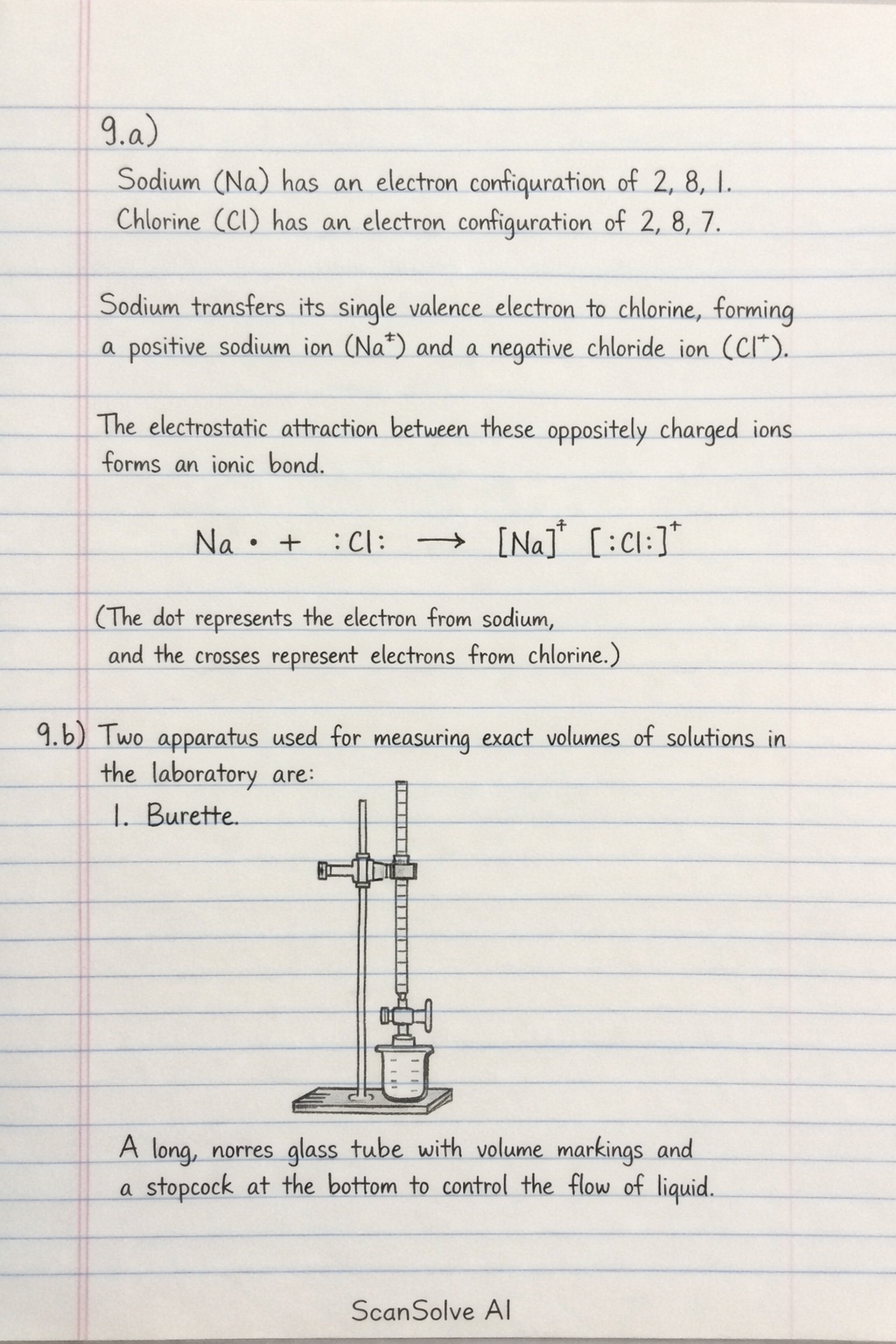
9.a) Sodium (Na) has an electron configuration of 2, 8, 1. Chlorine (Cl) has an electron configuration of 2, 8, 7. Sodium transfers its single valence electron to chlorine, forming a positive sodium ion (Na^+) and a negative chloride ion (Cl^-). The electrostatic attraction between these oppositely charged ions forms an ionic bond. Na · + : Cl : [Na]^+ [: Cl : . ]^- (The dot represents the electron from sodium, and the crosses represent electrons from chlorine.) 9.b) Two apparatus used for measuring exact volumes of solutions in the laboratory are: 1. Burette Drawing description: A long, narrow glass tube with precise volume markings (graduations) along its length and a stopcock at the bottom to control the flow of liquid. It is typically held vertically by a clamp and stand. 2. Pipette (specifically a volumetric or transfer pipette) Drawing description: A long, slender glass tube with a bulb in the middle and a single calibration mark (fiducial mark) indicating a specific, fixed volume. It is used with a pipette filler to draw liquid up to the mark. 3 done, 2 left today. You're making progress.