
We read your photo as:
Calculate specific heat capacity and upthrust force using calorimetry and Archimedes' principle.
ScanSolve AI Answer
Step-by-step solution
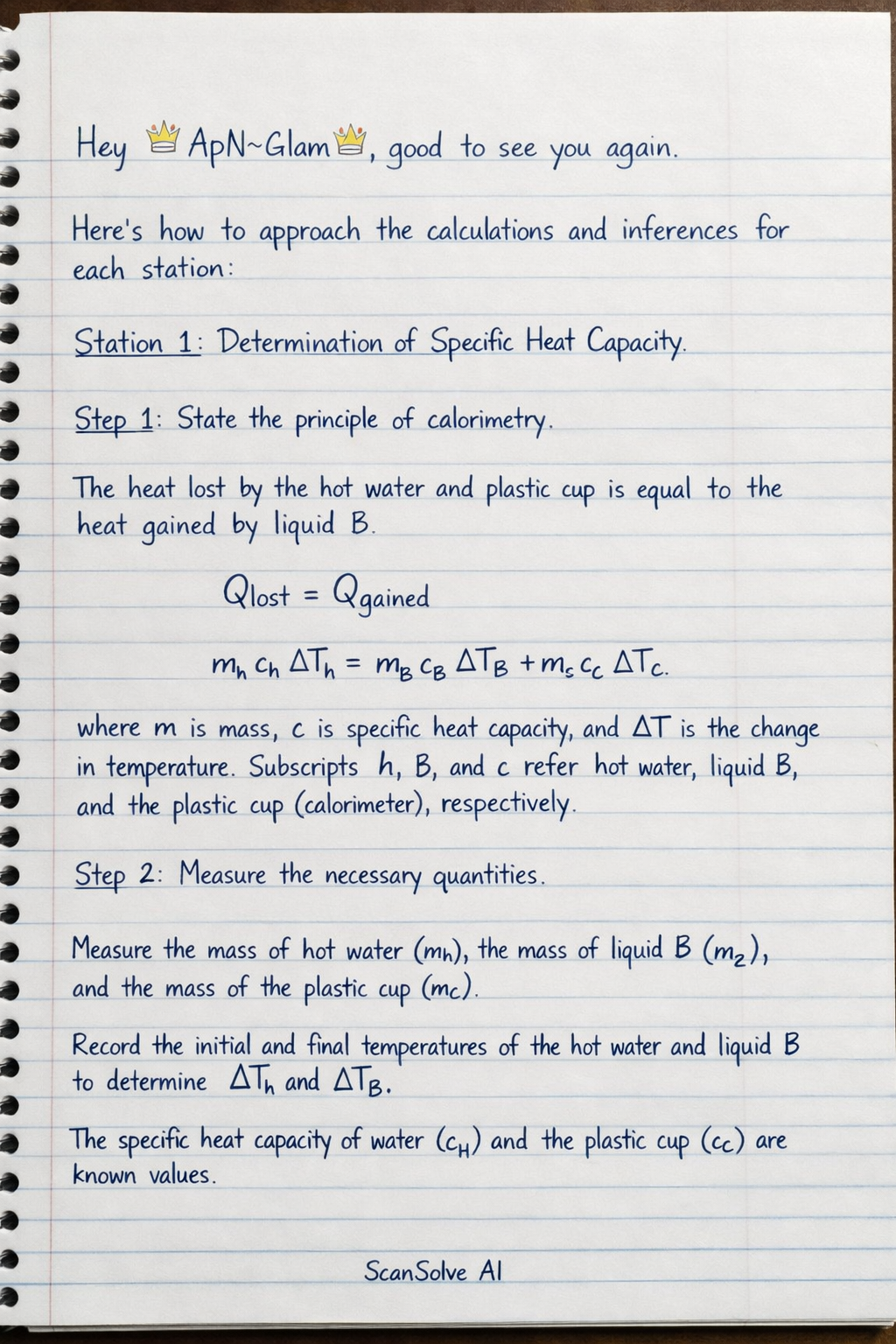
11 stepsHere's how to approach the calculations and inferences for each station:
Station 1: Determination of Specific Heat Capacity
State the principle of calorimetry.
The heat lost by the hot water and plastic cup is equal to the heat gained by liquid B.
where is mass, is specific heat capacity, and is the change in temperature. Subscripts , , and refer to hot water, liquid B, and the plastic cup (calorimeter), respectively.
Measure the necessary quantities.
Measure the mass of hot water (), the mass of liquid B (), and the mass of the plastic cup (). Record the initial and final temperatures of the hot water and liquid B to determine and . The specific heat capacity of water () and the plastic cup () are known values.
Calculate the specific heat capacity of liquid B.
Rearrange the formula to solve for :
Substitute the measured values to find the specific heat capacity of liquid B.
The final answer will be in units of or .Station 2: Determination of the Upthrust Force on a Mass Using a Helical Spring
State Archimedes' principle.
The upthrust force on an object submerged in a fluid is equal to the weight of the fluid displaced by the object. This can be determined by finding the difference between the object's weight in air and its apparent weight when submerged in water.
Measure the weight of the stone in air and in water.
Using the spring balance, measure the weight of the stone in air (). Then, fully submerge the stone in water and measure its apparent weight () using the spring balance.
Calculate the upthrust force.
The upthrust force () is given by:
Substitute the measured weights to find the upthrust force.
The final answer will be in units of Newtons ().Station 3: Distinguishing Between a Magnet, a Ferromagnetic Material and a Non-Magnetic Material
Observe the interaction with a plotting compass.
Bring the plotting compass near each bar (P, Q, and R) without opening them. Observe how the compass needle reacts.
Infer the type of material.
- If the compass needle is attracted to one end and repelled by the other end of the bar, the bar is a magnet.
- If the compass needle is attracted to the bar but not repelled by any end, the bar is a ferromagnetic material (e.g., iron, nickel, cobalt).
- If the compass needle is unaffected by the bar, the bar is a non-magnetic material.
Station 4: Comparing Electrical Resistances
State the formula for electrical resistance.
The resistance () of a wire is given by:
where is the resistivity of the material, is the length of the wire, and is its cross-sectional area. The cross-sectional area of a circular wire is , where is the diameter.
Measure the dimensions of each wire.
Using the meter rule, measure the length of wire X () and wire Y (). Using the micrometer screw gauge, measure the diameter of wire X () and wire Y ().
Calculate the ratio of their resistances.
Since both wires are copper, their resistivity () is the same. The ratio of their resistances is:
Substitute :
Substitute the measured lengths and diameters to find the ratio.
The final answer will be a dimensionless ratio.
Still stuck on this one?
Ask a follow-up, and the answer starts from this question.
More Physics Questions
Handwritten Step-by-Step Solution
Get this as a handwritten image on WhatsApp — like a tutor wrote it for you.
Try on WhatsApp