
We read your photo as:
Calculate the specific heat capacity of paraffin and explain why a partially filled flask might retain heat better.
ScanSolve AI Answer
Answer
Step-by-step solution
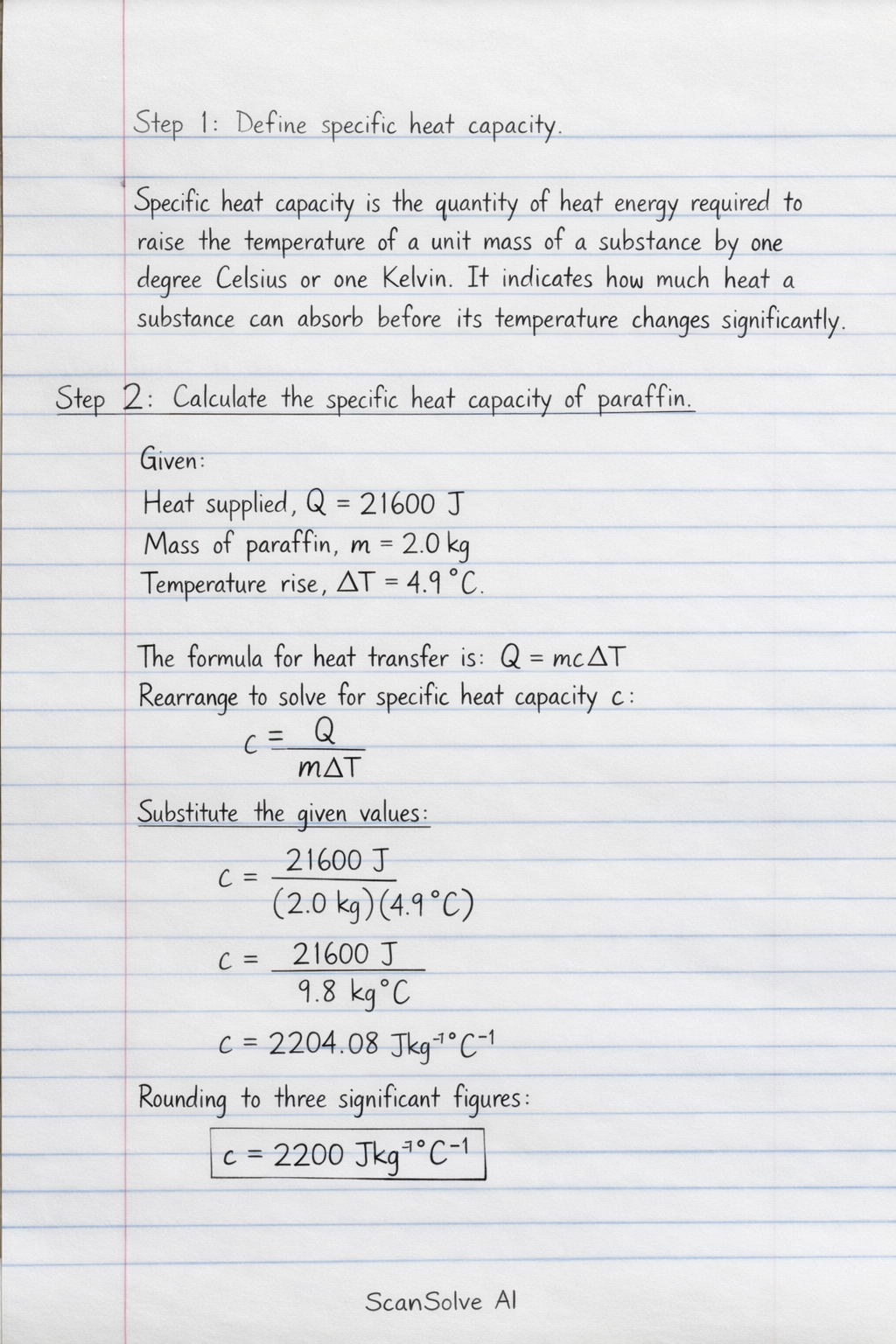
5 stepsDefine specific heat capacity.
Specific heat capacity is the quantity of heat energy required to raise the temperature of a unit mass of a substance by one degree Celsius or one Kelvin. It indicates how much heat a substance can absorb before its temperature changes significantly.
Calculate the specific heat capacity of paraffin.
Given:
Heat supplied,
Mass of paraffin,
Temperature rise,The formula for heat transfer is .
Rearrange to solve for specific heat capacity :Substitute the given values:
Rounding to three significant figures:
State with reason the flask in which the water is likely to have a higher temperature eight hours later.
Flask A, which is partially filled, will likely have a higher temperature eight hours later. The air trapped above the water in flask A acts as an insulating layer, reducing heat loss by convection and conduction from the water surface. In flask B, which is completely filled, there is less or no air space, allowing for more direct heat transfer to the flask walls and surroundings.
Determine the final temperature of the mixture.
Given:
Mass of ice,
Initial temperature of ice,
Mass of water,
Initial temperature of water,
Specific heat capacity of water,
Specific latent heat of fusion of ice,
Let the final temperature be .Heat gained by ice to melt ():
Heat gained by melted ice (now water) to reach ():
Heat lost by initial water to reach ():
According to the principle of calorimetry, heat gained equals heat lost:
Combine terms with :
Rounding to three significant figures:
Determine the linear velocity.
Given:
Frequency,
Radius,First, calculate the angular velocity :
Next, calculate the linear velocity :
Using :
Rounding to three significant figures:
Try one yourself
A new problem that tests the same skill.
Still stuck on this one?
Ask a follow-up, and the answer starts from this question.
More Physics Questions
Handwritten Step-by-Step Solution
Get this as a handwritten image on WhatsApp — like a tutor wrote it for you.
Try on WhatsApp