
We read your photo as:
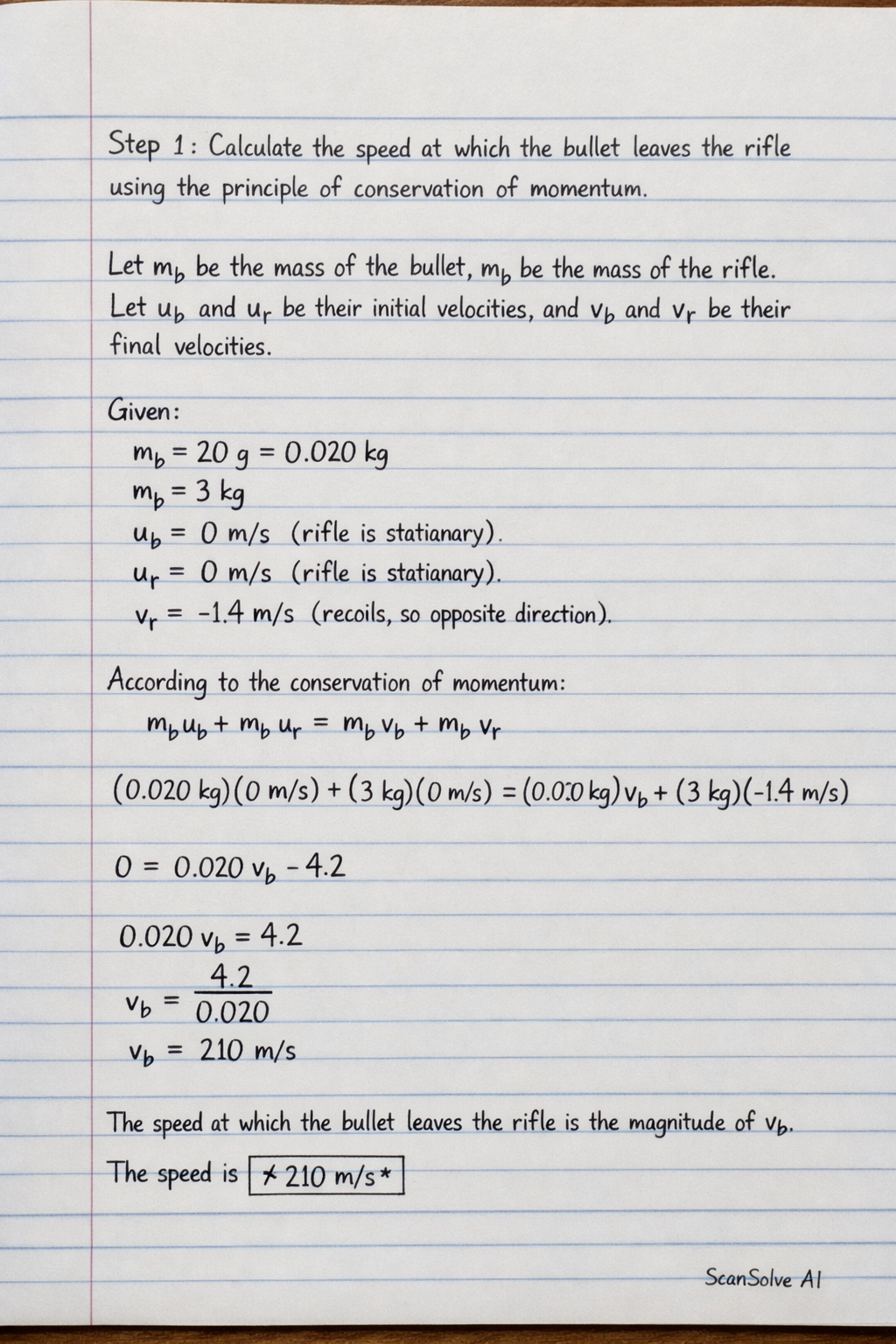
Calculate the speed at which the bullet leaves the rifle using the principle of conservation of momentum.
ScanSolve AI Answer
Answer
Step-by-step solution
3 stepsCalculate the speed at which the bullet leaves the rifle using the principle of conservation of momentum.
Let be the mass of the bullet, be the mass of the rifle.
Let and be their initial velocities, and and be their final velocities.Given:
(rifle is stationary)
(rifle is stationary)
(recoils, so opposite direction to bullet)According to the conservation of momentum:
The speed at which the bullet leaves the rifle is the magnitude of .
The speed isCalculate the magnitude of the average force exerted by the block on the bullet.
The bullet enters the block with the speed calculated in Step 1 and comes to rest.
Given:
Mass of bullet
Initial velocity of bullet
Final velocity of bullet
Distance travelledFirst, calculate the acceleration () of the bullet using a kinematic equation:
The negative sign indicates deceleration.
Next, calculate the average force () using Newton's Second Law:
The magnitude of the average force is the absolute value of .
The magnitude of the average force exerted by the block on the bullet isCompare the magnitude of the force calculated in QUESTION 4.2 to the magnitude of the force exerted by the bullet on the block.
According to Newton's Third Law of Motion, for every action, there is an equal and opposite reaction. The force exerted by the block on the bullet and the force exerted by the bullet on the block are an action-reaction pair. Therefore, their magnitudes are equal.
The magnitude of the force calculated in QUESTION 4.2 compared to the magnitude of the force exerted by the bullet on the block is
Try one yourself
A new problem that tests the same skill.
Still stuck on this one?
Ask a follow-up, and the answer starts from this question.
More Physics Questions
Handwritten Step-by-Step Solution
Get this as a handwritten image on WhatsApp — like a tutor wrote it for you.
Try on WhatsApp