
We read your photo as:
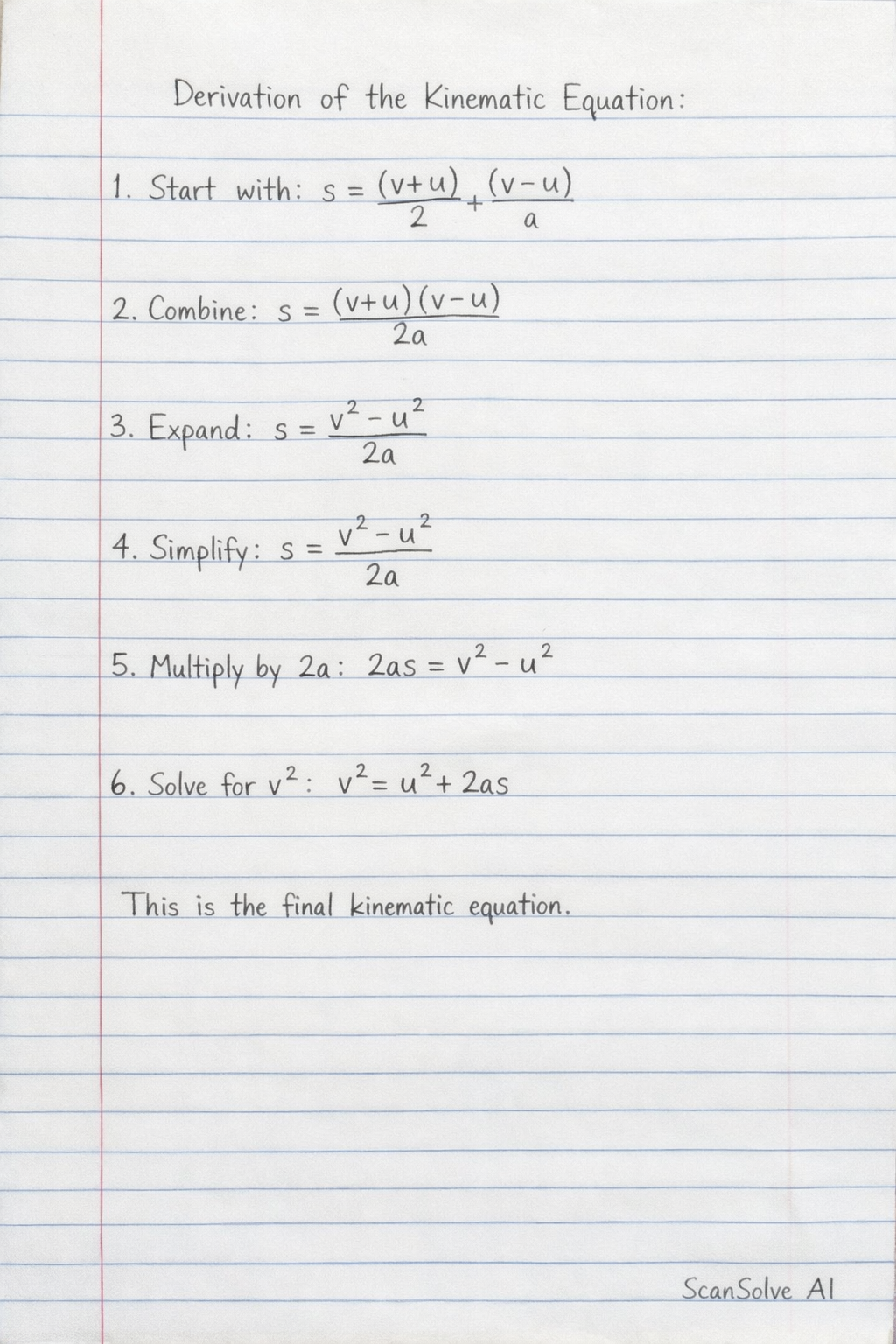
Start with the expression for displacement s derived from average velocity and time.
Physics
ScanSolve AI Answer
Step-by-step solution
6 stepsHere is the derivation of the kinematic equation:
Start with the expression for displacement derived from average velocity and time.
Combine the terms into a single fraction.
Expand the numerator using the difference of squares formula, .
Simplify the numerator by canceling out the terms.
Multiply both sides by to isolate .
Rearrange the equation to solve for .
This is the final kinematic equation.
The student's work is ✅ Correct.
Was this helpful?
Still stuck on this one?
Ask a follow-up, and the answer starts from this question.
Got a different question?Ask your own question
More Physics Questions
Q(ii)Use the average velocity to derive S= ut + 1/2 at2 (4 marks)QSolve the following kinematics problems involving displacement, initial velocity, acceleration, and…QThe displacement-time graph shows a person walking along a road. A) Calculate the average velocity…QThe displacement s metres of a particle moving along a straight line after t seconds is given by…QIdentify the components of the displacement.
Browse by topic:Mechanics
Handwritten Step-by-Step Solution
Get this as a handwritten image on WhatsApp — like a tutor wrote it for you.
Try on WhatsApp