
We read your photo as:
Describe the steps to set up and conduct an experiment to measure current at different voltages for an unknown resistor.
ScanSolve AI Answer
Answer
Step-by-step solution
2 stepsI can help you with all parts of this experiment. Since the table is empty, I cannot provide numerical answers for current readings or the slope, but I will explain each step.
Part a
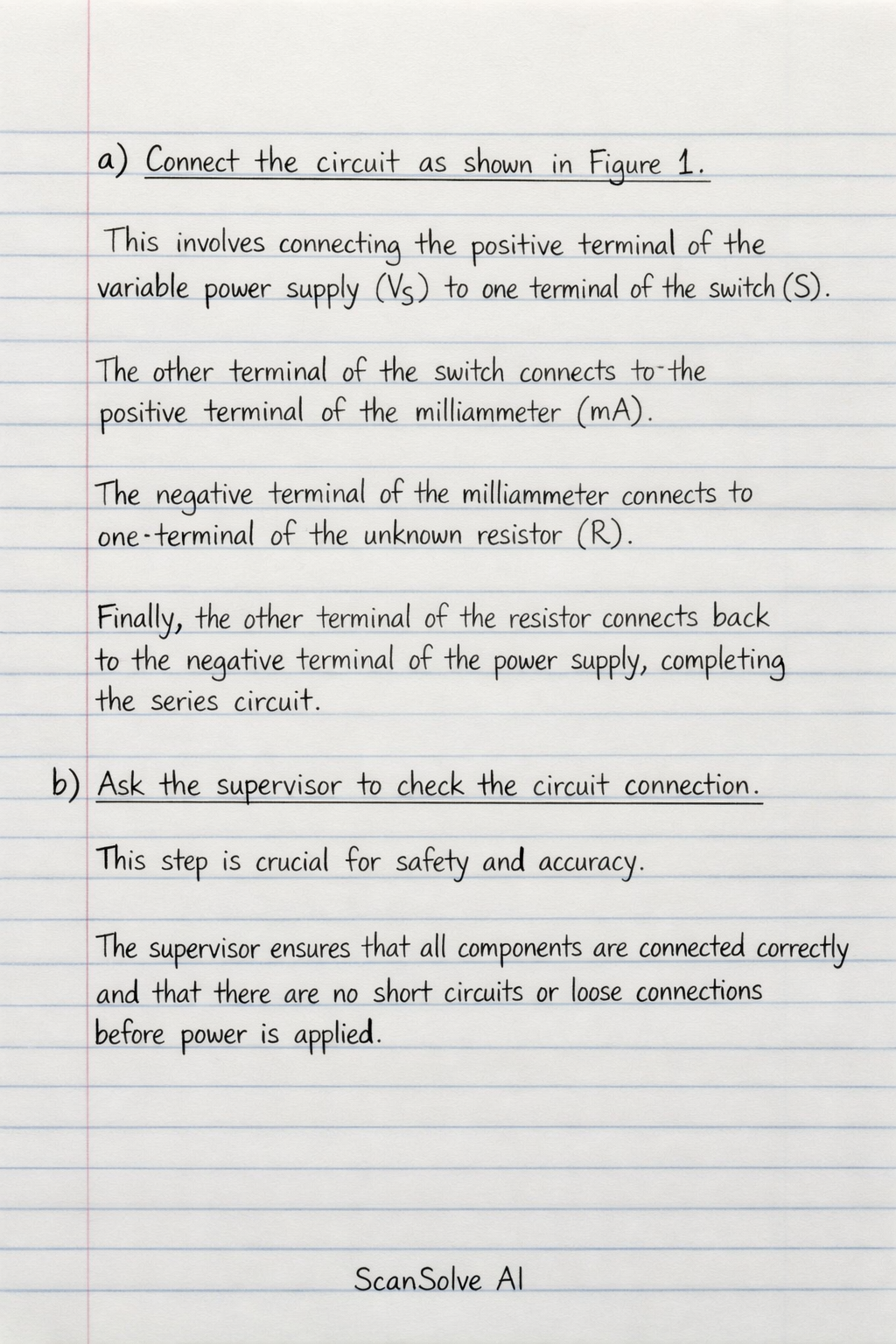
Connect the circuit as shown in Figure 1.
This involves connecting the positive terminal of the variable power supply () to one terminal of the switch (S). The other terminal of the switch connects to the positive terminal of the milliammeter (mA). The negative terminal of the milliammeter connects to one terminal of the unknown resistor (R). Finally, the other terminal of the resistor connects back to the negative terminal of the power supply, completing the series circuit.
Part b
Ask the supervisor to check the circuit connection.
This step is crucial for safety and accuracy. The supervisor ensures that all components are connected correctly and that there are no short circuits or loose connections before power is applied.
Part c
You are provided with Table 1.
Table 1 is where you will record your experimental data. It has columns for the set voltage ( in Volts) and the measured current ( in milliamperes).
Part d
Adjust the power supply, , to 0 V.
Before starting the experiment, the power supply voltage is set to 0 V to ensure a safe initial condition when the circuit is closed.
Part e
Close the switch S.
Closing the switch completes the circuit, allowing current to flow through the resistor and the milliammeter.
Part f
Read and record in Table 1, the milliammeter reading, (mA).
Once the switch is closed and the power supply is set to a specific voltage, you would read the value indicated by the milliammeter and write it in the corresponding row in Table 1. (Actual reading cannot be provided without performing the experiment).
Part g
Open the switch S.
Opening the switch breaks the circuit, stopping the current flow. This is done between readings to prevent the resistor from overheating and to reset the circuit for the next measurement.
Part h(i)
Plot the graph of voltage, , on the vertical axis against current, , on the horizontal axis.
Repeat steps 1 (e) to 1 (g) for other values of shown in Table 1.
This means you will systematically increase the power supply voltage to 2.0 V, 4.0 V, 6.0 V, 8.0 V, and 10.0 V. For each voltage, you will close the switch, record the current reading from the milliammeter, and then open the switch. This process collects all the necessary data points for your graph.
To do this, you will:
- Draw a horizontal axis for current (converting mA to A) and a vertical axis for voltage (in V).
- Choose appropriate scales for both axes.
- Plot each pair of values from your completed Table 1 as a point on the graph.
- Draw a straight line of best fit that passes as close as possible to most of your plotted points, ideally through the origin .
j) Determine the slope, , of the graph.
Select two points on the line of best fit.* Choose two points on your drawn line, and , that are far apart and easy to read accurately.
Calculate the slope.* Use the formula
Ensure current values are in Amperes (A) and voltage values are in Volts (V) to get the slope in Ohms ().
k) What does the slope, , represent?
The slope, , of the voltage-current graph represents the resistance of the unknown resistor. This is based on Ohm's Law, , where is the resistance.
The slope represents the resistance of the unknown resistor .
Try one yourself
A new problem that tests the same skill.
Still stuck on this one?
Ask a follow-up, and the answer starts from this question.
More Physics Questions
Handwritten Step-by-Step Solution
Get this as a handwritten image on WhatsApp — like a tutor wrote it for you.
Try on WhatsApp