We read your photo as:

Study the circuit diagram in the figure below and answer the questions that follow.

Physics

ScanSolve AI Answer

Step-by-step solution

5 steps

Here's the solution to the circuit problem:

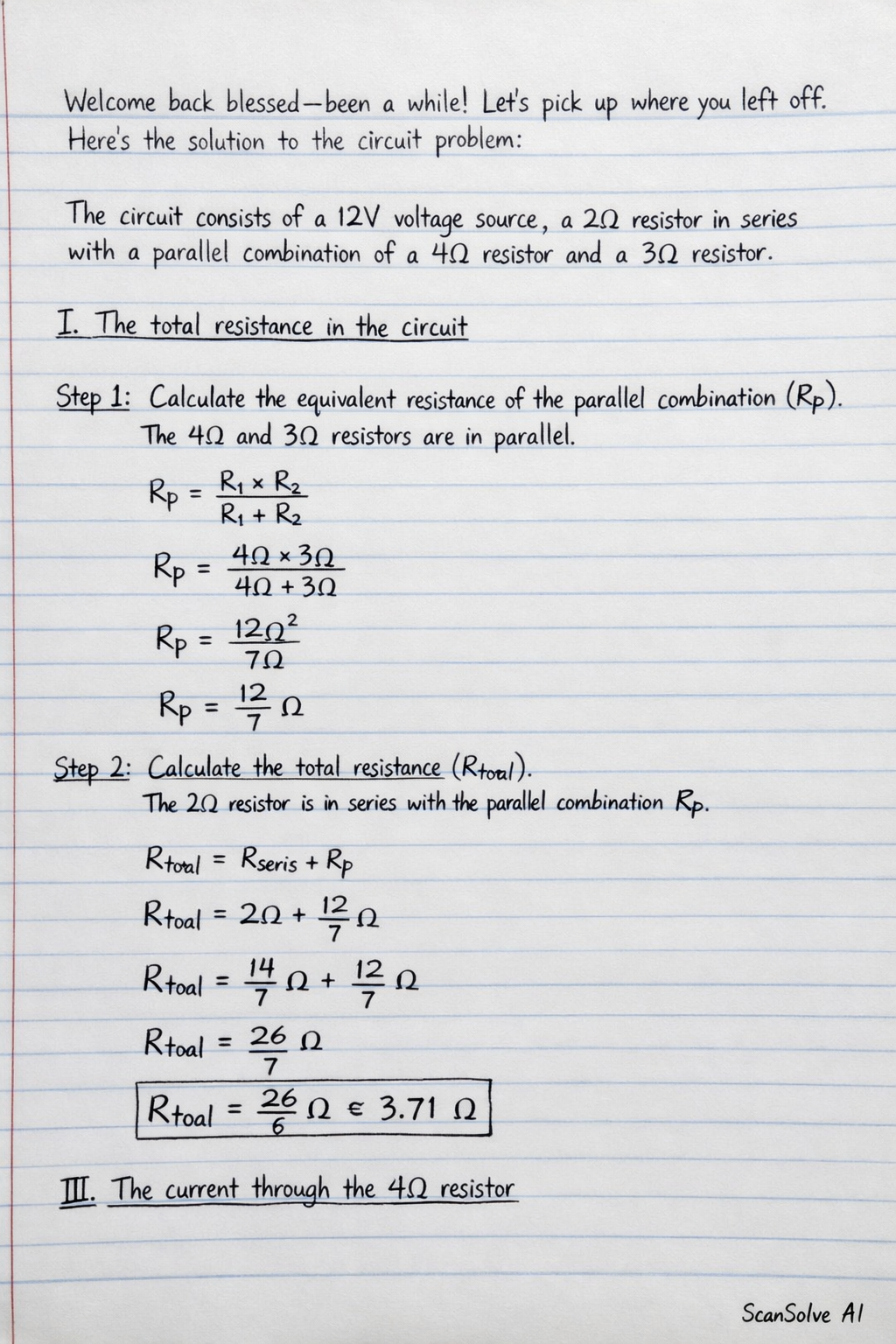
The circuit consists of a 12V voltage source, a 2Ω resistor in series with a parallel combination of a 4Ω resistor and a 3Ω resistor.

I. The total resistance in the circuit

  1. Calculate the equivalent resistance of the parallel combination (RpR_p).

    The 4Ω and 3Ω resistors are in parallel.

    Rp=R1×R2R1+R2R_p = \frac{R_1 \times R_2}{R_1 + R_2} Rp=4Ω×3Ω4Ω+3ΩR_p = \frac{4\Omega \times 3\Omega}{4\Omega + 3\Omega} Rp=12Ω27ΩR_p = \frac{12\Omega^2}{7\Omega} Rp=127ΩR_p = \frac{12}{7}\Omega
  2. Calculate the total resistance (RtotalR_{total}).

    The 2Ω resistor is in series with the parallel combination RpR_p.

    Rtotal=Rseries+RpR_{total} = R_{series} + R_p Rtotal=2Ω+127ΩR_{total} = 2\Omega + \frac{12}{7}\Omega Rtotal=147Ω+127ΩR_{total} = \frac{14}{7}\Omega + \frac{12}{7}\Omega Rtotal=267ΩR_{total} = \frac{26}{7}\Omega Rtotal=267Ω≈3.71Ω\boxed{R_{total} = \frac{26}{7}\Omega \approx 3.71\Omega}

    II. The current through the 4Ω resistor

  3. Calculate the total current (ItotalI_{total}) flowing from the source.

    Using Ohm's Law, V=IRtotalV = I R_{total}.

    Itotal=VsourceRtotalI_{total} = \frac{V_{source}}{R_{total}} Itotal=12V267ΩI_{total} = \frac{12V}{\frac{26}{7}\Omega} Itotal=12×726AI_{total} = \frac{12 \times 7}{26} A Itotal=8426AI_{total} = \frac{84}{26} A Itotal=4213AI_{total} = \frac{42}{13} A
  4. Calculate the voltage across the parallel combination (VpV_p).

    The total current ItotalI_{total} flows through the 2Ω resistor. The voltage drop across the 2Ω resistor (V2ΩV_{2\Omega}) is:

    V2Ω=Itotal×2ΩV_{2\Omega} = I_{total} \times 2\Omega V2Ω=4213A×2ΩV_{2\Omega} = \frac{42}{13}A \times 2\Omega V2Ω=8413VV_{2\Omega} = \frac{84}{13}V

    The voltage across the parallel combination (VpV_p) is the source voltage minus the voltage drop across the 2Ω resistor:

    Vp=Vsource−V2ΩV_p = V_{source} - V_{2\Omega} Vp=12V−8413VV_p = 12V - \frac{84}{13}V Vp=15613V−8413VV_p = \frac{156}{13}V - \frac{84}{13}V Vp=7213VV_p = \frac{72}{13}V
  5. Calculate the current through the 4Ω resistor (I4ΩI_{4\Omega}).

    The voltage across the 4Ω resistor is VpV_p.

    I4Ω=Vp4ΩI_{4\Omega} = \frac{V_p}{4\Omega} I4Ω=7213V4ΩI_{4\Omega} = \frac{\frac{72}{13}V}{4\Omega} I4Ω=7213×4AI_{4\Omega} = \frac{72}{13 \times 4} A I4Ω=1813AI_{4\Omega} = \frac{18}{13} A I4Ω=1813A≈1.38A\boxed{I_{4\Omega} = \frac{18}{13}A \approx 1.38A}
Was this helpful?

Still stuck on this one?

Ask a follow-up, and the answer starts from this question.

Got a different question?Ask your own question
Handwritten step-by-step solution preview

Handwritten Step-by-Step Solution

Get this as a handwritten image on WhatsApp — like a tutor wrote it for you.

Try on WhatsApp