
Summarize for me the formula of calculating the forces
ScanSolve AI Answer
Step-by-step solution
3 stepsTo calculate forces in a system in equilibrium (like a truss), the fundamental principle is that the net force and net torque acting on the system (or any part of it) must be zero.
Here are the key formulas and principles:
Equilibrium Conditions
For a body in static equilibrium, the sum of all external forces and moments must be zero.
Where:
- is the sum of all forces in the horizontal direction.
- is the sum of all forces in the vertical direction.
- is the sum of all moments (torques) about any arbitrary point.
Method of Joints (for trusses)
This method applies the equilibrium conditions ( and ) to each joint of the truss.
- Resolve Forces: Each force acting on a joint (member forces, external loads, reactions) is resolved into its horizontal and vertical components. If a force acts at an angle with the horizontal:
- Apply Equilibrium: For each joint, set the sum of horizontal components to zero and the sum of vertical components to zero.
- Sign Convention: Consistently define positive directions (e.g., right and up are positive). Assume unknown member forces are in tension (pulling away from the joint); a negative result indicates compression.
Method of Sections (for trusses)
This method involves cutting the truss into two sections and applying the three equilibrium conditions (, , ) to one of the sections. This is useful for finding forces in specific members without analyzing every joint.
These formulas allow you to set up a system of equations that can be solved to find unknown forces (reactions and internal member forces).
Still stuck on this one?
Ask a follow-up, and the answer starts from this question.
More Physics Questions
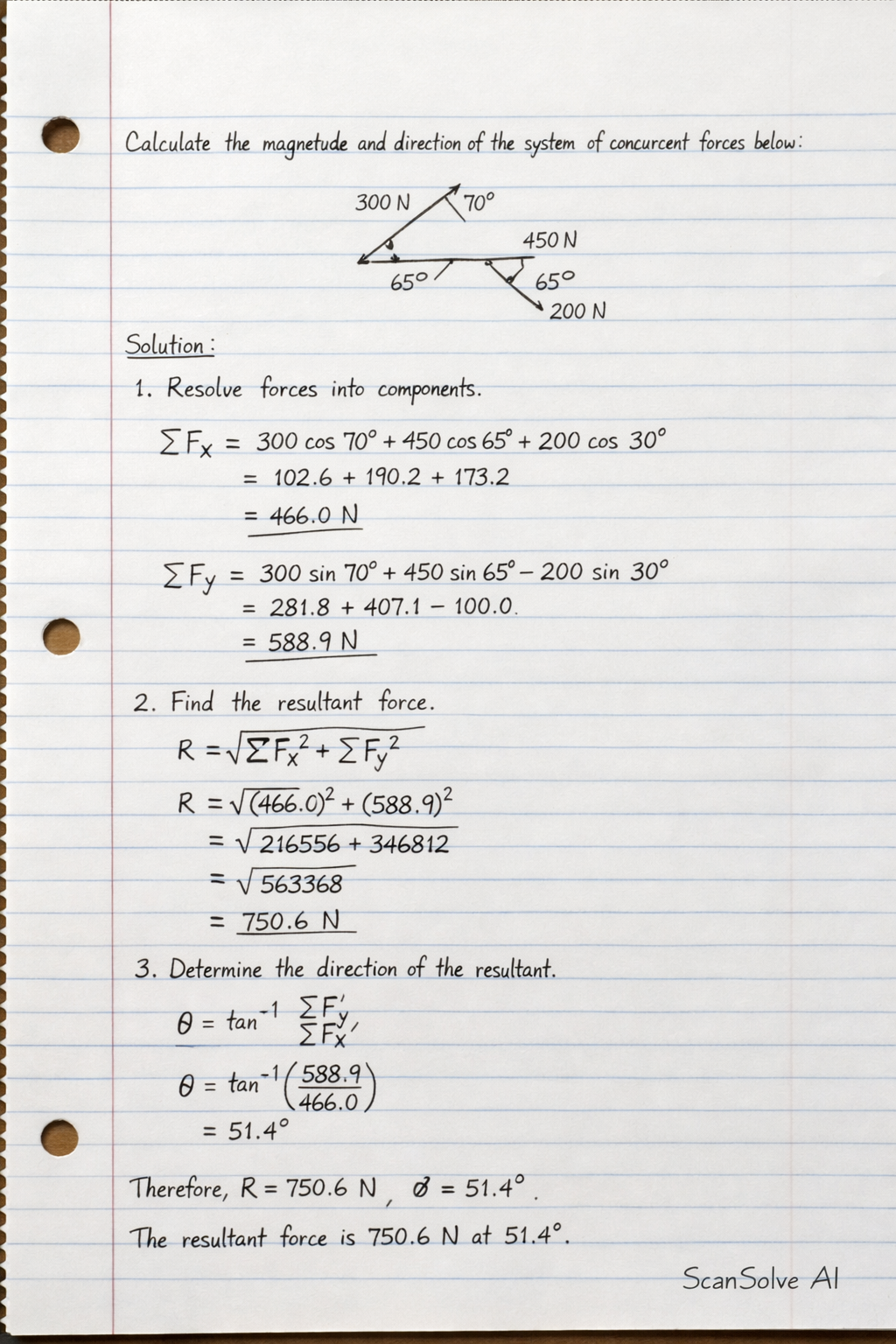
Handwritten Step-by-Step Solution
Get this as a handwritten image on WhatsApp — like a tutor wrote it for you.
Try on WhatsApp