
We read your photo as:
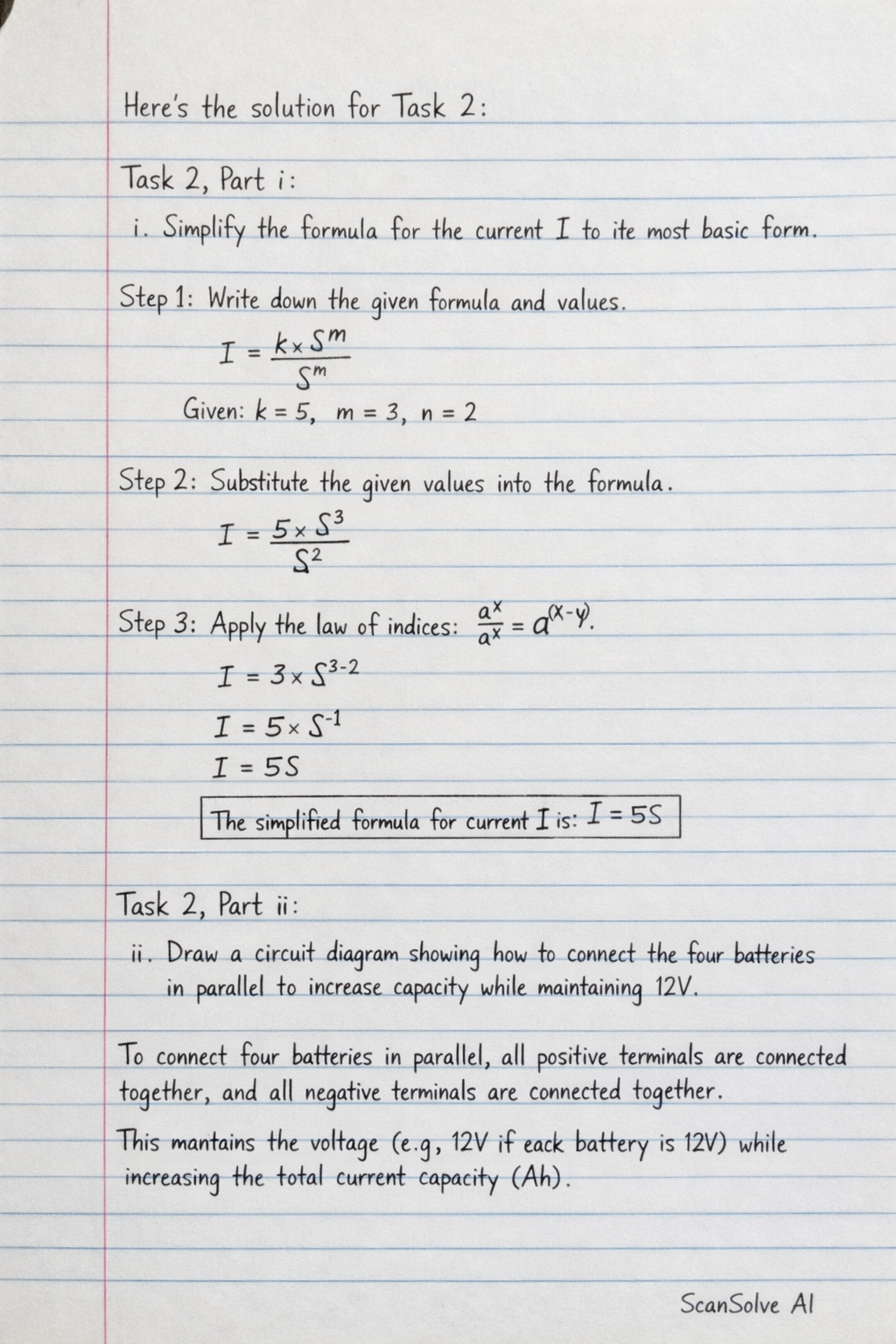
Task 2: i. Simplify the formula for the current I to its most basic form. ii. Draw a circuit diagram showing how to connect the four batteries in parallel to increase capacity while maintaining 12V. i
ScanSolve AI Answer
Step-by-step solution
13 stepsHere's the solution for Task 2:
Task 2, Part i:
Part i· 3 steps
Simplify the formula for the current I to its most basic form.
Write down the given formula and values.
The formula is .
Given constants are , , .Substitute the given values into the formula.
Apply the law of indices .
The simplified formula for current is .
Task 2, Part ii:
Part ii
Draw a circuit diagram showing how to connect the four batteries in parallel to increase capacity while maintaining 12V.
To connect four batteries in parallel, all positive terminals are connected together, and all negative terminals are connected together. This maintains the voltage (e.g., 12V if each battery is 12V) while increasing the total current capacity (Ah).
A circuit diagram would show:
- Four battery symbols arranged side-by-side.
- A common line connecting all the positive terminals of the batteries.
- Another common line connecting all the negative terminals of the batteries.
- The output terminals would be taken from these two common lines.
Task 2, Part iii:
Part iii· 3 steps
Calculate the inductive reactance XL.
Write down the formula for inductive reactance and given values.
The formula for inductive reactance is .
Given values are , , and .Substitute the values into the formula.
Calculate the result.
The inductive reactance is .
Task 2, Part iv:
Part iv· 3 steps
Calculate the capacitive reactance XC.
Write down the formula for capacitive reactance and given values.
The formula for capacitive reactance is .
Given values are , , and .
Convert capacitance to Farads: .Substitute the values into the formula.
Calculate the result.
The capacitive reactance is .
Task 2, Part v:
Part v· 4 steps
Calculate the total impedance Z.
Write down the formula for total impedance in a series RC circuit and given values.
The formula for impedance in a series RC circuit is .
Given values are and .Substitute the values into the formula.
Calculate the squares.
Sum the squared values and take the square root.
The total impedance is .
Still stuck on this one?
Ask a follow-up, and the answer starts from this question.
More Physics Questions
Handwritten Step-by-Step Solution
Get this as a handwritten image on WhatsApp — like a tutor wrote it for you.
Try on WhatsApp