Temperature measurement can be divided into two categories that is, electrical and non-electrical methods. List three (3) types of thermometer in each case.
|Physics
Temperature measurement can be divided into two categories that is, electrical and non-electrical methods. List three (3) types of thermometer in each case.
ScanSolve AI Answer
Answer
3103rad/s≈5.77rad/s
here are the solutions to your questions.
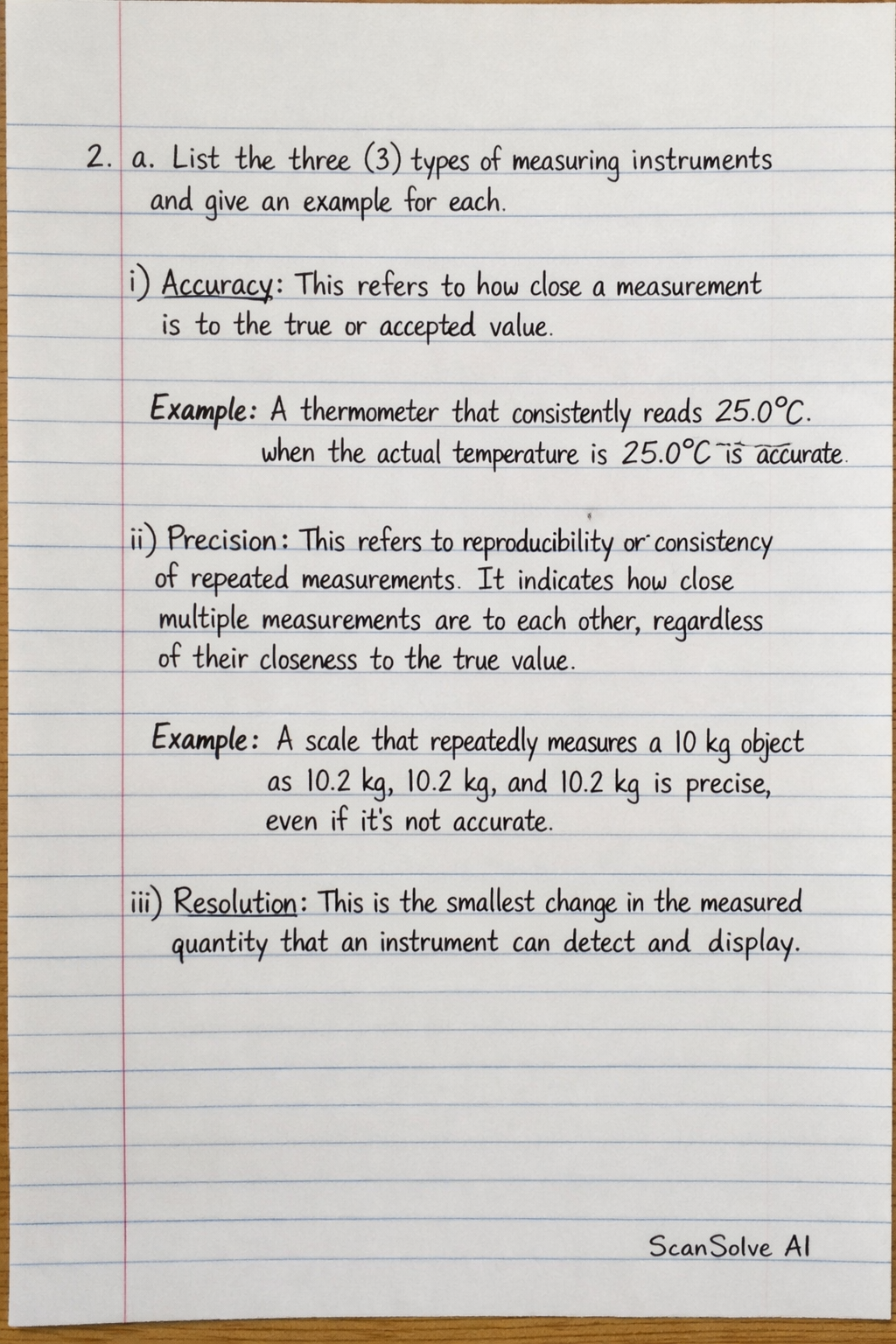
2. a. List the three (3) types of measuring instruments and give an example for each.
The question refers to characteristics of measuring instruments:
i) Accuracy: This refers to how close a measurement is to the true or accepted value.
Example: A thermometer that consistently reads 25.0∘C when the actual temperature is 25.0∘C is accurate.
ii) Precision: This refers to the reproducibility or consistency of repeated measurements. It indicates how close multiple measurements are to each other, regardless of their closeness to the true value.
Example: A scale that repeatedly measures a 10 kg object as 10.2 kg, 10.2 kg, and 10.2 kg is precise, even if it's not accurate.
iii) Resolution: This is the smallest change in the measured quantity that an instrument can detect and display.
Example: A digital voltmeter that can display readings to three decimal places (e.g., 1.234 V) has a higher resolution than one that only displays to one decimal place (e.g., 1.2 V).
2. b. Temperature measurement can be divided into two categories that is, electrical and non-electrical methods. List three (3) types of thermometer in each case.
Electrical Thermometers:
Resistance Temperature Detector (RTD): Measures temperature based on the change in electrical resistance of a metal (e.g., platinum).
Thermistor: Measures temperature based on the change in electrical resistance of a semiconductor material.
Thermocouple: Measures temperature based on the voltage generated at the junction of two dissimilar metals.
Non-Electrical Thermometers:
Liquid-in-glass thermometer: Measures temperature based on the thermal expansion of a liquid (e.g., mercury or alcohol) in a sealed glass tube.
Bimetallic thermometer: Measures temperature based on the differential thermal expansion of two bonded metals, causing a strip to bend.
Gas thermometer: Measures temperature based on the change in pressure or volume of a gas.
2. c. A second order is described by the differential equation 0.15dt2d2y+0.3dtdy+5y=5x, where x is the input and y the output. By comparing the equation with the standard second order form, determine:
The given differential equation is:
0.15dt2d2y+0.3dtdy+5y=5x
The standard form of a second-order differential equation is:
dt2d2y+2ζωndtdy+ωn2y=K′x
To compare, divide the given equation by 0.15:
dt2d2y+0.150.3dtdy+0.155y=0.155xdt2d2y+2dtdy+3100y=3100x
Step 1: Determine the system undamped natural frequency (ωn).
Comparing the coefficient of y with ωn2:
ωn2=3100ωn=3100=310=3103rad/s
The system undamped natural frequency is 3103rad/s≈5.77rad/s.
Step 2: Determine the damping ratio (ζ).
Comparing the coefficient of dtdy with 2ζωn:
2ζωn=2ζωn=1
Substitute the value of ωn:
ζ(310)=1ζ=103
The damping ratio is 103≈0.173.
2. d. A temperature measuring instrument incorporates a platinum resistance thermometer, a Wheatstone bridge, a voltage amplifier and a pen recorder. The individual sensitivities are:
Resistance transducer = 0.36Ω/∘C
Wheatstone bridge = 0.01V/Ω
Amplifier = +10V/V
Pen recorder = 0.2cm/V
Step 1: Calculate the overall sensitivity of the system.
The overall sensitivity (Soverall) is the product of the individual sensitivities:
Soverall=Stransducer×Sbridge×Samplifier×SrecorderSoverall=(0.36Ω/\circC)×(0.01V/Ω)×(10V/V)×(0.2cm/V)Soverall=0.36×0.01×10×0.2cm/\circCSoverall=0.0072cm/\circC
The overall sensitivity of the system is 0.0072cm/\circC.
Step 2: Calculate the temperature change corresponding to a recorded pen movement of 4 cm.
Let ΔL be the pen movement and ΔT be the temperature change.
ΔL=Soverall×ΔT4cm=(0.0072cm/\circC)×ΔTΔT=0.0072cm/\circC4cmΔT=555.555...\circC
The temperature change corresponding to a recorded pen movement of 4 cm is 555.56\circC.
Drop the next question.
Was this helpful?
Need help with your own homework?
Get instant step-by-step solutions to any question. Free to start.
List the three (3) types of measuring instruments and give an example for each.
Example*: A thermometer that consistently reads 25.0^ when the actual temperature is 25.0^ is accurate.
ii) Precision: This refers to the reproducibility or consistency of repeated measurements.
Temperature measurement can be divided into two categories that is, electrical and non-electrical methods. List three (3) types of thermometer in each case.
This physics problem tests your understanding of fundamental physical laws and their applications. The step-by-step solution below breaks down the problem using relevant equations and physical reasoning.
ScanSolve AI Answer
here are the solutions to your questions. 2. a. List the three (3) types of measuring instruments and give an example for each. The question refers to characteristics of measuring instruments: i) Accuracy: This refers to how close a measurement is to the true or accepted value. Example*: A thermometer that consistently reads 25.0^ when the actual temperature is 25.0^ is accurate. ii) Precision: This refers to the reproducibility or consistency of repeated measurements. It indicates how close multiple measurements are to each other, regardless of their closeness to the true value. Example*: A scale that repeatedly measures a 10 kg object as 10.2 kg, 10.2 kg, and 10.2 kg is precise, even if it's not accurate. iii) Resolution: This is the smallest change in the measured quantity that an instrument can detect and display. Example*: A digital voltmeter that can display readings to three decimal places (e.g., 1.234 V) has a higher resolution than one that only displays to one decimal place (e.g., 1.2 V). 2. b. Temperature measurement can be divided into two categories that is, electrical and non-electrical methods. List three (3) types of thermometer in each case. Electrical Thermometers: 1. Resistance Temperature Detector (RTD): Measures temperature based on the change in electrical resistance of a metal (e.g., platinum). 2. Thermistor: Measures temperature based on the change in electrical resistance of a semiconductor material. 3. Thermocouple: Measures temperature based on the voltage generated at the junction of two dissimilar metals. Non-Electrical Thermometers: 1. Liquid-in-glass thermometer: Measures temperature based on the thermal expansion of a liquid (e.g., mercury or alcohol) in a sealed glass tube. 2. Bimetallic thermometer: Measures temperature based on the differential thermal expansion of two bonded metals, causing a strip to bend. 3. Gas thermometer: Measures temperature based on the change in pressure or volume of a gas. 2. c. A second order is described by the differential equation 0.15 (d^2y)/(dt^2) + 0.3 (dy)/(dt) + 5y = 5x, where x is the input and y the output. By comparing the equation with the standard second order form, determine: The given differential equation is: 0.15 (d^2y)/(dt^2) + 0.3 (dy)/(dt) + 5y = 5x The standard form of a second-order differential equation is: (d^2y)/(dt^2) + 2_n (dy)/(dt) + _n^2 y = K'x To compare, divide the given equation by 0.15: (d^2y)/(dt^2) + (0.3)/(0.15) (dy)/(dt) + (5)/(0.15) y = (5)/(0.15) x (d^2y)/(dt^2) + 2 (dy)/(dt) + (100)/(3) y = (100)/(3) x Step 1: Determine the system undamped natural frequency (_n). Comparing the coefficient of y with _n^2: _n^2 = (100)/(3) _n = sqrt((100)/(3)) = (10)/(sqrt(3)) = 10sqrt(3)3 \, rad/s The system undamped natural frequency is 10sqrt(3)3 \, rad/s ≈ 5.77 \, rad/s. Step 2: Determine the damping ratio (). Comparing the coefficient of (dy)/(dt) with 2_n: 2_n = 2 _n = 1 Substitute the value of _n: ((10)/(sqrt(3))) = 1 = sqrt(3)10 The damping ratio is sqrt(3)10 ≈ 0.173. 2. d. A temperature measuring instrument incorporates a platinum resistance thermometer, a Wheatstone bridge, a voltage amplifier and a pen recorder. The individual sensitivities are: Resistance transducer = 0.36 \, /^ Wheatstone bridge = 0.01 \, V/ Amplifier = +10 \, V/V Pen recorder = 0.2 \, cm/V Step 1: Calculate the overall sensitivity of the system. The overall sensitivity (S_overall) is the product of the individual sensitivities: S_overall = S_transducer × S_bridge × S_amplifier × S_recorder S_overall = (0.36 \, /^) × (0.01 \, V/) × (10 \, V/V) × (0.2 \, cm/V) S_overall = 0.36 × 0.01 × 10 × 0.2 \, cm/^ S_overall = 0.0072 \, cm/^ The overall sensitivity of the system is 0.0072 cm/^. Step 2: Calculate the temperature change corresponding to a recorded pen movement of 4 cm. Let L be the pen movement and T be the temperature change. L = S_overall × T 4 \, cm = (0.0072 \, cm/^) × T T = 4 \, cm0.0072 \, cm/^ T = 555.555... \, ^ The temperature change corresponding to a recorded pen movement of 4 cm is 555.56^. Drop the next question.