We read your photo as:

Find the tension in diagram below.

Physics

ScanSolve AI Answer

Answer

T1=17.93 NT_1 = 17.93 \, \text{N}

T2=14.64 NT_2 = 14.64 \, \text{N}

Step-by-step solution

3 steps

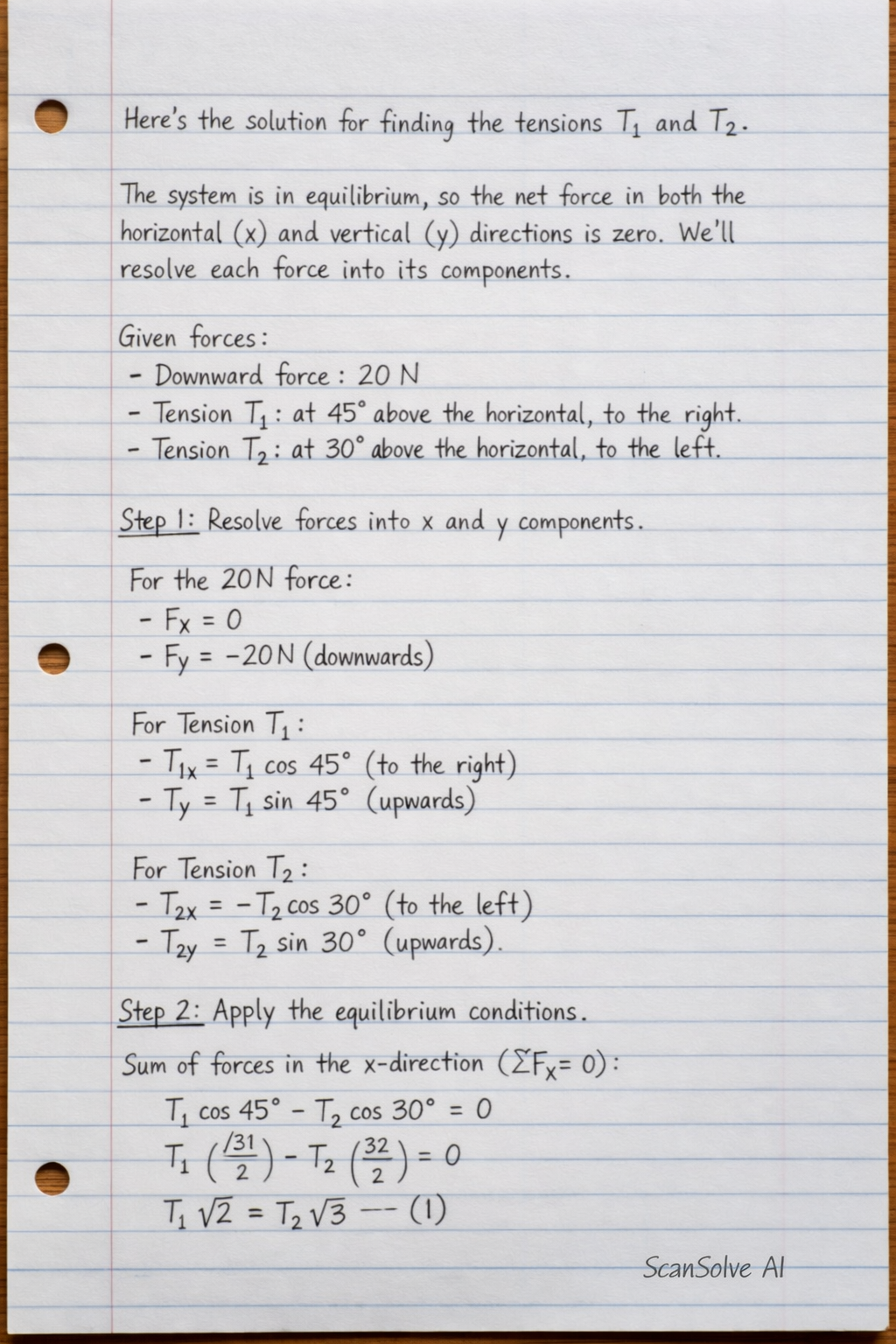
Here's the solution for finding the tensions T1T_1 and T2T_2.

The system is in equilibrium, meaning the net force in both the horizontal (x) and vertical (y) directions is zero. We'll resolve each force into its components.

Given forces:

  • Downward force: 20 N20 \, \text{N}
  • Tension T1T_1: at 45∘45^\circ above the horizontal, to the right.
  • Tension T2T_2: at 30∘30^\circ above the horizontal, to the left.
  1. Resolve forces into x and y components.

    • For the 20 N20 \, \text{N} force: Fx=0F_x = 0 Fy=−20 NF_y = -20 \, \text{N} (downwards)

    • For Tension T1T_1: T1x=T1cos⁡(45∘)T_{1x} = T_1 \cos(45^\circ) (to the right) T1y=T1sin⁡(45∘)T_{1y} = T_1 \sin(45^\circ) (upwards)

    • For Tension T2T_2: T2x=−T2cos⁡(30∘)T_{2x} = -T_2 \cos(30^\circ) (to the left) T2y=T2sin⁡(30∘)T_{2y} = T_2 \sin(30^\circ) (upwards)

  2. Apply the equilibrium conditions.

    Sum of forces in the x-direction (∑Fx=0\sum F_x = 0):

    T1cos⁡(45∘)−T2cos⁡(30∘)=0T_1 \cos(45^\circ) - T_2 \cos(30^\circ) = 0 T1(22)−T2(32)=0T_1 \left(\frac{\sqrt{2}}{2}\right) - T_2 \left(\frac{\sqrt{3}}{2}\right) = 0 T12=T23(1)T_1 \sqrt{2} = T_2 \sqrt{3} \quad (1)

    Sum of forces in the y-direction (∑Fy=0\sum F_y = 0):

    T1sin⁡(45∘)+T2sin⁡(30∘)−20=0T_1 \sin(45^\circ) + T_2 \sin(30^\circ) - 20 = 0 T1(22)+T2(12)−20=0T_1 \left(\frac{\sqrt{2}}{2}\right) + T_2 \left(\frac{1}{2}\right) - 20 = 0

    Multiply by 2 to clear denominators:

    T12+T2=40(2)T_1 \sqrt{2} + T_2 = 40 \quad (2)
  3. Solve the system of equations for T1T_1 and T2T_2.

    From equation (1), substitute T12=T23T_1 \sqrt{2} = T_2 \sqrt{3} into equation (2):

    T23+T2=40T_2 \sqrt{3} + T_2 = 40

    Factor out T2T_2:

    T2(3+1)=40T_2 (\sqrt{3} + 1) = 40 T2=403+1T_2 = \frac{40}{\sqrt{3} + 1}

    To rationalize the denominator, multiply the numerator and denominator by (3−1)(\sqrt{3} - 1):

    T2=40(3+1)×(3−1)(3−1)T_2 = \frac{40}{(\sqrt{3} + 1)} \times \frac{(\sqrt{3} - 1)}{(\sqrt{3} - 1)} T2=40(3−1)(3)2−12T_2 = \frac{40(\sqrt{3} - 1)}{(\sqrt{3})^2 - 1^2} T2=40(3−1)3−1T_2 = \frac{40(\sqrt{3} - 1)}{3 - 1} T2=40(3−1)2T_2 = \frac{40(\sqrt{3} - 1)}{2} T2=20(3−1)T_2 = 20(\sqrt{3} - 1)

    Using 3≈1.732\sqrt{3} \approx 1.732:

    T2≈20(1.732−1)=20(0.732)=14.64 NT_2 \approx 20(1.732 - 1) = 20(0.732) = 14.64 \, \text{N}

    Now, substitute the value of T2T_2 back into equation (1) to find T1T_1:

    T12=T23T_1 \sqrt{2} = T_2 \sqrt{3} T1=T232T_1 = T_2 \frac{\sqrt{3}}{\sqrt{2}} T1=20(3−1)32T_1 = 20(\sqrt{3} - 1) \frac{\sqrt{3}}{\sqrt{2}} T1=203−32T_1 = 20 \frac{3 - \sqrt{3}}{\sqrt{2}}

    To rationalize, multiply by 22\frac{\sqrt{2}}{\sqrt{2}}:

    T1=20(3−3)22T_1 = 20 \frac{(3 - \sqrt{3})\sqrt{2}}{2} T1=10(32−6)T_1 = 10(3\sqrt{2} - \sqrt{6})

    Using 2≈1.414\sqrt{2} \approx 1.414 and 6≈2.449\sqrt{6} \approx 2.449:

    T1≈10(3×1.414−2.449)T_1 \approx 10(3 \times 1.414 - 2.449) T1≈10(4.242−2.449)T_1 \approx 10(4.242 - 2.449) T1≈10(1.793)=17.93 NT_1 \approx 10(1.793) = 17.93 \, \text{N}

    The tensions are:

    T1=17.93 NT_1 = \boxed{17.93 \, \text{N}} T2=14.64 NT_2 = \boxed{14.64 \, \text{N}}
Was this helpful?

Try one yourself

A new problem that tests the same skill.

Still stuck on this one?

Ask a follow-up, and the answer starts from this question.

Got a different question?Ask your own question
Handwritten step-by-step solution preview

Handwritten Step-by-Step Solution

Get this as a handwritten image on WhatsApp — like a tutor wrote it for you.

Try on WhatsApp